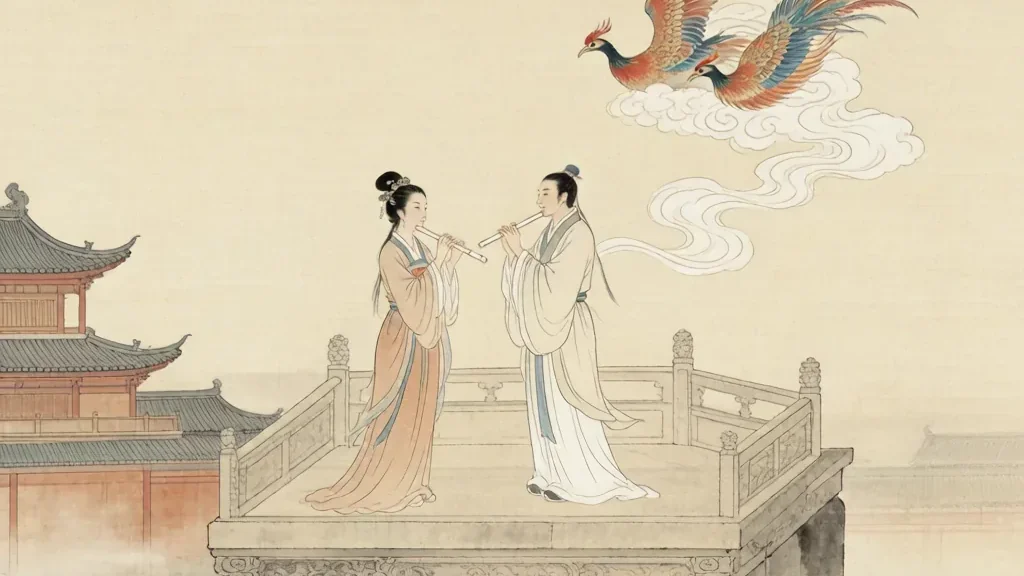
Some love is so pure it rises above the world, and the Chinese idiom nòng yù chuī xiāo tells that ascension in music. Written 弄玉吹箫 and pronounced , it means "Nongyu plays the flute" — the legend of a princess whose flute drew a heavenly lover and carried them both to the skies. English says "a match made in heaven," but Chinese tells it through breath and reed: a girl who played so beautifully that the immortals answered. For readers discovering Chinese culture, the phrase is a doorway into a Romance of love, music, and transcendence that has charmed China for two thousand years. In this article we meet Princess Nongyu and her flautist, trace the legend, and see why "playing the flute" became a symbol of love that transcends death.
The Princess Who Loved the Flute
The tale is set in the court of Duke Mu of Qin (秦穆公), a ruler of the Spring and Autumn period. His daughter, Nongyu (弄玉), was gifted and solitary, devoted above all to playing the , a vertical bamboo flute. She declared she would marry no one who could not match her music. One night she dreamed of a handsome youth playing a flute atop a castle in the clouds, and awoke certain her destined husband existed beyond the world.
The dream proved prophecy. A man named Xiao Shi (萧史) appeared at court who could play the flute so sweetly that phoenixes descended to listen. Nongyu recognized in him the youth of her dream. The duke consented to their marriage, and the two made music together — she on the , he on his flute — until the day phoenixes came to bear them upward, and the lovers rose to heaven, leaving the court below in wonder. The story is less a historical record than a beloved legend of perfect union.
Literal Meaning and Characters
The four characters name the scene. (弄) is to play with or finger (an instrument); (玉) is jade, here part of the princess's name Nongyu ("jade-playing"); (吹) is to blow; and (箫) is the bamboo flute. Read as "Nongyu-blow-flute." The name Nongyu itself is poetic: (jade) marks her as precious and pure, a fitting heroine for a celestial romance. A learner will meet often in Chinese poetry, where the flute stands for elegance and longing.
The phrase is built around a proper name, which is unusual for an idiom — most avoid naming individuals. This one keeps Nongyu at its center, which is part of its charm: the legend is so cherished that the girl's name became shorthand for transcendent love. To say "Nongyu plays the flute" is to summon the whole romance in four characters.
Music as the Language of Love
The legend makes music the bridge between human and divine. Nongyu and Xiao Shi do not meet through family arrangement or battle but through shared sound; their bond is literally harmonious. The flute here is more than an instrument — it is a voice of the soul that attracts the kindred soul and, finally, the immortals. Chinese culture has long treated music as a moral and cosmic force, and this tale is its most romantic expression.
The descending phoenixes deepen the symbolism. In Chinese myth the phoenix (凤凰) is a bird of harmony and auspicious union, appearing only for the virtuous and the well-matched. That these birds come to carry the lovers away signals that their love is not merely happy but sanctioned by heaven. The idiom thus celebrates a love so right that the cosmos itself assists its ascent — a far cry from the thwarted romances more common in legend.
How the Idiom Is Used Today
Modern Chinese uses to evoke an ideal, fated love — often in literature, weddings, and tender compliments. A couple said to be "like Nongyu and Xiao Shi" are blessed as perfectly matched and destined. The tone is romantic and slightly literary; it is the phrase you reach for when ordinary words like "soulmates" feel too plain. It appears in poetry and in praise of a harmonious marriage.
The idiom also lives in place and artifact. Gardens and pavilions across China bear names echoing the flute and the phoenix, and the story ornaments everything from porcelain to opera. Used this way it is less a claim about a specific couple than a cultural ideal — the hope that love, at its best, lifts us beyond the ordinary world. The flute's note still sounds as a symbol of that hope.
Companions in the Lexicon of Love
The phrase keeps company with other romance idioms. 梁山伯与祝英台 (Liáng Zhù, the Butterfly Lovers) tells of love defeated by the world yet transformed into freedom; 弄玉吹箫 tells of love assisted by the world and raised to heaven. 才子佳人 (cái zǐ jiā rén, "gifted scholar, beautiful lady") names the ideal pair. Together they map China's imagination of love — sometimes tragic, sometimes triumphant, always transcendent.
For learners, this cluster is a gentle entry into Chinese romantic idiom. "Nongyu plays the flute" is the happy twin of the Butterfly Lovers, and knowing both lets you evoke love's two fates — the one that rises and the one that flies. The flute and the phoenix remain among the loveliest images in the language.
A Closing Reflection
There is a sweetness in that the sterner idioms of this series lack. It tells us that love, at its truest, is a kind of music — a shared note that draws the phoenix and lifts the players past the roof of the world. Nongyu asked for a husband who could match her flute, and the heavens answered with one who could lift her to them. To hear the idiom is to be invited, briefly, to believe that the right love does not merely endure but ascends, and that somewhere a flute is still playing us upward.
A Court of the Spring and Autumn Era
The legend is set in the court of Duke Mu of Qin, a ruler of the Spring and Autumn period, when the great Zhou kingdom had fractured into competing states. Qin was then a western power on the fringes of the Chinese cultural world, and its court was a place where martial ambition met refined arts. Placing the love story in this setting gives it a historical sheen, even though the tale is legend rather than record. The courtly world of music, rank, and marriage alliance lets the flute romance glow all the brighter: amid the hard politics of the age, a princess who prizes a single art above status becomes a quiet rebellion against the arranged-marriage logic of her time.
The Xiao and the Sound of Longing
The xiao, a vertical bamboo flute, is more than a prop in this story; it is one of the most evocative instruments in Chinese musical culture. Played softly and breathily, it was long associated with solitude, elegance, and the kind of yearning that reaches beyond the everyday world. Poets from the Chu ci onward used the flute's clear tone to voice longing for a faraway friend or a higher realm, so when Nongyu plays it, readers already hear a sound tuned to transcendence. The instrument thus carries the romance's emotional charge: the xiao does not shout like a drum or strum like a qin, it breathes, and in the legend that breath is what draws the phoenix and lifts the players past the roof of the world.
❓ Frequently Asked Questions
📝 Chinese Vocabulary
弄玉吹箫 — : Nongyu plays the flute; a love that rose to heaven.
弄玉 — : Princess Nongyu, the flute-playing heroine.
箫 — : a vertical bamboo flute.
萧史 — : Xiao Shi, the flautist who became her husband.
秦穆公 — : Duke Mu of Qin, Nongyu's father.
凤凰 — : The Chinese phoenix, a bird of harmony and auspicious union that in the legend descends to carry the lovers to heaven.
笛 — : A transverse bamboo flute, distinct from the vertical xiao, often paired with it in Chinese music and poetry.
秦 — : The state of Qin, ruled by Duke Mu, where Princess Nongyu's courtly legend is set.
🎉 Fun Facts
- Nongyu vowed to marry only one who could match her flute-playing, and dreamed of him before they met.
- Xiao Shi's music was said to summon phoenixes, the birds of harmony and auspicious union.
- The lovers are among the few in Chinese legend who ascend happily rather than perish tragically.
- The name Nongyu includes 玉 (jade), marking her as precious and pure.
- The story made Nongyu and Xiao Shi models of conjugal harmony, and later Daoist collections list them among the xian, or transcendents, suggesting the legend was read as a path to immortality through music.
- Beyond porcelain and gardens, the flute-and-phoenix motif became a staple of classical Chinese opera and painting, where it stands for an ideal, heaven-blessed marriage.