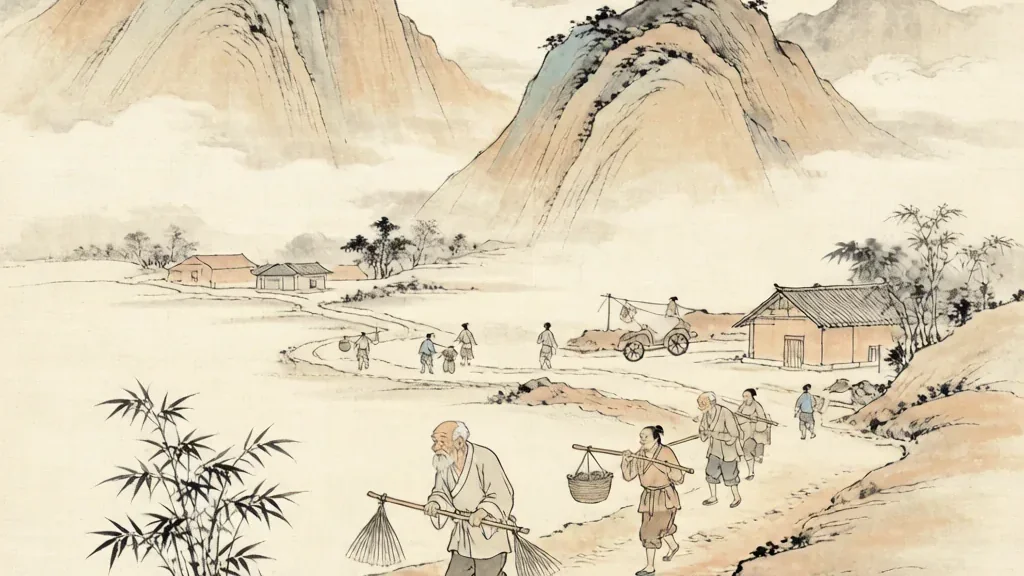
There are stories that celebrate cleverness, and there are stories that celebrate strength. And then there is a rarer kind of story — one that celebrates the stubborn refusal to accept the impossible. The Chinese idiom 愚公移山 (yú gōng yí shān), "the foolish old man moves mountains," belongs to this last category. It is a story about an old man, two enormous mountains, and a single idea so simple that it sounds absurd until you realize it cannot be argued with: that time, multiplied by persistence, can defeat anything.
The tale is recorded in the "Liezi" (列子), a Daoist text compiled in the 4th century BCE, though the story itself is likely far older. Today it remains one of the most beloved and frequently cited idioms in the Chinese language.
The Two Mountains That Blocked the Way
In ancient times, in the north of China, there lived a man known to history only as Yu Gong — "the Foolish Old Man." He was ninety years old, and he lived with his family in a small village that sat directly in the shadow of two great mountains: Taihang Mountain (太行山) to the north and Wangwu Mountain (王屋山) to the south. These were not hills. They were vast, towering masses of rock and earth, seven hundred li in circumference and many thousands of feet high, their peaks lost in cloud, their slopes covered in ancient forest.
The mountains made life difficult for everyone in the region, but for Yu Gong's village they were a particular torment. Every journey to the outside world required a long, exhausting detour around the peaks. Trade was slow, travel was dangerous, and the simple act of visiting a neighboring town could take days. The mountains loomed over every aspect of village life, immovable and indifferent, the way forces of nature always loom over the small affairs of human beings.
One day, Yu Gong gathered his family together — his sons, his grandsons, and the children of his neighbors — and made an announcement that must have seemed, at first, like the rambling of a very old man. He proposed that they move the mountains. Not around them. Not away from them. He proposed that they dig the mountains down, basket by basket, and carry the rock and earth to the Bohai Sea, far to the east, until the way was clear.
The Skeptic and the Answer
The family agreed. They began to dig, breaking up the rock with hoes and chisels, loading the rubble into baskets, and carrying it in long processions toward the sea. The work was backbreaking and the progress was, by any reasonable measure, invisible. A year passed, and they had barely scratched the surface of one of the peaks. The mountains had not shrunk by so much as a noticeable fraction.
A neighbor known as Zhi Sou — "the Wise Old Man" — came to watch, and he laughed. The names here are deliberate and delicious: Yu Gong, "the Foolish Old Man," is the hero, and Zhi Sou, "the Wise Old Man," is the fool. Zhi Sou shook his head and said, "How foolish you are! You are old and weak. You cannot even move a single hill. How do you expect to move two great mountains like Taihang and Wangwu? You will die before you make the slightest difference."
Yu Gong's reply is the heart of the story, and it has echoed through Chinese culture ever since. "It is true that I am old," he said. "But when I die, my sons will continue the work. When they die, my grandsons will take their place, and after them their sons, and after them their sons. The mountains will not grow. But my lineage will never end. Generation after generation, we will dig and carry, dig and carry. Why should we not be able to level these mountains?"
Zhi Sou had no answer. The logic was airtight. The mountains were fixed. Time, and people, were not. Against a project measured in centuries, the simple arithmetic of perseverance becomes unstoppable. The mountains could not grow, but the family could continue. Therefore, eventually, the mountains would fall.
The Gods Take Notice
The mountains, it turned out, were not indifferent to this threat. The spirits of Taihang and Wangwu heard Yu Gong's words and grew alarmed. Here was a man who could not be reasoned with, could not be discouraged, and could not be stopped by death, because he had already extended the project beyond his own lifetime. They reported the matter to the Supreme Deity, the Lord of Heaven, who watched from above.
The Lord of Heaven did not laugh. He was moved — not by the scale of Yu Gong's ambition, but by the sincerity of his determination. Here was a mortal who had understood something that even many immortals did not: that genuine commitment, sustained across generations, is the most powerful force in the world. Touched by this devotion, the Lord of Heaven sent two mighty celestial beings down to earth. They lifted the two mountains, carried them away, and set them down in a distant region, far from Yu Gong's village. From that day forward, the road was clear, and the village could travel freely.
So the old man did move the mountains — though not, in the end, by digging them away basket by basket. He moved them by being so unshakably committed that the universe itself could no longer ignore him.
Why the Story Resonates
The genius of the story lies in its reversal of who is wise and who is foolish. Zhi Sou, the "Wise Old Man," is short-sighted because he measures the project by a single lifetime. Yu Gong, the "Foolish Old Man," is wise because he measures it by a lineage. The world calls him foolish because his goal looks impossible. The story calls him wise because he understands that "impossible" is just a word for "not yet accomplished."
This is a profoundly different kind of wisdom from the cleverness celebrated in many other parables. Yu Gong does not outsmart the mountains. He does not find a trick or a shortcut. He simply refuses to stop. And in refusing to stop, he changes the nature of the problem itself. The mountains were once a permanent obstacle. By the end of the story, they are something that the gods themselves must intervene to remove — because a mortal's persistence has become too powerful to ignore.
In the 20th century, the story took on new political significance. The speech made the idiom inseparable from the national narrative of struggle and perseverance, and it is still taught in Chinese schools today as a foundational cultural text.
But the story's power goes beyond any single political moment. It speaks to anyone who has ever faced an obstacle that seemed permanent and chosen to work at it anyway — the caregiver tending a long illness, the scientist pursuing a cure that may not come in their lifetime, the immigrant building a life for grandchildren they will never meet. Yu Gong's insight is that our projects do not have to fit inside our lifetimes to be worth starting. Some work is measured in generations, and the people who begin it may never see it finished. They begin it anyway, because the only thing worse than an unfinished project is one that was never begun.
The Foolish Old Man, in the end, was not foolish at all. He simply understood time better than the people who laughed at him. And the mountains, for all their size, could not withstand someone who understood time.
The Liezi and Its Daoist Roots
The Liezi is a Daoist classic attributed to the sage Lie Yukou, though the surviving text took shape over centuries and blends philosophy with playful parable. Yu Gong's story appears in a chapter concerned with the transformation of things and the limits of ordinary judgment. Daoist writing often delights in figures who defeat the impossible not by force but by alignment with a larger current, and the old man's patience fits that pattern. What is unusual is the happy ending supplied by the gods, since Daoist tales more often leave the lesson implicit. The text uses Yu Gong to argue that genuine commitment changes the order of things, so that even heaven must respond. Reading the idiom inside its source shows it as a meditation on time and will as much as a simple story of hard work.
Yu Gong and Jingwei: Two Tales of Stubbornness
Chinese folklore loves the impossible task, and Yu Gong shares the stage with Jingwei, the bird who tries to fill the sea with pebbles. Both refuse to accept limits, one an old man against mountains, the other a small bird against the ocean, and both became emblems of refusal to quit. The pairing is so common that textbooks present them together as the two great parables of perseverance. Where they differ is tone: Jingwei's effort is endless and defiant, a grief turned to labor, while Yu Gong's is measured in generations and ends in success. Together they map the range of the Chinese ideal of 恒 (héng), constancy, showing that the culture honors not only cleverness but the dull, magnificent refusal to stop.
The Mountains as Real Geography
The two peaks are not inventions. The Taihang range runs for hundreds of kilometers across northern China, and Mount Wangwu stands in modern Henan, both real landscapes that villagers in the story's setting would have known intimately. Today Taihang is a famous mountain corridor and Wangwu is a national geological park, so readers can still stand where, in the tale, the old man began his impossible digging. The realism grounds the fantasy: the obstacle is a genuine, looming fact of local geography, which makes the ambition proportionately heroic. Folk tourism around Wangwu even points to spots associated with the legend. By anchoring a cosmic lesson in named hills, the story lets listeners measure the distance between a real mountain and a human determination to move it.
The Idiom in Modern China
Few old tales have been put to as much modern use as Yu Gong's. In the twentieth century the story was held up as a model of collective, persevering effort, and phrases like the spirit of Yu Gong appeared in campaigns urging people to tackle huge national projects. Outside politics, the name became a term of affection for anyone who keeps at a hopeless-looking task, from amateur inventors to long-term caregivers. The shift from foolish to admirable is now complete in daily speech. What survives from the original is the core insight that some work is measured in generations and that beginning it matters more than finishing it in one lifetime, a message that keeps the ancient parable useful in thoroughly modern contexts.
❓ Frequently Asked Questions
📝 Chinese Vocabulary
愚公 — : "The Foolish Old Man" — the protagonist of the story, whose name is a deliberate irony, since his "foolishness" proves to be true wisdom.
移山 — : "To move a mountain" — the act of removing an obstacle through sustained effort over generations.
太行山 — : The Taihang Mountains, a real mountain range in northern China, one of the two mountains Yu Gong vowed to remove.
王屋山 — : Mount Wangwu, the second mountain in the story, also a real peak in modern-day Henan province.
智叟 — : "The Wise Old Man" — the skeptic in the story, whose name is itself ironic, as his conventional wisdom is shown to be shallow.
列子 — : The Liezi; the Daoist text that preserves the tale of Yu Gong.
渤海 — : The Bohai Sea, the far eastern destination where Yu Gong's family carried the mountain's rock and earth.
山神 — : The mountain spirit who reported Yu Gong's vow to the Lord of Heaven.
🎉 Fun Facts
- Both Taihang and Wangwu are real mountains that still exist today — the Taihang range runs for over 400 kilometers across northern China, and Mount Wangwu is now a designated national geological park.
- The story is often paired with Jingwei Fills the Sea (精卫填海) as the two great Chinese parables of impossible perseverance — one features a bird, the other an old man, but both refuse to accept the limits of the possible.
- In modern Chinese, calling someone 愚公 is no longer an insult — it has become a compliment meaning "someone of unshakeable determination."
- In the twentieth century the story was promoted as a model of collective effort, and the spirit of Yu Gong became a common slogan in public campaigns for large projects.
- A well-known Chinese animated film retold the tale in 1957, fixing the image of the old man and his basket-carrying family for postwar audiences.
- In the original Liezi version the gods who carry the mountains away are named, and the episode is framed as proof that sincere persistence moves even heaven, a point later readers emphasized in their own ways.