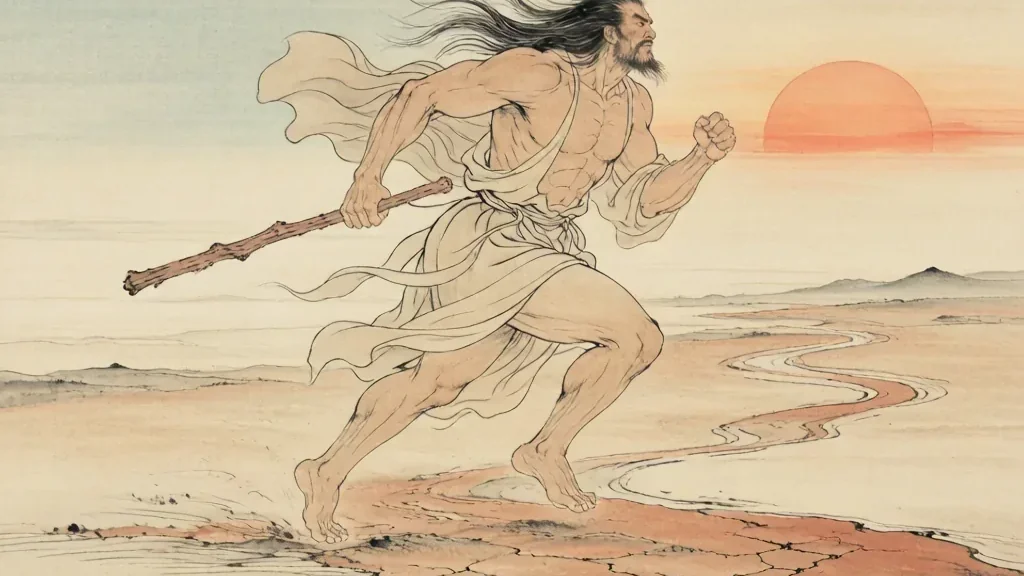
The myth of 夸父逐日, pronounced , tells of Kuafu, a giant who chased the sun across the sky in a feat of dizzying ambition and met his death from thirst. The literal meaning is Kuafu pursuing the sun, and the tale appears in the ancient geographical myth collection 山海经, the Classic of Mountains and Seas. Depending on the telling, Kuafu is a heroic figure who races the celestial orb to prove the strength of humankind, or a cautionary emblem of overreaching pride. When he could not catch the sun, he drank entire rivers to slake his thirst, fell, and his staff took root as a forest of peach trees. This article explores the myth's earliest texts, the figure of the giant, the cosmic chase, the rivers and death, the peach forest, and the shifting meanings the story has carried from antiquity to today.
The Source in Classic of Mountains and Seas
The earliest version of the Kuafu story is found in the 山海经, a terse, strange compilation of myth, geography, and creature lore probably assembled over centuries and reaching something like its present shape in the early centuries of the common era. The book mixes real topography with fantastical beasts, and Kuafu belongs to its layer of primordial giants and divine wrestlers.
The text gives the episode in a few clipped lines, almost like a log entry from a dream. Kuafu chases the sun, reaches the sunset, drinks from the Yellow and Wei rivers, still thirsty, goes toward the north sea, and dies of thirst on the way. His staff becomes a forest of peach trees. The brevity leaves room for later interpreters to fill the silence with meaning.
Because the Shanhaijing was treated as both geography and scripture, the Kuafu tale was absorbed into the broader fund of Chinese myth alongside figures like Nuwa and Houyi. Its odd, archaic tone gives it the weight of deep time, as if recording events from the birth of the world rather than a poet's invention.
Who Was Kuafu
Kuafu is described as a giant, a member of a lineage of enormous beings in early Chinese myth. Some versions name his clan and place him among the descendants of mythic ancestors who contended with the forces of nature. His size is not merely comic; it signals a being scaled to cosmic tasks, one who can stride from mountain to mountain and think of grasping the sun.
The name itself may carry the sense of boasting or exaggeration, fitting a character defined by audacious self-assertion. He is not a god exactly but a titan-like figure who challenges the order of heaven through sheer bodily will. That liminal status, between human and divine, is what makes his failure tragic rather than merely comic.
Later commentaries sometimes moralize Kuafu as a fool, yet the raw myth resists simple judgment. A giant who dares the sun is also a symbol of the human wish to master what is immeasurably greater, and that wish is as admirable as it is doomed.
The Chase Across the Sky
The central action is the pursuit of the sun from dawn to the western horizon. In the mythic geography of the Shanhaijing, the sun travels through the heavens and sets in a remote western vale, and Kuafu races to intercept it before it sinks. The image of a running giant shadowing the moving light is one of the most cinematic in world mythology.
Some retellings add that Kuafu wished to seize the sun and bring its fire under human control, a motif of mastery over nature akin to other culture heroes who steal fire or tame rivers. Whether his aim was glory, warmth, or dominion, the chase expresses a refusal to accept the sun as an untouchable god.
The futility is built into the premise. The sun is not a thing one catches on foot, and the more Kuafu runs the more the distance mocks him. Yet the attempt itself reshapes the world, for his death fertilizes the land with peach trees, suggesting that even failure can leave a gift.
The Drinking of the Rivers
Exhausted by the chase, Kuafu drinks from the Yellow River and the Wei River, two of the great waterways of north China, and still is not satisfied. The detail magnifies his scale: only a giant could imagine draining rivers as if they were cups. It also marks the turning point from aspiration to bodily collapse.
The rivers cannot quench him because his thirst is metaphysical, born of striving against the impossible. Water from the land cannot cool a fever caused by racing the sun. The episode thereby hints that some desires grow with the pursuit and can never be filled by ordinary means.
Having emptied two rivers, Kuafu sets off toward the northern sea, hoping its vastness will suffice, but he dies on the way. The movement from the familiar Yellow and Wei to the distant northern sea charts a journey outward from the known world into the mythic beyond, where the giant finally falls.
Death and the Peach Forest
Kuafu's death of thirst is the pivot of the myth. He collapses, and his belonging staff, the wooden rod he carried, drops and takes root, growing into a grove of peach trees. In Chinese symbolism the peach is a fruit of longevity and protection, so the giant's death yields a beneficent orchard that outlasts him.
This transformation softens the tragedy. The staff that aided his walk becomes the means by which he continues to nourish the world, turning a personal failure into a public good. The peach forest is a quiet answer to the sun: if Kuafu could not catch the light, he at least left shade and fruit for those who come after.
The ending also links the myth to agricultural and ritual life. Peach wood was used to ward off evil, and peach orchards were valued, so the story roots a useful plant in the body of a fallen hero. Death here is not extinction but conversion into the living landscape.
Interpretations as Heroism
Modern readings often reclaim Kuafu as a heroic striver. In a twentieth-century frame that valued struggle against nature, the giant became a symbol of the human spirit refusing to bow to limits. His death is recast not as punishment but as glorious effort, the noblest kind of losing.
This positive view stresses the courage of the attempt. To chase the sun is to affirm ambition, curiosity, and the will to transcend the given world. Even children's versions now present Kuafu as a brave figure who dreamed big, with the moral that trying matters more than succeeding.
The peach forest supports this reading: the hero's legacy is concrete and kind. A culture that remembers Kuafu fondly rather than mockingly shows that it honors the striver whose reach exceeds his grasp, finding beauty in the effort itself.
Interpretations as Warning
Older and more conservative readings lean the other way, treating Kuafu as a lesson in the danger of overreaching. To pit a mortal body against the sun is to confuse one's place in the cosmos, and the thirst that kills him is the natural wage of hubris. In this frame the myth warns against measuring oneself against the divine.
The drained rivers reinforce the warning. Kuafu's appetite is so large it threatens the world's water, a hint that unbounded ambition can harm the commonwealth, not only the ambitious. The giant's private quest carries public cost, a theme that resonates with criticisms of tyrants who exhaust the realm for glory.
Thus the same story serves both as inspiration and as caution, depending on whether the teller admires the reach or fears the fall. Chinese myth often holds both judgments at once, and Kuafu is a prime example of that productive ambiguity.
Kuafu in Later Culture
The figure appears in poetry and painting as a running giant with windswept hair, often shown at the horizon with the sun behind him. Artists use the myth to convey motion and vastness, the small human form of the giant still dwarfed by the celestial orb he pursues.
In contemporary China the name Kuafu is borrowed for projects and products that aim at grand scale, from scientific endeavors to commercial brands, signaling bold aspiration. The myth has become a cultural shorthand for big dreams, even when the specific story is not retold.
School lessons present the tale among the foundational myths alongside Houyi shooting the suns and Jingwei filling the sea, so that children learn a set of cosmic contests between beings and the forces of nature. Kuafu's chase sits naturally among them as the contest against the sun itself.
Why the Sun Draws Us
The sun is the perfect object of mythic pursuit because it is the most visible, necessary, and unreachable thing in the sky. To chase it is to express the full human tension between dependence and defiance: we need the sun yet wish to command it. Kuafu externalizes that tension in a single run.
The story also speaks to the limit of the body. No matter how great the giant, thirst reminds him he is creature, not creator. The myth thus balances pride and creatureliness, letting the sun stay divine while the giant stays magnificently, tragically human.
Finally, the peach forest ensures the myth ends in life rather than mere silence. Kuafu loses the race but wins a kind of immortality through the trees, teaching that even failed ambition can plant something for the future. That consoling close is why the tale survives with affection.
❓ Frequently Asked Questions
What does 夸父逐日 mean?
It means Kuafu chasing the sun, and it refers to a bold but overreaching pursuit of the impossible.
Where is the story recorded?
The tale appears in the Shanhaijing, the Classic of Mountains and Seas, an ancient mythic geography.
How did Kuafu die?
After drinking the Yellow and Wei rivers, he still thirsted, set off for the northern sea, and died of thirst on the way.
What became of his staff?
His staff took root and grew into a forest of peach trees, leaving a beneficent legacy.
Is Kuafu a hero or a warning?
Both: he is praised for daring ambition yet also cited as a caution against overreaching one's limits.
How is the myth used today?
It symbolizes grand aspiration and appears in education, art, and branding as a sign of bold dreams.