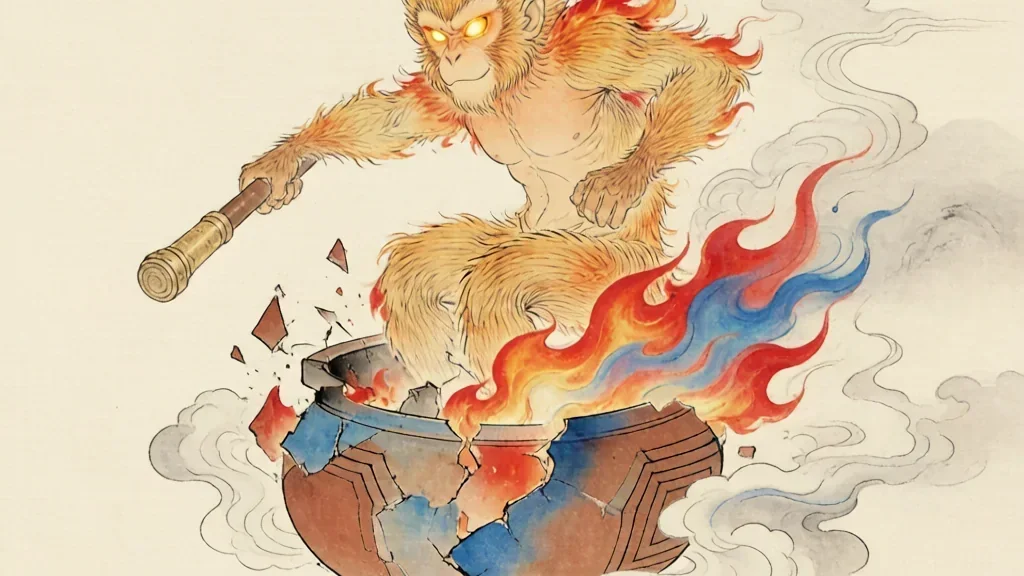
Some eyes see through every lie, and the Chinese idiom huǒ yǎn jīn jīng gives those eyes a mythical glow. Written 火眼金睛 and pronounced , it means "fiery eyes and golden pupils" — the supernatural sight that can pierce any disguise. English says "x-ray vision" or "a discerning eye," but Chinese reaches into legend: the monkey who sat in holy fire and came out seeing truth. For readers new to Chinese culture, the phrase is a lively entry into the novel Journey to the West and into a people's love of the trickster who cannot be fooled. In this article we meet Sun Wukong and his ordeal in the furnace, weigh the idiom's meaning, and see why "fiery golden eyes" became the emblem of undeceivable insight.
The Furnace of the Jade Emperor
The idiom comes from Journey to the West (西游记), the sixteenth-century novel of the pilgrim monk and his companions. The Monkey King, Sun Wukong (孙悟空), had wreaked such havoc that the heaven tried to execute him. Thrown into the eight-trigram furnace of the Lord Laozi (太上老君) to be burned to ash, he survived forty-nine days by hiding in a corner ruled by the wind trigram, which fanned rather than consumed. When he burst out, the smoke had forged in his eyes a pair of fiery, golden pupils that could see demons in any disguise.
The ordeal turned a punish into a gift. The same fire meant to destroy the Monkey became the kiln that made his sight infallible. From that moment, no demon could mask itself as a pretty villager or a kindly monk without the Monkey's golden eyes flashing recognition. The idiom thus carries a paradox Chinese readers love: suffering can forge the very power that later saves you.
Literal Meaning and Characters
The four characters are a portrait. (火) is fire; (眼) is eye; (金) is gold; and (睛) is the pupil or eyeball. Read as "fire-eye-gold-pupil." The image is vivid and slightly fierce — eyes that glow like coals and shine like metal. A learner will notice that specifically means the pupil, the window of sight, so the idiom lights up the very seat of seeing.
The "fire" is not merely heat but the refining fire of the furnace, the alchemical blaze that tempered the Monkey's vision. The "gold" signals something precious and unclouded. Together they name a sight that is both purified and unbreakable — exactly the qualities needed to see through illusion. The idiom is, in effect, a tiny myth of how discernment is earned.
Seeing Through Deception
At its core, the idiom celebrates the power to detect falsehood. In the novel, demons constantly disguise themselves to eat the monk or sabotage the journey; only the Monkey's golden eyes expose them. The lesson for readers is that appearances lie, and that true protection is the ability to see what is really there. The fiery eyes are a metaphor for suspicion rightly used — not paranoia, but clear-eyed trust earned through testing.
This theme runs deep in Chinese storytelling, where transformation and disguise are constant. Fox spirits, demon kings, and false immortals populate the folklore, and the hero who can unmask them is the hero who survives. thus names a survival skill as much as a gift — the capacity to tell friend from foe when the foe wears a smiling face.
How the Idiom Is Used Today
Modern Chinese uses for anyone with sharp, undeceivable judgment. A seasoned editor who spots a fake, an investor who smells a scam, a parent who knows when a child is lying — all are said to have fiery golden eyes. The tone is admiring and a little playful, often invoking the Monkey King with a smile. It is common in praise of experience and wariness.
The idiom also appears in consumer advice and news, where "train your fiery golden eyes" means "learn to spot fakes" — counterfeit goods, phishing emails, fraud. In this practical use, the mythic sight becomes a citizen's skill, and the Monkey King becomes a patron of the cautious. The phrase proves wonderfully adaptable, carrying its novelistic glow into everyday vigilance.
Companions in the Lexicon of Sight
The phrase sits beside 明察秋毫 (míng chá qiū háo, "seeing the autumn hair"), which prizes fine natural observation, while this one prizes mythic penetration of deception. 洞若观火 (dòng ruò guān huǒ, "see through like fire") praises clear understanding. Together they let a speaker choose between the naturalist's eye, the judge's eye, and the Monkey's eye — three kinds of seeing for three kinds of truth.
For learners, the Monkey King connection is a gift: the idiom comes with a story everyone in China knows, so using it carries instant cultural resonance. Referencing "fiery golden eyes" is almost like citing a shared myth, and native speakers will hear both the compliment and the wink behind it.
A Closing Reflection
There is comfort in for anyone who has been fooled. The Monkey earned his sight by surviving the fire meant to end him; our own clearer eyes are often forged the same way, through mistakes and their burns. To wish for golden pupils is not to wish for an easy life but for the wisdom to see through the next disguise. In a world of pretty masks, the idiom is a small blessing: may your eyes be fired, may they be gold, and may no false face pass them by.
Alchemy of the Eight Trigrams
The furnace that made the golden eyes was no ordinary stove but the eight-trigram furnace of Lord Laozi, the supreme alchemical vessel in Daoist cosmology. Each trigram governed an element or force, and the wind trigram, which the Monkey used for shelter, fanned rather than consumed. This detail roots the idiom in a serious tradition of laboratory-style spirituality, where the body and the self were 'refined' like ore into metal. Readers who know this background hear in 火眼金睛 not just a fairy-tale glow but an echo of real alchemical aspiration. The eyes are the successful product of a great work of refinement, and the idiom quietly celebrates the Daoist belief that the highest sight is produced, not given, through patient ordeal.
The Monkey as Cultural Rebel
Sun Wukong is more than a character; he is a national symbol of defiance, cleverness, and the refusal to bow. His golden eyes fit that identity perfectly, because the ability to see through disguise is the rebel's essential tool against hypocritical authority. Across films, comics, and festival plays, the Monkey who unmasks demons stands in for anyone who exposes falsehood in high places. The idiom thus carries a faint charge of resistance: to have fiery golden eyes is to be the one who cannot be fooled by those who pretend to power or piety. That is why the phrase feels both playful and a little subversive when aimed at corrupt officials or confidence tricksters in everyday speech, and why the Monkey endures as a people's hero.
❓ Frequently Asked Questions
📝 Chinese Vocabulary
火眼金睛 — : fiery eyes, golden pupils; sight that sees through deception.
睛 — : pupil, eyeball.
孙悟空 — : the Monkey King who gained the eyes.
太上老君 — : the Lord Laozi whose furnace forged them.
西游记 — : the novel Journey to the West where the tale appears.
火 — : Fire — the refining blaze of the furnace that forged the Monkey's discerning sight.
眼 — : Eye — the organ of sight the idiom lights up as a symbol of undeceivable perception.
金 — : Gold — the metal whose color names the precious, unclouded quality of the Monkey's pupils.
🎉 Fun Facts
- The Monkey survived forty-nine days in the furnace by hiding in the wind-trigram corner, which fanned rather than burned him.
- The same fire meant to kill him instead forged his undeceivable sight — a classic "suffering becomes power" twist.
- The idiom is now used in consumer advice for "training your eyes" to spot fakes and scams.
- Sun Wukong's golden eyes are among the most recognized images in all of Chinese popular culture.
- In traditional opera and New Year prints, Sun Wukong's golden eyes are often shown glowing red, a visual shorthand that lets audiences recognize the hero before he speaks.
- Modern Chinese ophthalmologists and optometrists sometimes playfully wish patients 'fiery golden eyes' after a successful correction, borrowing the idiom for clear vision in the literal sense.