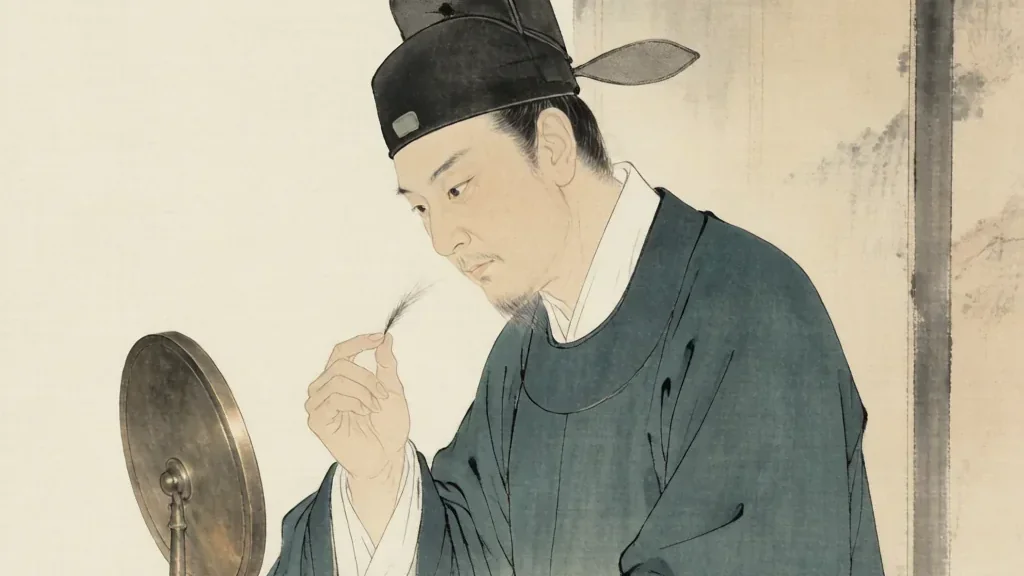
True justice begins with seeing clearly, and the Chinese idiom míng chá qiū háo makes that sight almost supernatural. Written 明察秋毫 and pronounced , it means "to observe clearly the autumn hair" — to notice the finest, slightest detail, like the down on a beast in fall. English says "keen-eyed" or "penetrating judgment," but Chinese reaches for the tiny hair on a creature's coat. For readers exploring Chinese culture, the phrase is a doorway into a tradition that prized sharp, impartial perception as the foundation of good rule. In this article we trace the idiom to the philosopher Mencius, weigh its meaning, and see why "seeing the autumn hair" became the test of a wise judge.
Mencius and the Keen-Eyed King
The idiom comes from the Mencius (孟子), where the philosopher debates King Hui of Liang about the nature of good government. The king insists he is compassionate, pointing to small mercies he performs. Mencius challenges him with a contrast: a person whose eyesight is sharp enough to see the tip of an autumn hair may yet fail to notice a cartload of firewood or a flock of sheep. In other words, the king sees trifles but misses the great suffering of his people.
Mencius's point was moral, not optical. The "autumn hair" stands for the minute; the "cartload of firewood" stands for the massive and obvious. A ruler who notices tiny kindnesses to a few but ignores systemic hunger is, in the philosopher's sharp image, precisely the man with perfect near-sight and total blindness to what matters. The phrase thus began as a rebuke to misplaced attention, not merely as praise of sharp eyes.
Literal Meaning and Characters
The characters are a close-up. (明) is bright or clear; (察) is to observe or scrutinize; (秋) is autumn; and (毫) is a hair or the finest down. Read as "clear-observe-autumn-hair." The "autumn hair" is the fine new fur a beast grows in fall, so light and small it tests the keenest eye. A learner will note that also appears in measures of fine writing, linking sharp sight to careful thought.
The image depends on season. Autumn is when animals shed and regrow down, so the "autumn hair" is culturally specific — a detail only a careful observer of nature would name. The idiom thus carries a gentle love of the natural world inside its claim about perception. To see the autumn hair is to be attuned, in the smallest way, to the turning of the year.
Seeing Clearly as a Moral Duty
In Confucian thought, clear sight was never only physical. The good official was expected to perceive the truth of a dispute, the need of the poor, the hidden motive of the wicked — to "see" what others missed. therefore became a praise for judges, magistrates, and leaders who penetrated appearances to the facts beneath. A ruler who could do this was fit to govern; one who could not was dangerous, however kind his intentions.
The idiom also warns against the opposite failure: seeing the small and missing the large. As Mencius used it, the phrase cuts both ways — it can praise a keen eye or mock a king who sees hairs but not hunger. This double edge makes it a rich tool: you can honor a careful judge and, in the next breath, remind a proud person that fine sight is worthless if aimed at the wrong thing.
How the Idiom Is Used Today
Modern Chinese uses for investigators, auditors, editors, and anyone with piercing discernment. A detective who spots the clue, an accountant who catches the error, a critic who names the flaw — all are praised this way. The tone is respectful; it marks the speaker as someone who values precision over vagueness. It appears in praise of careful work and in hope for honest oversight.
The idiom also lives in self-defense. A person wrongly accused may say they trust the court to "see the autumn hair" — that is, to perceive the truth in fine detail. In this use the phrase becomes a small prayer for justice: may those in power look closely enough to find what is really there. It carries, even now, the Confucian hope that clear sight serves the weak.
Companions in the Lexicon of Judgment
The phrase belongs to a family of perception idioms. 火眼金睛 (huǒ yǎn jīn jīng, "fiery eyes, golden pupils") describes the mythic ability to see through deception; 明察秋毫 describes the naturalist's fine sight. 洞若观火 (dòng ruò guān huǒ, "see through like watching fire") praises clear understanding. Together they let a speaker praise different kinds of insight — the legal, the mystical, the analytical.
For learners, this cluster is useful because it shows how Chinese ties perception to virtue. To see well is to govern well; to be blind to the great is to fail despite good intentions. Knowing the autumn hair and the fiery eyes lets you discuss judgment with the moral weight a native speaker feels behind such praise.
A Closing Reflection
There is a humility in that the English "keen-eyed" misses. The idiom does not only celebrate sharp sight; it asks where we point it. Mencius's king could see the hair and miss the famine, and so can we — noticing small faults in others while ignoring large truths about ourselves. To live by the phrase is to train the eye on what matters, to see the fine detail and the vast need together. That double vision is the beginning, and the daily practice, of wisdom.
The Mencius and the Art of Debate
The autumn-hair image appears inside one of the Mencius's set-piece debates, where the philosopher corners a ruler with a vivid analogy rather than a sermon. Mencius was a master of the pointed comparison, and the hair-versus-firewood contrast shows his method: make the king's own claim ridiculous by scaling it. The idiom therefore descends from a tradition of oral argument in which a single sharp image did the work of a chapter of proof. Readers who meet the phrase in isolation miss this rhetorical pedigree. Knowing it came from a debate helps explain why the idiom carries both praise and bite; it was forged as a weapon against self-satisfied power, and only later softened into a general compliment for careful judges and keen-eyed observers.
Seeing Small, Missing the Great
The warning Mencius attached to the phrase became a recurring motif in Chinese moral writing: the danger of fine sight aimed at the wrong object. A critic who spots a typo but not a fraud, a parent who notices a sock out of place but not a child's unhappiness, a ruler who counts trifles but not hunger — all repeat the king's error. The idiom thus trains attention as much as it praises it, asking the reader to aim the clear eye at the cartload, not only the hair. This double usage is what keeps 明察秋毫 alive: it can honor the careful and, in the next breath, humble the proud. The deepest lesson is one of proportion, that discernment without priority is a finer form of blindness, and that wisdom begins by choosing what deserves to be seen.
❓ Frequently Asked Questions
📝 Chinese Vocabulary
明察秋毫 — : to observe clearly the autumn hair; keen, penetrating judgment.
察 — : to observe, scrutinize.
秋毫 — : autumn hair, the finest down.
孟子 — : the philosopher who coined the image.
梁惠王 — : the king Mencius debated.
明 — : Bright or clear — the quality of sight the idiom says must be trained on what matters.
秋 — : Autumn — the season when beasts grow the fine down that tests the keenest eye.
毫 — : A hair or the finest down — the minute thing the idiom uses as a measure of perception.
🎉 Fun Facts
- The "autumn hair" is the fine new fur beasts grow in fall, a detail only a close observer of nature would name.
- Mencius used the image to contrast near-sight (tiny mercies) with blindness to great suffering.
- The idiom became a standard praise for judges and magistrates in imperial China.
- The character 毫 also measures fine things in writing, linking sharp sight to careful thought.
- The same character 毫 that names the autumn hair also measures the finest units in writing, so sharp sight and careful prose share one word.
- Imperial examination graders were expected to 明察秋毫, catching plagiarism and faint errors across thousands of identical answer sheets.