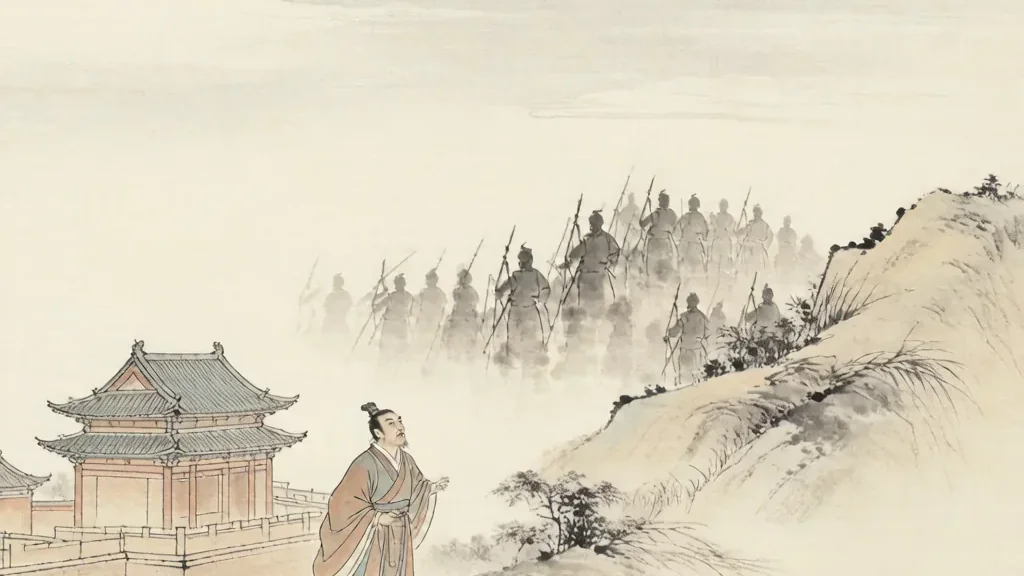
Among the many forms fear that comes not from facing a stronger enemy, but from having already been defeated in your own mind. It is the fear that transforms ordinary things — a bush stirring in the wind, a tree casting a long shadow — into threats. The Chinese idiom 草木皆兵 (cǎo mù jiē bīng), "every bush and tree is an enemy soldier," captures this state of psychological collapse with terrifying precision. It comes from one of the most dramatic episodes in Chinese military history: the Battle of Fei River in 383 CE, when the mightiest army in the land was shattered not by swords but by its own commander's fear.
The story is recorded in the "Book of Jin" (晋书), the official dynastic history, and it involves two of the most consequential figures of the fourth century: Fu Jian, the emperor of the Former Qin dynasty who had united all of northern China under his rule, and Xie An, the prime minister of the Eastern Jin dynasty who held the south. Their confrontation at the Fei River would decide the fate of China, and the way it unfolded has become a timeless lesson in how fear can turn overwhelming strength into catastrophic weakness.
The Emperor Who Would Conquer All
By 383 CE, Fu Jian had achieved what many had thought impossible. He had unified the fractious tribes and kingdoms of northern China into a single, powerful empire. His Former Qin dynasty stretched from the steppes of Mongolia to the Yangtze River, and his armies were the most formidable in the known world. His confidence was immense, and his ambition was boundless. There remained only one prize: the Eastern Jin dynasty in the south, the last holdout of Han Chinese rule, stubbornly surviving in the fertile lands beyond the Yangtze.
Fu Jian assembled an enormous army. Historical records claim it numbered nearly a million men, though modern historians estimate it was closer to 300,000 to 600,000 — still an almost unimaginable force for the time. Fu Jian was so confident of victory that he reportedly boasted that his soldiers could throw their whips into the Yangtze River and stop its flow. The metaphor was meant to convey overwhelming numerical superiority, and it reflected a man who believed victory was not merely likely but inevitable.
Against this colossal force, the Eastern Jin could muster perhaps 80,000 soldiers under the command of generals Xie Shi and Xie Xuan, with Prime Minister Xie An coordinating strategy from the capital. The odds seemed hopeless. And yet, as Fu Jian would soon discover, numbers are not the only thing that matters in war. Sometimes the most important battlefield is the one inside the commander's own head.
The View from Shouchun
The two armies faced each other across the Fei River, near the city of Shouchun in modern-day Anhui province. Fu Jian and his forces had captured the city and established their position on the northern bank. The Jin army had arrived and taken up positions on the southern bank. Between them flowed the Fei River — not particularly wide, not particularly deep, but enough of an obstacle to prevent either side from attacking without preparation.
On the morning before the decisive engagement, Fu Jian climbed to a high vantage point in Shouchun to survey the enemy positions across the river. He expected to see a small, ragged force, perhaps already showing signs of fear and disorder. Instead, what he saw sent a chill through his heart. The Jin army was arrayed in perfect formation, their banners crisp in the morning light, their ranks disciplined and still. They looked not like defenders waiting to be crushed but like soldiers who fully expected to win.
Then Fu Jian made a fatal error of perception. He turned his gaze to the hills beyond the river, to the slopes of Mount Bagong that rose in the distance. The mountain was covered in dense vegetation — trees, bushes, tall grasses that stirred in the wind. And in that moment, in the grip of a fear he could not name, Fu Jian saw not vegetation but soldiers. Thousands upon thousands of soldiers, hidden among the trees, waiting to spring an ambush. He pointed at the mountain and said to his generals, "Look — the enemy has soldiers everywhere. Even the grass and the trees are their troops."
The Unraveling of an Empire
The psychological damage was done. Fu Jian, who had arrived believing in certain victory, now believed he was surrounded. He ordered his army to pull back from the riverbank to give the Jin forces room to cross — a tactical maneuver that was meant to lure the enemy into a trap. But the retreat, once begun, could not be controlled. Soldiers in the rear ranks saw their comrades moving backward and assumed the battle was lost. Someone shouted that the Qin army had been defeated. Panic spread like fire through dry grass.
The Jin forces seized the moment. They crossed the river and attacked with devastating force, and the Qin army — still numbering in the hundreds of thousands — collapsed into chaos. Soldiers threw down their weapons and fled in every direction. The rout was so complete that when the survivors finally stopped running, they had covered hundreds of miles. The sound of the wind in the trees and the cry of cranes in the distance sent fresh waves of terror through them, each sound mistaken for the approach of pursuing Jin cavalry.
Fu Jian himself was wounded by an arrow during the retreat and barely escaped with his life. His empire, which had taken decades to build, disintegrated within months. The northern tribes that he had subdued rose in rebellion. His generals turned against one another. And the man who had boasted that his soldiers could dam the Yangtze with their whips died a fugitive, betrayed and murdered by one of his own former subordinates.
The Lessons of Mount Bagong
The idiom 草木皆兵 has survived for over sixteen centuries because it speaks to something fundamental about the human condition. It is not merely about military defeat. It is about the moment when confidence flips into terror, when a strong person suddenly sees weakness everywhere, and when the mind begins to manufacture evidence for its own worst fears. Fu Jian did not lose because his army was smaller or less skilled — his army was vastly larger. He lost because he looked at a mountain covered in trees and saw an army that was not there.
In modern Chinese, 草木皆兵 is used to describe any situation where someone is so frightened or anxious that they perceive threats where none exist. A student who thinks every question on an exam is a trick, an employee who believes every colleague's whisper is about them, a country that sees invasion plans in every foreign policy statement — all of these are examples of "seeing soldiers in the grass and trees." The idiom is a warning against allowing fear to shape perception, because once perception is distorted, the disaster has already begun.
The story also offers a profound lesson about leadership. Fu Jian's panic did not stay contained within his own mind. It radiated outward, amplified by the rumor and confusion of a massive army, until it became a self-fulfilling prophecy. A commander who sees enemies everywhere will eventually create real enemies through the actions he takes based on his false perceptions. The fear that began in one man's eyes as he looked at a mountain ended in the collapse of an empire.
There is a bitter irony at the heart of this story. Fu Jian was, by most accounts, a capable and even enlightened ruler. He promoted merit over aristocratic birth, patronized Buddhism, and genuinely tried to build a unified and prosperous state. His fatal flaw was not incompetence or cruelty but something more human and more universal: the inability to trust his own strength when it mattered most. The Jin army was outnumbered perhaps five to one. The vegetation on Mount Bagong was just vegetation. And yet fear, once admitted, is stronger than facts. It can turn the mightiest army into a mob of frightened men, and it can make a mountain of trees look like an invincible enemy.
The Calm Strategist Xie An
While Fu Jian panicked, the man who won the Fei River was famous for his calm. Xie An, the Eastern Jin prime minister, received news of the great victory while playing weiqi and is said to have remarked on it quietly, as if unwilling to break his composure. That restraint became almost as legendary as the battle itself, a model of the leader who does not let fear reach his face. Where Fu Jian's imagination produced soldiers in the trees, Xie An's self-possession held a smaller army steady against a larger one. The contrast between the two commanders is part of why the idiom endures: it is not only about seeing threats that are not there, but about the steadiness that prevents such errors in the first place. Where Fu Jian saw soldiers in the grass, Xie An saw only a problem to be solved with calm.
A Battle Decided by Nerve
The Fei River is studied as a textbook case in which morale, not numbers, decided the outcome. The Former Qin host was vast but newly assembled from conquered tribes with divided loyalties, while the Jin army was smaller but cohesive and well led. When Fu Jian's fear spread through his ranks, the numerical advantage became a liability, a mob of unsure men who could be routed by a confident strike. Military historians point to the battle when arguing that an army's belief in itself can outweigh its size. Cao mu jie bing captures the inward half of that lesson, the moment a commander's confidence flips to terror and the stronger side defeats itself before a blow is struck. Numbers counted for nothing once the mind had already surrendered.
Fear as a Weapon and a Weakness
The idiom shows fear working in two directions at once. For the Jin, the sight of disciplined enemy ranks and a deceived enemy commander was a weapon, because Fu Jian's misperception did their work for them. For Fu Jian, the same fear was a fatal weakness, turning vegetation into an army and a cautious retreat into a rout. The story thus teaches that perception can be as decisive as force, and that the leader who controls his own mind controls the battle. In daily life the lesson travels easily: the person who reads threat into every neutral signal not only suffers needlessly but may act in ways that create the very conflict they feared, making imagination a self-fulfilling prophecy. The story warns that the fearful mind is its own worst enemy on the battlefield.
Sayings Born of One Battle
Few battles gave Chinese as many enduring phrases as the Fei River. Alongside cao mu jie bing, the era produced feng sheng he li for the panicked sounds of retreat and tou bian duan liu, Fu Jian's boast that his soldiers could dam the river with their whips, now used for arrogant overconfidence. Having several idioms from one event let later speakers grade a single disaster from different angles: the visual terror, the auditory panic, the pride that preceded the fall. For students of Chinese, this cluster is a useful reminder that idioms are not isolated proverbs but a connected web, often sharing a single historical root. Learning one Fei River phrase naturally leads to the others and to the whole story behind them.
❓ Frequently Asked Questions
📝 Chinese Vocabulary
草 — : "Grass" or "bush" — the ordinary vegetation that, to a frightened mind, becomes a hidden soldier.
木 — : "Tree" or "wood" — representing all the natural features of the landscape that fear transforms into threats.
皆 — : "All" or "every" — emphasizing the totality of the paranoia, the sense that threats are everywhere.
兵 — : "Soldier" — the imagined enemy, the phantom threat born of fear.
苻坚 — : The Emperor of Former Qin whose paranoia at Fei River led to the collapse of his empire.
风声鹤唳 — : The sound of wind and the cry of cranes, the companion phrase for the panic of Fu Jian's retreating army.
谢安 — : The calm Eastern Jin prime minister who coordinated the defense and never let his composure break during the crisis.
前秦 — : The Former Qin dynasty, Fu Jian's northern empire that collapsed after its defeat at the Fei River.
🎉 Fun Facts
- The Battle of Fei River in 383 CE is one of the most famous battles in Chinese history and is still studied in military academies as a classic example of how psychological factors can defeat numerical superiority.
- The idiom is often combined with another phrase from the same battle — 风声鹤唳 (fēng shēng hè lì), "the sound of wind and the cry of cranes" — to describe the complete psychological collapse of Fu Jian's retreating army.
- Mount Bagong (八公山), where Fu Jian saw phantom soldiers, is a real location near modern-day Huainan in Anhui province and has become a tourist attraction precisely because of this legendary misperception.
- Fu Jian's boast about his soldiers damming the Yangtze with their whips — 投鞭断流 (tóu biān duàn liú) — also became a Chinese idiom, now used ironically to describe overconfidence that precedes a disastrous failure.
- The idiom's image of harmless plants read as soldiers appears in later Chinese novels and operas as a shorthand for a defeated army's terror.
- Linguists note that cao mu jie bing belongs to a small group of sayings, with feng sheng he li and tou bian duan liu, all born from the single Battle of Fei River, a rare case where one battle produced several idioms.