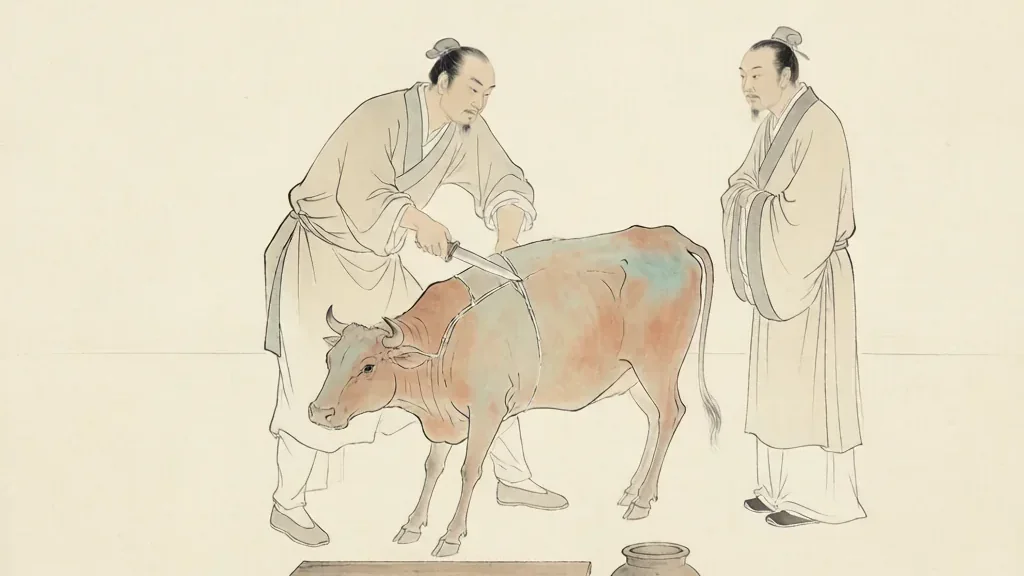
The highest skill looks like no skill at all. The Chinese idiom 庖丁解牛 (páo dīng jiě niú) — "Cook Ding carves the ox" — tells of a royal cook who butchers cattle with such effortless grace that his knife never dulls, because he follows the natural seams of the beast rather than hacking against bone. Drawn from the Zhuangzi, it has become the supreme Chinese image of mastery: not brute effort, but deep understanding that makes effort disappear. To "carve the ox like Cook Ding" is to do a hard thing as if it were easy, because you have seen into its structure.
The Cook and the King
The parable opens in the 庄子 (Zhuāngzǐ) with Cook Ding (庖丁, páo dīng — "páo" meaning cook, "dīng" a personal name) demonstrating his art before Lord Wenhui (文惠君). As he slices an ox, his hands, shoulders, feet, and knife move in a rhythm so precise and musical that the lord exclaims in admiration. He asks how Ding achieved such mastery. The cook's answer becomes one of the most quoted passages in Chinese philosophy.
Ding explains that what he loves is the principle (道, dào) beyond mere technique. When he first butchered, he saw only the whole ox; after three years, he no longer saw the whole ox but perceived its inner structure. Now he meets the ox with his spirit, not his eyes — his knife slips along the natural openings and gaps between joints, never touching the knots of bone.
The lord, hearing this, declares he has learned a principle of nurturing life (养生, yǎngshēng) from a cook's work. The story thereby becomes not just about butchery but about living: move with the grain of things, and the world yields without wearing you down.
The Characters and the Knife That Never Dulls
The four characters: 庖 (páo) "cook," 丁 (dīng) the cook's name, 解 (jiě) "to cut apart / dissect," and 牛 (niú) "ox." The phrase names an ordinary trade elevated to art. The ordinariness is the point — wisdom hides in the kitchen, not only the court.
The most famous detail is the knife. Ordinary butchers replace their blades monthly (hacking bone) or yearly (cutting muscle); Cook Ding's knife, after nineteen years and thousands of oxen, is still as sharp as the day it left the whetstone. The reason: it never meets resistance, only space. The knife's longevity is the proof of understanding.
The verb 解 (to untie, loosen, dissect) is telling. Ding does not "kill" or "chop" the ox; he "unlocks" it, as if the ox were already divided by nature and he merely reveals the divisions. The idiom thus reframes work as discovery of existing structure rather than violent imposition of will.
The Meaning: Skill as Understood Principle
At its heart, 庖丁解牛 teaches that mastery is understanding, not force. The novice meets resistance everywhere because he sees a solid obstacle; the master sees the seams and walks the knife through them. Difficulty, in this view, is often a failure of perception rather than a fact of the task.
This is a profound alternative to the "try harder" ethos. Where other idioms praise grinding effort (dripping water, iron rod to needle), Cook Ding praises insight that makes effort unnecessary. The knife that never dulls is the image of a life that does not wear out from struggle, because it moves with the world's grain.
The idiom also elevates the humble craftsman. A cook becomes the teacher of a lord; kitchen work becomes a path to the Dao. Zhuangzi delights in this inversion, showing that wisdom is not the property of the high but of those who truly see. The ox-yard, not the court, is the school of principle.
The Daoist Lesson of Nurturing Life
The lord's final lesson — that he learned 养生 (nurturing life) from the cook — points to the idiom's deepest layer. To live well is to move through the world as Ding moves through the ox: along the natural openings, avoiding the hard knots (which stand for life's unavoidable difficulties), so that one is not ground down.
This is not escapism. Ding still butchers every ox; he does not avoid the task. He simply performs it in a way that preserves him. The idiom thus counsels engagement without depletion — full participation in life's demands coupled with a technique that spares the self. The knife stays sharp because the cook respects the structure he works within.
Modern readers find here an early blueprint for "working smart." But Zhuangzi's version is softer: it is not efficiency for gain but harmony for preservation. The goal is not to butcher faster but to butcher without losing yourself to the bone.
How the Idiom Is Used Today
In modern Chinese, 庖丁解牛 praises mastery so complete it looks effortless. A surgeon with a steady, economical hand, a programmer who dissolves a hard bug, a teacher who makes a difficult subject clear — all may be called "carving the ox like Cook Ding."
It also appears in how-to and management writing as a metaphor for analyzing complexity. To "carve the ox" a problem is to find its joints — the natural divisions that let you resolve it cleanly. The idiom thus travels from butchery into problem-solving and systems thinking.
For individuals, it is a model of lifelong learning. Ding's three-year transformation (from seeing the whole ox to seeing its structure) is the arc of any expertise: first the confusing mass, then the underlying order. The idiom reassures beginners that confusion is only the first stage.
A Reflection on the Knife's Edge
庖丁解牛 offers a gentler heroism than the self-flagellating study idioms. It does not ask you to lie on ice or jab your thigh; it asks you to look, to learn the seams, to let understanding do the cutting. The knife that never dulls is the life that never burns out.
We spend much effort hacking at bone — forcing results, resisting structure, meeting every difficulty head-on. The cook invites a different question: where are the openings? What is the grain of this task, this relationship, this day? Find it, and the work that seemed to need a blunt blade needs none. That is the quiet mastery the old parable still teaches, one ox at a time.
Zhuangzi's Use of the Craft Story
The Cook Ding parable belongs to a distinctive habit of the Zhuangzi: making philosophers out of workers. Across the book, a wheelwright, a boatman, a woodcarver, and a cook each lecture a ruler on a deeper truth, and the joke is that the court's official wisdom is upstaged by the workshop's. Zhuangzi uses these lowly teachers to argue that understanding is not the property of titles or learning but of those who truly see. The butchery scene is especially favored because it pairs a bloody, common trade with a serene, almost musical rhythm, forcing the reader to rethink what wisdom looks like. This literary strategy, the humble craftsman as sage, is one of the text's most original and enduring contributions to Chinese thought.
From Whole Ox to Inner Structure
Ding describes a three-stage growth that any learner will recognize. At first he saw only a solid ox, an intimidating block with no clear way in. After three years he stopped seeing the whole beast and perceived its joints, cavities, and sinews, the hidden order beneath the surface. Finally he met the ox with his spirit rather than his eyes, moving by feel along the gaps. This progression maps onto all expertise: a beginner faces confusion, an intermediate sees patterns, and a master responds without conscious analysis. The idiom quietly reassures anyone struggling at the first stage that the blank, frightening whole ox is normal, and that perception itself can be trained until what once seemed solid reveals the seams that make it manageable.
❓ Frequently Asked Questions
📝 Chinese Vocabulary
庖丁解牛 — : "Cook Ding carves the ox"; mastery through understanding structure.
庖 — : Cook; the humble craftsman who becomes a teacher of the Dao.
解 — : To dissect / untie; to reveal the ox's natural divisions.
道 — : The Way / principle beyond technique that Ding says he loves.
养生 — : Nurturing life; the lesson the lord drew from the cook's art.
庄子 — : The Daoist classic, and its eponymous author, that preserves the parable of Cook Ding.
文惠君 — : Lord Wenhui, the ruler before whom Cook Ding demonstrates his art and learns the lesson of nurturing life.
筋 — : Sinew or tendon; the natural seam between joints that Ding's knife follows instead of striking bone.
🎉 Fun Facts
- Cook Ding's knife stayed sharp for nineteen years and thousands of oxen because it never met bone.
- He said that after three years he "no longer saw the whole ox" — he perceived its inner structure instead.
- The lord concluded he had learned 养生 (nurturing life) from a kitchen task, not a court lecture.
- The idiom reframes hard work as discovering existing structure rather than imposing force.
- The parable is unusual in world literature for turning a slaughterhouse task into a lesson about philosophy and peace, which is why it is still quoted in discussions of craft, focus, and flow.
- Zhuangzi delights in humble teachers, and Cook Ding belongs to a cast of cooks, wheelwrights, and woodcarvers who, in his book, out-think the Confucian gentlemen, a deliberate inversion that elevates everyday labor.