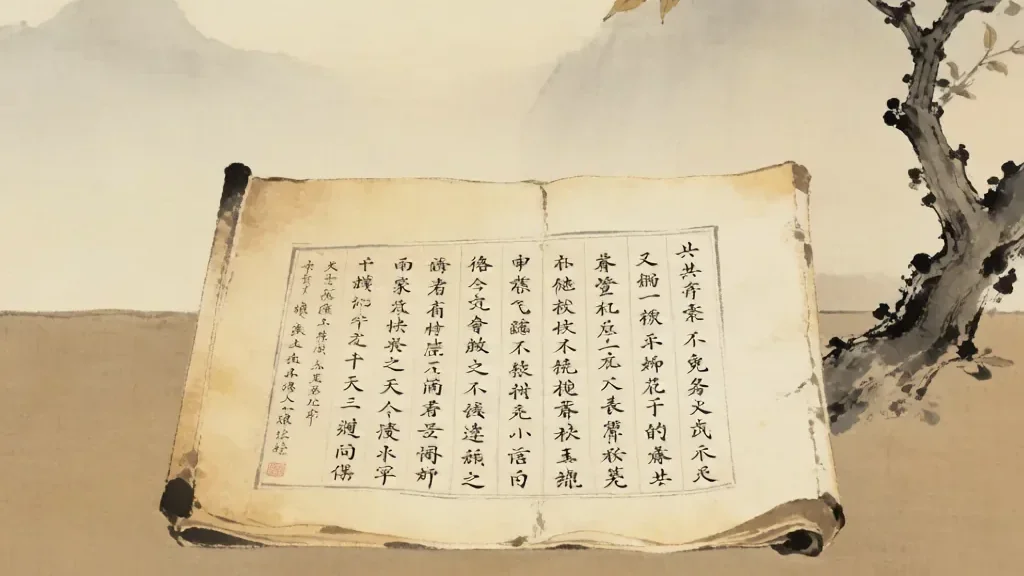
The 唐诗三百首, commonly called the Three Hundred Tang Poems, is the single most influential anthology in the history of Chinese poetry, the book by which generations of readers, children, and foreign learners have met the verse of the Tang. Compiled in the middle of the eighteenth century by an ordinary scholar-official using the pen name Hengtang Tuishi, it gathered a little over three hundred pieces into a portable volume meant for home instruction rather than for the library. Its modest size and sure taste made it the standard primer of the empire and, later, of the modern classroom and the translation shelf. This article explains what the anthology is, who made it and why, how it is organized, which poems it canonized, and how a Qing domestic reader's selection came to define the Tang for the whole world.
The Compiler and the Moment
The anthology was the work of Sun Zhu, who wrote under the studio name Hengtang Tuishi, a retired gentleman of the Jiangsu region during the reign of the Qianlong emperor. He was not a famous poet or a court arbiter but a local educator who found the existing anthologies either too large for a child or too oddly chosen for pleasure. His aim was practical: a thin book that a family could put in a boy's hands and trust. The personal, almost domestic origin of the collection is the secret of its success, because it was shaped by the needs of teaching rather than by the claims of scholarship.
The eighteenth century was a time of both scholarly enormity and popular simplification, and the Three Hundred Tang Poems belongs to the second current. While great imperial libraries were being cataloged, Sun Zhu was cutting the Tang down to a pocket size. The contrast shows the two lives of Chinese poetry, the monumental and the intimate, and this anthology is the supreme example of the intimate form achieving the larger fame.
The Number Three Hundred
The title's round number deliberately echoes the 诗经, the Book of Songs, which Confucius was said to have reduced to three hundred and five pieces, spoken of loosely as three hundred. By calling his book the Three Hundred Tang Poems, Sun Zhu placed the Tang lyric in the lineage of the classical canon and claimed for it the same foundational status. The number is a statement of ambition as much as a count, and the echo gave the new book an air of scripture.
In practice the anthology contains a few more than three hundred poems, because round numbers in Chinese titling are conventional rather than exact. The slight surplus does not break the spell; it confirms that the book belongs to the same generous tradition of the canonical round figure. The title thus performs a piece of cultural genealogy every time it is spoken.
Forms and the Range of the Tang
The anthology is organized not by author or theme but by form, and within form by a rough chronology, so that the reader moves through the major shapes the Tang gave to verse. It opens with the old yuefu and the pentasyllabic ancient style, passes to the quatrain and the regulated octet in both five and seven syllables, and includes a selection of the fu rhapsody and the occasional lyric. This formal arrangement taught the student the architecture of Tang poetry before he learned its biography, which is exactly what a practical teacher would want.
By covering the quatrain, the regulated octave, and the looser ancient forms together, the book gave a balanced picture of the age rather than favoring one fashion. A reader who mastered the Three Hundred had, in miniature, the whole grammar of Tang verse, and could recognize a jueju or a lüshi on sight. The formal plan is therefore a hidden curriculum, teaching craft through example rather than rule.
Selection and the Question of Taste
Sun Zhu's choices favored clarity, feeling, and singability over difficulty or display. He included the famous banquet and parting quatrains that any educated person would quote, the regulated octets of the great masters, and a sampling of the long ancient-style narratives. He tended to avoid the most allusive and hermetic verse, the later work of Li Shangyin's obscure end, and the dense fu, keeping the book within the grasp of a beginner. The taste is conservative and humane.
This editorial restraint is why the anthology succeeded where scholarly collections failed. By refusing the obscure, Sun Zhu made the Tang available to the unlearned, and availability is a kind of canonization stronger than praise. The poems he chose became the Tang not because a critic said so but because millions of children memorized them, and memorization is the deepest form of literary authority.
The Book as a Primer
From the nineteenth century onward the Three Hundred Tang Poems functioned as the standard first poetry reader in the Chinese home and school, the book placed beside the characters and the arithmetic. Its poems were the matter of recitation, copying, and the first essay, and a child who could write out a dozen of them had a cultural foundation. The anthology thus did the work that in the West might be done by a book of nursery verse and a grammar combined.
The primer role explains certain features of the book, its manageable length, its preference for short forms, its moral and natural themes suitable for the young. It also explains its durability: readers met these poems before they could judge them, and the early affection outlasted later sophistication. The anthology is the rare critical object that most of its audience encountered as a kind of mother tongue.
Poems the Anthology Made Canonical
Whatever its limits, the book fixed the popular canon of the Tang. The quatrains of Wang Zhihuan on the frontier, the parting lines of Li Bai, the regulated octets of Du Fu on the streaming hair and the wall, the little songs of Meng Haoran and the lyrics of Bai Juyi, all entered common memory through these pages. Many a poem now called the most famous Tang poem owes that status to inclusion here rather than to any independent measure of merit.
The anthology also preserved the habit of reading the Tang as a set of memorable single pieces rather than as the achievement of whole careers. A reader could know the Three Hundred and still know little of a poet's longer or darker work, and the book therefore shaped a certain partial Tang, bright and quotable, that became the public face of the age. The partial view is not false, only selected, and selection is the anthologist's right.
Relation to Earlier Anthologies
The Three Hundred belongs to a long line of Tang anthologies, from the mid-Tang collections made while the great poets were still alive, through the enormous Song-era compilations, to the critical selections of the Ming. Compared with these, Sun Zhu's book is small and unpretentious, and its novelty is precisely its domestic scale. Where the Ming anthologists argued about orthodoxy, he simply picked what a family would enjoy and learn, and the quietness of his method is its strength.
The book also differs from the great 文选, the early medieval anthology that shaped the learned canon for a millennium, in that it confines itself to one dynasty and one dominant form of verse. The Wen Xuan taught breadth; the Three Hundred taught focus. Together they show the two ways a tradition can be handed down, the comprehensive and the essential, and the essential won the larger public.
The Companion Anthology of Song Lyrics
The fame of the Three Hundred Tang Poems spawned a parallel title, the Three Hundred Song Lyrics, a later Qing compilation that applied the same pocket format to the ci of the Song dynasty. The echo confirms the canonical power of Sun Zhu's model: once three hundred Tang poems had become scripture, three hundred Song lyrics was the obvious next book. The pattern shows how a single editorial decision can generate a whole family of imitators.
These companion volumes also fixed a period taxonomy that still governs how Chinese poetry is taught, the Tang for shi and the Song for ci, two dynasties each entrusted with one form. The simplification is historically rough, since the Tang also wrote ci and the Song also wrote shi, but the anthology logic favors clean pairs, and the pairs have proved stubbornly useful in the classroom.
Printing, Commentary, and Translation
Almost from the start the anthology was printed with brief notes and sometimes with a few words of appreciation per poem, and the commented editions multiplied through the nineteenth century. In the modern period it has appeared in countless editions with punctuation, biography, and illustration, and it was among the very first Chinese books to be translated whole into European languages, appearing in English, French, and German versions that shaped the Western image of Chinese poetry.
The translation history is a large subject in itself. Because the Three Hundred was short and famous, it became the text on which early sinologists cut their teeth, and the versions they produced, uneven as some are, carried the Tang into world literature. A reader in English today is still most likely to meet the Tang through a selection descended from this Qing household book, a remarkable fate for a teacher's aid.
Criticism and the Charge of Narrowness
The anthology has always had critics who note its omissions, its bias toward the accessible, and its neglect of the experimental and the difficult. Some argue that it flattened the Tang into a set of pretty quatrains and that it underrepresents the social range of the age. These complaints are fair as literary history but miss the book's purpose, which was never to be complete but to be usable, and usability is its own kind of completeness.
The defense is that no anthology can be the whole, and that the Three Hundred earns its place by what it started in readers rather than by what it left out. A book that sends a child to the Tang is worth more than a catalog that satisfies a specialist, and the continuing sale of the little volume, in paperback and on the phone, suggests that readers still want exactly this door more than they want the whole house.
The Living Anthology
Today the Three Hundred Tang Poems survives as both relic and tool, recited by schoolchildren, quoted in films, and scrolled on screens, its poems serving as the shared cultural currency of the Chinese-speaking world. Its authority is no longer that of a teacher's decree but of a habit too old to break, and that is the strongest authority of all. The book that began as a Qing gentleman's aid to his family has become, in effect, the voice of the Tang itself.
What the anthology finally proves is that canon is made not by the critic's stamp but by the母亲's hand placing a book in the child's lap. Sun Zhu wanted only a clean, kind, learnable selection, and he got, as a byproduct of that modest wish, the power to decide which Tang poems the world would remember. The Three Hundred is the great example of how the smallest editorial act, repeated by millions, becomes the largest literary fact.
❓ Frequently Asked Questions
What is the Three Hundred Tang Poems?
It is the most influential anthology of Tang verse, compiled in the 1700s by Sun Zhu under the name Hengtang Tuishi as a portable home reader.
Why is it called three hundred?
The round number echoes the Book of Songs, said to be three hundred, placing the Tang lyric in the classical canon's lineage.
How is the anthology organized?
By form rather than author or theme, moving from yuefu and ancient style to quatrain, regulated octet, and a little fu.
Why did it become a primer?
Its short length, clear poems, and humane themes suited children, and memorization made its choices the public canon of the Tang.
What are its main criticisms?
Critics note its bias toward the accessible and its neglect of difficult, allusive, or socially wider Tang verse.
Is there a Song companion volume?
Yes, the Three Hundred Song Lyrics later applied the same pocket format to the ci of the Song dynasty.