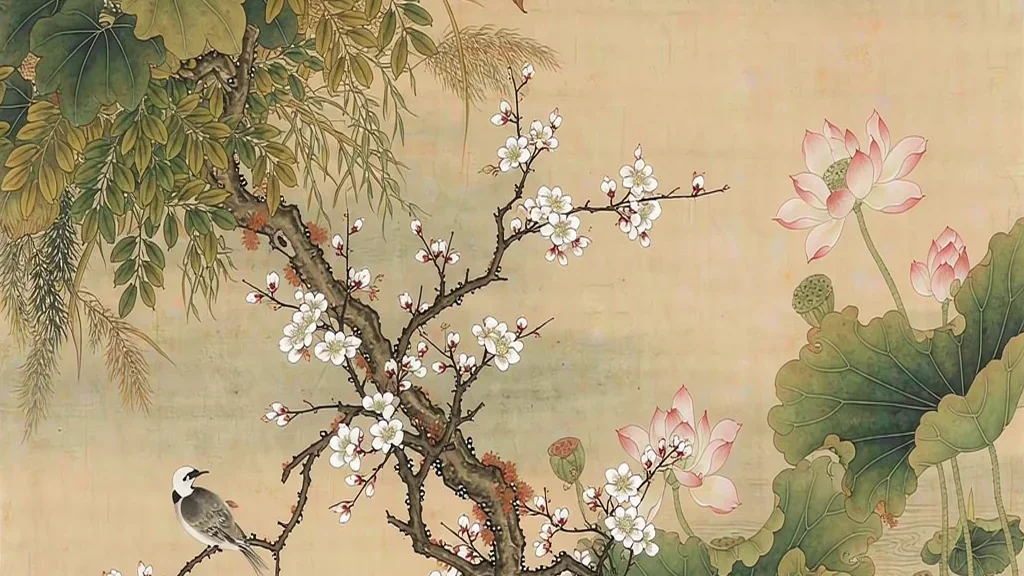
In the vast landscape of Chinese poetry, the jueju (绝句, "cut-off verse") is the smallest perfect thing — a four-line poem that compresses the resources of a great tradition into a handful of characters, each one so precisely chosen that removing a single syllable would shatter the whole. The Tang masters could evoke a parting, a landscape, a moment of enlightenment, or the entire tragedy of a civil war in just twenty or twenty-eight Chinese characters. The jueju is Chinese poetry at its most concentrated, a form that teaches us that less is not only more — it can be everything.
The Name and Its Meaning
The word jueju (绝句) literally means 'severed lines' or 'cut-off verse.' There are two explanations for this name. The first is technical: a jueju is essentially half a lüshi — four lines instead of eight — cut off from the longer form. The second is historical: early jueju were composed by selecting and arranging four lines from longer ballads, 'cutting off' a self-contained stanza. Whatever the etymology, the name captures something essential about the form: it is a fragment that feels complete, a piece of something larger that stands perfectly on its own.
The jueju can be written in either five-character (wuyan jueju, 五言绝句) or seven-character (qiyan jueju, 七言绝句) lines. Both forms follow the tonal patterns of regulated verse in their 'canonical' version, but there is also a looser 'ancient-style' jueju that ignores tonal rules. The regulated jueju became the dominant form, especially after Du Fu and Wang Wei perfected it in the High Tang period.
Wang Wei and the Silent Concentration
Wang Wei (王维, 699–759 CE), the 'Poet-Buddhist' who was also a master painter and musician, wrote some of the most exquisite jueju in the language. His 'Deer Enclosure' — a poem of only twenty characters — captures an entire world: 'Empty mountain not seeing anyone, / only hearing echoes of people's voices. / Reflected light enters the deep forest, / again shining on the green moss.' The poem moves from emptiness to sound, from sound to light, from light to the vivid detail of moss. In four lines, Wang Wei has transported us from a mountain to a moment of perception so precise it feels like our own memory.
Wang Wei's jueju often embodies Chan Buddhist principles of direct, non-conceptual awareness. He does not explain or comment; he simply presents the scene with such clarity that the reader experiences it directly. His best-known jueju series, 'The Wang River Collection' (辋川集), consists of twenty poems, each describing a different spot on his country estate. Taken together, they form a kind of landscape scroll in words, each poem a window onto a single, perfect view.
Li Bai's Exuberant Quatrains
Where Wang Wei was quiet and contemplative, Li Bai (李白, 701–762 CE) was explosive and spontaneous. His jueju often feel improvised, as if dashed off in a moment of inspiration — though the art that conceals art is the highest skill. 'Seeing Off a Friend' captures Li Bai's characteristic blend of grandeur and intimacy: 'The blue mountains stretch across the northern wall, / the white water winds around the eastern city. / Once we have parted here, / you'll drift like tumbleweed ten thousand miles away.'
Perhaps Li Bai's most famous jueju is 'Quiet Night Thought': 'Moonlight before my bed — / could it be frost on the ground? / Lifting my head, I gaze at the bright moon; / lowering my head, I think of home.' The poem has been memorized by every Chinese schoolchild for over a thousand years. Its simplicity is deceptive: the poem enacts the very motion of homesickness — the physical gesture of lifting and lowering the head, the visual confusion between moonlight and frost, the sudden ache of memory. Twenty characters, and an entire world of feeling.
Du Fu's Historical Quatrains
Du Fu, the great master of the lüshi, also wrote powerful jueju that display a different side of his genius. His quatrains often compress historical or political reflection into startling images. In one of his most famous jueju, he writes: 'Two yellow orioles sing in the green willows; / a line of white egrets climbs the blue sky. / My window frames the Western Mountains' eternal snow; / my door moors boats that sail to faraway Eastern Wu.' The first two couplets offer parallel images of natural beauty, but the last line introduces the poet's longing for a distant region he cannot reach — a veiled reference to his exile and the civil war that prevented his return home.
Du Fu's 'On the Front River' series of jueju shows him experimenting with the form's capacity for multiple viewpoints. Some poems in the series describe the same scene at different times of day; others shift from close-up to long shot, from sound to silence. Du Fu demonstrated that the tiny jueju could be a laboratory for perception, a place where the poet could test different ways of seeing and saying.
The Jueju Legacy in East Asia and Beyond
The jueju traveled beyond China's borders and influenced poetic traditions across East Asia. In Korea, the chőlgu (the Korean pronunciation of jueju) became a standard form for classical poetry in Chinese. In Japan, the jueju's concision influenced the development of haiku — though haiku is a completely independent form, the Japanese poets who read Chinese jueju admired their ability to suggest vast spaces and deep emotions in the smallest possible frame. The Zen-inflected spareness of Matsuo Basho's haiku owes something to the Chinese quatrain tradition.
In the West, the jueju has attracted admirers among poets seeking alternatives to European forms. Ezra Pound's famous 'In a Station of the Metro' — 'The apparition of these faces in the crowd; / Petals on a wet, black bough' — can be read as an English-language jueju, capturing a single perception in an image that resonates beyond its literal content. The Chinese quatrain continues to challenge poets worldwide: can you say everything in four lines? The best jueju suggest that you can — if you choose your words with the care of a master craftsman setting jewels.
Meng Haoran and the Quiet of Daily Life
Meng Haoran represents the gentle, domestic side of the Tang quatrain. Rather than frontier or cosmic subjects, he wrote of a friend's visit, a morning after rain, or the simple wish to return to the southern village. His 'Spring Dawn' opens with sleep disturbed by birdsong and closes with the thought of fallen flowers, turning a normal awakening into a quiet meditation on time. Because he never held high office, his poems carry none of the anxiety of career, only the ease of a man at home in the countryside. Wang Wei and Li Bai both admired him, and his example helped define the landscape quatrain as a form of ordinary attention rather than grand statement. His reputation reached later painters, who treated his verses as captions for misty river scenes, and his refusal of office became a lasting model for the scholar who preferred mountains to a ministry.
Wang Zhihuan's Visions of Height and Distance
Wang Zhihuan wrote few poems that survive, but two or three secured his fame. 'On the Stork Tower' climbs a tower and ends with the line that to see a thousand miles you must rise one more story, a couplet that became a proverb about ambition and perspective. His frontier quatrains set the Yellow River and the distant passes against the longing of a traveler, using the jueju's small frame to suggest enormous space. The form suits him because its compression matches the starkness of the border landscape: a few images, a single emotion, and the vast emptiness beyond. Together with Cen Shen and Wang Changling, he made the frontier quatrain one of the most stirring subgenres of Tang verse. Modern readers still learn 'On the Stork Tower' by heart, and its closing line is quoted whenever someone is urged to aim higher or see further. Scholars note that his surviving output is tiny, yet each piece is so finished that anthologists cannot omit him, proof that in the jueju a handful of lines can outlast volumes.
The Jueju of Parting and Travel
No occasion called for the jueju more than the farewell. Because Tang officials were constantly transferred, friends parted often, and the parting quatrain became a small ritual of affection and good wishes. Li Bai's 'Seeing Off a Friend' turns a roadside leave-taking into an image of drifting like tumbleweed, while Wang Wei's 'Sending Yuan the Second to the North' urges a last cup of wine before the friend enters the dusty passes. The form's brevity matched the moment: a few heartfelt lines, brushed quickly, then the journey begins. These poems taught a civilization to meet separation with grace, and the parting quatrain remains one of the warmest veins of Chinese lyric feeling. The form also trained a civic courtesy: it taught that leave-taking should be generous rather than bitter, and that distance need not end affection. Even today the jueju is recited at stations and airports when friends separate, so the Tang habit of the farewell poem still breathes in modern life.
❓ Frequently Asked Questions
📝 Chinese Vocabulary
绝句 — : Jueju; a four-line regulated quatrain
五绝 — : Five-character jueju; 20 characters total
七绝 — : Seven-character jueju; 28 characters total
王维 — : Wang Wei; Tang poet-painter master of the landscape jueju
王之涣 — : Wang Zhihuan; Tang poet celebrated for lofty frontier quatrains such as 'On the Stork Tower'
孟浩然 — : Meng Haoran; Tang poet of quiet rural scenes and the companion of Wang Wei in the landscape tradition
柳宗元 — : Liu Zongyuan; Tang poet and essayist whose 'River Snow' is a classic of solitary jueju
辋川集 — : Wang River Collection; Wang Wei's sequence of twenty landscape jueju around his country estate
🎉 Fun Facts
- Li Bai's 'Quiet Night Thought' is the most memorized poem in the Chinese language — every literate Chinese person knows it by heart.
- Wang Wei's 'Deer Enclosure' is frequently cited as the perfect example of 'wordless poetry' — a poem that does not explain but simply shows.
- The shortest jueju in the classical canon is Liu Zongyuan's 'River Snow' — only twenty characters, yet it paints an unforgettable scene of solitude.
- Wang Zhihuan's 'On the Stork Tower' is engraved on towers and bridges across China and is one of the first poems taught to children.
- Tang poets often composed jueju on the spot at banquets, brushing them directly onto walls for friends to read.
- Liu Zongyuan's 'River Snow' opens with two lines made only of nouns and images, with no verbs at all, yet the scene is perfectly clear.