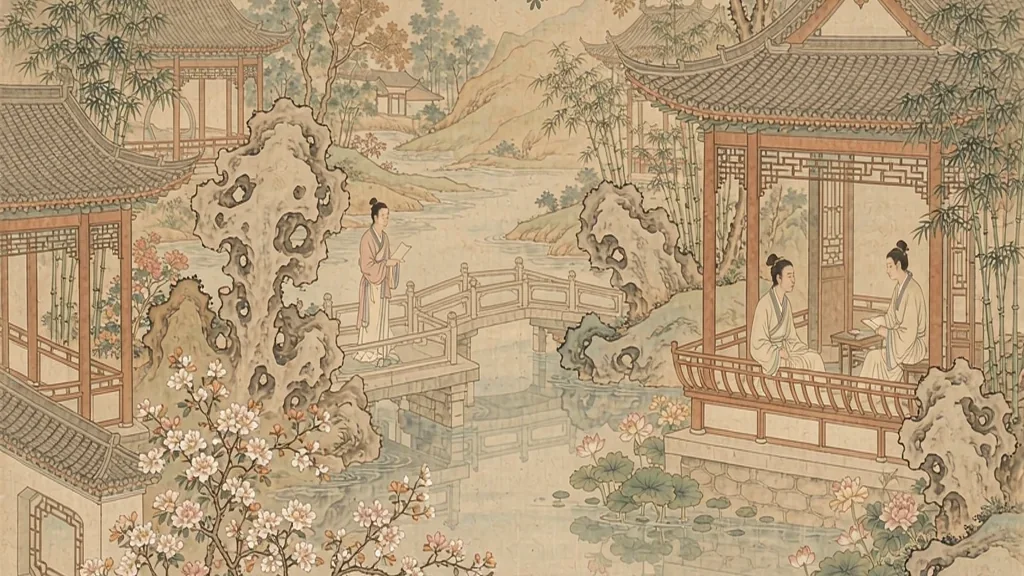
The garden occupies a uniquely central place in the history of Chinese poetry, serving not merely as a physical setting but as a dense symbolic landscape where retreat, memory, friendship, and philosophical reflection converge. From the early folk songs collected in the Shijing to the polished regulated verses of the Tang and the introspective lyrics of the Song, the cultivated garden appears as a recurring stage upon which poets staged their inner lives. Unlike the European tradition in which the garden is often framed as a site of romance or pastoral escape, the Chinese literary garden is intimately tied to the figure of the retired or frustrated official, the seasonal cycle of plants, and the ideal of a harmonized small world that mirrors the order of the cosmos. To read Chinese garden poetry is to enter a space where architecture, botany, and Confucian, Daoist, and Buddhist sensibilities overlap, producing some of the most quietly luminous lines in the entire classical repertoire.
Origins in the Earliest Verse
The association between poetry and the cultivated landscape reaches back to the Shijing, or Book of Songs, whose anonymous folk compositions of the Zhou dynasty already describe enclosed courtyards, planted trees, and the emotional charge of vegetation seen through a window or beyond a wall. Several Shijing poems use the image of the mulberry grove or the enclosed garden to frame longing and separation, establishing a pattern in which plants become outward signs of inward states. The royal hunting parks described in early court hymns represent a more monumental ancestor of the garden, spaces of sovereign display that later poets would domesticate into intimate retreats.
During the Han dynasty the imperial fangzhong and the vast enclosed preserves known as you began to appear in fu rhapsodies, long descriptive prose-poems that catalogued rare plants, artificial hills, and watercourses. These works treated the garden as a microcosm of the empire, a rhetorical claim of universal rule. The shift from imperial park to private scholar's garden, which would define the poetic tradition, gained momentum only in the later medieval period as literati sought refuge from court politics.
The Scholar Garden as a Literary Space
From the Six Dynasties onward, the private garden became the privileged environment of the educated elite, a place where a man of letters could receive friends, drink wine, compose couplets, and ponder his relationship to public service. The garden was conceived as an extension of personality: its rocks, streams, and pavilions were arranged to express the owner's taste and temperament. Poets such as Xie Lingyun in the fourth and fifth centuries helped fashion the convention of the landscape garden poem, in which a walk among rocks and cascades becomes a meditation on the limits of official ambition and the consolations of nature.
By the Tang dynasty the modest urban garden, often no larger than a courtyard, was celebrated as sufficient for the life of the mind. The poet Bai Juyi, who served in a sequence of provincial posts, wrote repeatedly about his humble gardens in Jiangzhou and later Luoyang, treating the planting of a tree or the digging of a pond as moral acts of cultivation. His garden poems helped canonize the idea that worldly retreat did not require vast estates but only a deliberate posture of contentment within a small enclosed world.
The Garden and the Cycle of Seasons
Because the classical garden was planted with species chosen for their seasonal behavior, garden poetry is inseparable from the literature of the four seasons. The peony announces late spring opulence; the lotus dominates the summer pond; the chrysanthemum becomes the autumn emblem of endurance; the plum blossom braves the late winter snow. A poet writing from his garden almost inevitably registers which plant is in flower, and that registration carries an ethical or emotional weather. The falling blossom in particular became one of the most over-determined images in Chinese verse, a figure for the brevity of youth, the无常 of fortune, and the melancholy beauty of transience.
The seasonal garden also supplied the occasion for regulated octave and quatrain composition among friends. A blossoming tree or a first snowfall would prompt a poem circulated to companions, who answered with matching rhymes, so that the garden functioned as a kind of open-air salon where social bonds were renewed through literary exchange. The physical garden and the social practice of poetry were thus mutually constitutive.
Famous Gardens and Their Poets
Certain historical gardens became almost mythical in the poetic imagination. The Suzhou gardens of the Jiangnan region, though many surviving examples postdate the Tang, crystallize the ideal of the scholar garden that poets had long described. The Lushan retreats favored by Bai Juyi and the rustic farmstead of Tao Yuanming, who is often celebrated for his untamed garden and chrysanthemum fence, anchored the topos of the reclusive hortus. In the Song period, Su Shi's writings about his borrowed gardens and improvised pavilions extended the notion that poetic vision could consecrate even a borrowed plot of land.
The Southern Song poet Ye Shaoweng produced perhaps the most quoted garden quatrain in the language, the Visiting a Friend's Garden But Not Being Admitted, in which the locked gate and the overflowing red apricot blossom become a compact lesson in how poetic value escapes enclosure. Such poems turned the garden into a philosophical puzzle about access, possession, and the generous excess of spring.
The Garden as Retreat and Political Allegory
For officials caught in the factional struggles of the capital, the garden offered a sanctioned withdrawal that was at once genuine and coded. To cultivate a garden was to announce one's temporary or permanent retirement from contention, a posture that could protect a man from charges of ambition while permitting continued cultural authority. Many garden poems therefore carry a subdued political undertone: the rejected blossom, the untended weed, the closed gate all gesture toward the poet's exclusion from court favor. The garden is never simply decorative in this tradition; it is a charged site of self-representation.
At the same time, the Daoist and Chan Buddhist currents running through garden poetry reframed the small plot as a training ground for detachment. The monk-poet or the lay devotee might describe weeding or watering as spiritual discipline, and the garden's insistence on growth and decay as a daily sermon on impermanence. The boundary between horticulture and contemplation grew deliberately thin.
Plants as Symbolic Vocabulary
The Chinese garden poem relies on a stable symbolic lexicon of plants, each carrying centuries of accumulated association. The orchid and the bamboo signify integrity and gentlemanly restraint; the pine and the plum withstand adversity; the lotus rises unsullied from mud, a Buddhist figure for purity; the willow marks parting because its drooping branches resemble the gestures of a traveler bidding farewell. A single garden poem could thus operate like a small emblem book, inviting the reader to decode its botany. Mastery of this vocabulary was part of what it meant to be a literate reader of verse.
This symbolic economy also explains why the same few species recur across a thousand years of poetry. The constancy of the garden's plant cast lent the tradition a sense of continuity and conversation, as each new poet alluded, knowingly or not, to the blossoms and branches of his predecessors. The garden was a shared language as much as a place.
Connections to Painting and the Literati Ideal
The garden poem cannot be fully understood apart from the allied arts of painting and the arranged garden itself, which were often designed by the same literati hands that wrote the verses. The Ming dynasty treatise Yuanye by Ji Cheng codified design principles that a poet would recognize from his own lines: concealment and revelation, borrowed scenery, and the cultivation of apparent artlessness. A garden was sometimes composed to be walked like a poem, with sequenced views analogous to the unfolding of stanzas. The famous ideal of poetry painted and painting versified encapsulates this interdependence.
In practice, a scholar might compose a poem inscribed on a garden rock or pavilion plaque, so that the literary and the spatial were physically joined. The garden became a three-dimensional anthology, and the poem became a mobile garden carried in memory. This fusion distinguishes the Chinese garden poem from mere description and explains its durability as a cultural form.
Notable Garden Poems and Their Themes
Among the most enduring garden poems is Wang Wei's sequence on his Wangchuan villa, in which each small locus of the estate receives a quatrain, building a fragmented but coherent portrait of retired contentment. Du Fu's writings from his thatched cottage at Chengdu show the garden in a humbler, more anxious register, where newly planted trees and来访 friends register the poet's precarious shelter during years of war. Li Qingzhao's later lyrics turn the abandoned garden into a theater of grief after her husband's death, proving how the same topos could be bent toward elegy.
The variety of these treatments demonstrates that the garden was a flexible container for nearly every classical emotion. Whether the tone was serene, satirical, erotic, or bereaved, the enclosed planted space supplied the vocabulary through which feeling could be made legible to another reader.
Modern Legacy and Continuing Resonance
The garden poem tradition did not end with the imperial age. Modern Chinese poets, even those writing in vernacular free verse, continue to invoke the courtyard, the chrysanthemum, and the locked gate as shorthand for a contemplative Chinese sensibility. Contemporary preservation of the Suzhou gardens, now recognized by UNESCO, has renewed popular interest in the verses once composed within them, and many sites post bilingual plaques quoting the relevant poems. The garden thus remains a living interface between literature and place, where a visitor can stand inside the very scene a Tang or Song poet described.
In an age of crowded cities, the classical garden poem offers a portable refuge, a reminder that a small deliberate space and a few well-chosen words can constitute a complete world. The endurance of these poems suggests that the human need for an enclosed, cultivated retreat is itself a kind of perennial blossom, returning each season in new tongues.
❓ Frequently Asked Questions
Why is the garden so common in Chinese poetry?
The garden was the privileged space of the educated elite, where retreat, friendship, and reflection converged, making it a natural stage for verse about inner life.
What do plants symbolize in garden poems?
Each species carries centuries of association: bamboo and orchid signal integrity, pine and plum endurance, lotus purity, and willow parting.
How is a garden poem different from a landscape poem?
Garden poems focus on enclosed cultivated spaces tied to retirement and friendship, while landscape poetry often treats grander wild scenery and travel.
Did real gardens inspire specific famous poems?
Yes, Wang Wei's Wangchuan estate, Bai Juyi's courtyards, and Tao Yuanming's chrysanthemum fence all generated enduring verse.
How are gardens and painting connected?
The same literati often designed gardens and wrote or painted, treating a garden as a walkable poem and a poem as a portable garden.
Is the garden poem tradition still alive?
Yes, modern poets still invoke courtyards and blossoms, and preserved Suzhou gardens display bilingual plaques quoting the classical verses.