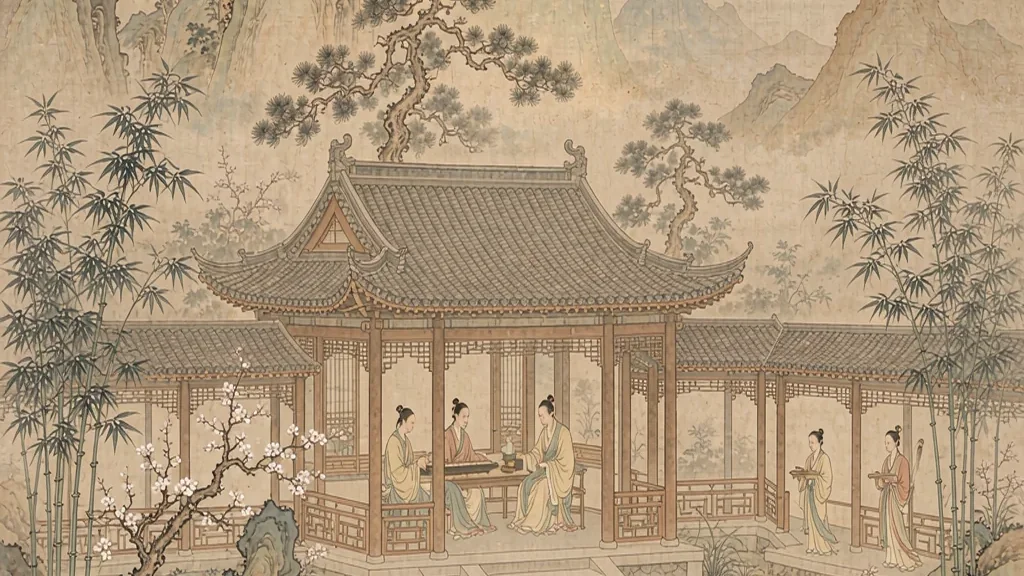
The Chinese tradition holds that poetry and painting are not two arts but one, a belief captured in the saying that they share the same origin and in Su Shi's famous judgment that in the work of Wang Wei there is painting within the poem and poem within the painting. For a thousand years the scholar who wrote a poem was often also the one who held the brush, and the painting was incomplete until a poem had been inscribed upon it in the same flowing hand that signed it. This article explores the union of poetry and painting in China, the theory behind it, the practice of the inscribed picture, the ideal of the amateur gentleman artist, and the ways the two arts taught each other to suggest more than they state.
The Claim of One Origin
The axiom that poetry and painting are of one source rests on a simple observation: both seek to capture a scene or a feeling through a medium that is not the thing itself. The poet uses words to make a mountain appear; the painter uses ink to make a mood appear, and the end is the same, a realized image in the mind. The old saying that a poem is a painting without form and a painting a poem without words states the equivalence plainly, and it underwrote the habit of treating the two as branches of a single craft.
This unity was more than theory. Because the same men practiced both, the arts cross-fertilized constantly. A painter reached for the composition of a poem; a poet reached for the spacing of a picture. The result is a tradition in which to read a landscape poem is to be shown a painting, and to look at a painted scroll is to hear a poem, and the reader moves between the two without noticing the seam.
Su Shi on Wang Wei
The key critical text is Su Shi's remark on Wang Wei, that his poems contain painting and his paintings contain poetry. Su Shi, the great Song polymath, was himself a poet, painter, and calligrapher, and his words fixed Wang Wei as the archetype of the combined artist. The judgment also set a standard: the highest work in either medium should carry the virtue of the other, the poem should be visual, the picture should be literary.
Su Shi's formula shaped criticism for centuries. A painting was praised for being poetic, meaning calm, allusive, and slightly incomplete; a poem was praised for being painterly, meaning clear in its staging of light and distance. The mutual standard pushed both arts toward restraint, because the poetic in painting was exactly what was left unsaid, and the painterly in poetry was exactly what was shown without explaining.
The Inscribed Poem on the Painting
The supreme instance of the union is the inscribed poem, the 题画诗, written directly onto the painting in the artist's or a friend's calligraphy. The verse might name the scene, complete its feeling, or gently argue with the image, and the brush that wrote it became part of the composition. The inscribed picture is therefore a collaboration across time, the painter and the poet often the same person, sometimes two friends, and the poem is not a caption but a fourth element beside ink, paper, and seal.
The placement of the inscription mattered as much as its words. A poem set in the upper void of a landscape joins the mist; a couplet squeezed beside a branch answers the spray. The writer had to think like a composer, balancing text against image so that neither drowned the other. The inscribed poem is thus the art of relationship, the poet adjusting his lines to the space another art had left.
Wang Wei, the Poet Who Painted
Wang Wei is the recurring name in this history because he was both a master of the quiet landscape poem and, by later report, a master of the ink landscape, and because his two outputs share the same still, attentive temper. Whether or not the paintings we attribute to him are authentic, the idea of Wang Wei as the poet-painter governed the tradition: the man who sat among bamboo playing the qin was exactly the man who could leave the mountain unfinished on silk and trust the blank.
His example taught that the same eye serves both arts. To notice the slant of light on a hill is to gather a poem and a picture at once, and the gentleman who cultivated that noticing needed no separate training in either. Wang Wei thus became the patron of the amateur, the proof that sensibility, not technique, is the root of both poetry and painting.
The Three Perfections and the Seal
The union expanded into the ideal of the three perfections, poetry, calligraphy, and painting, often joined by the seal as a fourth. A finished literati work typically carries the poem in the writer's hand, the image in his brush, and the red seal as the stamp of possession and character, so that a single object is also a small self-portrait of a complete man. The seal is not decoration but the signature of a person who could do all three.
This clustering had a social meaning. To present such a work was to display not wealth but cultivation, the proof that one belonged to the class that could write, paint, and sign. The three perfections were therefore a marker of status won by study, and the poem on the painting was the most visible sign of that status, the place where the claims of the hand and the mind met on one surface.
Shared Aesthetics of Suggestion
The deepest bond is the shared taste for suggestion over statement. The painter leaves the paper bare to imply the mist; the poet leaves the feeling unnamed to imply the loss, and both trust the viewer or reader to complete the work. The Chinese arts are built on this confidence in the audience, the belief that the partly said is the more said, and the poem and the picture reinforce each other's restraint.
The principle of leaving white, the 留白, is the technical meeting point. In painting the unpainted ground is the sky, the water, the distance; in poetry the unspoken line is the grief, the awe, the silence. A poet who had also painted knew exactly how much to withhold, because he had practiced the same economy with ink. The two arts trained the same muscle of omission.
What Each Art Can Do
For all the unity, the tradition also knew the limits of each. Painting shows the simultaneous layout of a scene that poetry must unfold in time; poetry names the particular feeling that painting can only hint with a figure's slumped shoulder. Su Shi and others noted that a painting cannot carry the long argument a poem can, while a poem cannot fix the instant a picture freezes. The wise artist used each for its strength and let the other supply what it lacked.
This complementarity is why the inscribed poem developed: the picture gives the place, the poem gives the thought, and together they do what neither does alone. The painting of a lone boat needs the poem to say the loneliness; the poem of a mountain needs the painting to show the height. The two arts are one not because they are identical but because they finish each other, and the best works exploit the gap between them.
The Literati and the Amateur Ideal
The union of poetry and painting was an amateur's ideal. The literati held that the true artist painted and wrote for self-cultivation, not for the market, and that a small ink play done after wine was worth more than a finished professional commission. This stance protected the arts from the charge of craft for hire and kept the poem-painting in the circle of gentlemen. The amateur was, by definition, the man who could also write the verse on his own picture.
The ideal had its blind spots. It could undervalue the trained professional and the decorative, and it sometimes excused weak technique with the claim of lofty intent. Yet it also freed the arts from mere imitation, because the gentleman's goal was expression, not likeness, and the poem on the painting was the license to prefer feeling over fact. The amateur ideal is why so much Chinese painting looks like handwriting with a scene attached.
Poems Made on Paintings
A large body of verse exists whose subject is a painting, from Su Shi's lines on a monk's spring river scroll to the many couplets written on landscapes, birds, and bamboo by later masters. These poem-paintings let the writer compete with the image, completing the fisherman the brush left vague or correcting the mood the colors set. The genre is a kind of dialogue in which words answer paint, and the best examples make the two indistinguishable in effect.
Su Shi's poem on the monk Huichong's late spring river is the classic case, where the verse supplies the warmth the picture cannot, the duck that first feels the water turn gentle, the reed shoots that know the season. The poem does not describe the painting so much as continue it, adding the life the still image lacks. Such works are the practical proof of the one-origin saying, the place where the two arts are literally on the same page.
The Living Union
The bond of poetry and painting persists in modern China, where the inscribed picture is still made, the saying still quoted, and the expectation that a cultivated person can do a little of both still lingers. The forms have changed, but the habit of reading a scene as a poem and writing a poem as a scene survives in the visual culture of the language. The scroll and the stanza remain partners.
What the union finally gives the Chinese arts is a refusal to separate seeing from saying. To look is to compose a line; to write is to lay out a view, and the master moves between them as one act. The poem on the painting is the emblem of this oneness, a small proof that the brush and the word were never, for the Chinese imagination, two different tools but one hand doing one work on the world.
❓ Frequently Asked Questions
Why are poetry and painting linked in China?
Both seek to realize a scene or feeling through a medium, and the saying that they share one origin made them branches of a single craft practiced by the same men.
What did Su Shi say about Wang Wei?
He said Wang Wei's poems contain painting and his paintings contain poetry, fixing Wang Wei as the archetype of the combined artist.
What is an inscribed poem on a painting?
A poem written in calligraphy directly onto the picture, becoming a fourth element that completes or argues with the image.
What are the three perfections?
Poetry, calligraphy, and painting, often joined by the seal, a single object displaying the complete cultivation of a gentleman.
How do the two arts differ?
Painting shows a scene at once that poetry unfolds in time; poetry names a feeling painting can only hint, so each finishes the other.
What is the literati ideal of painting?
The literati held that true art is amateur, made for self-cultivation rather than the market, valuing expression over likeness.