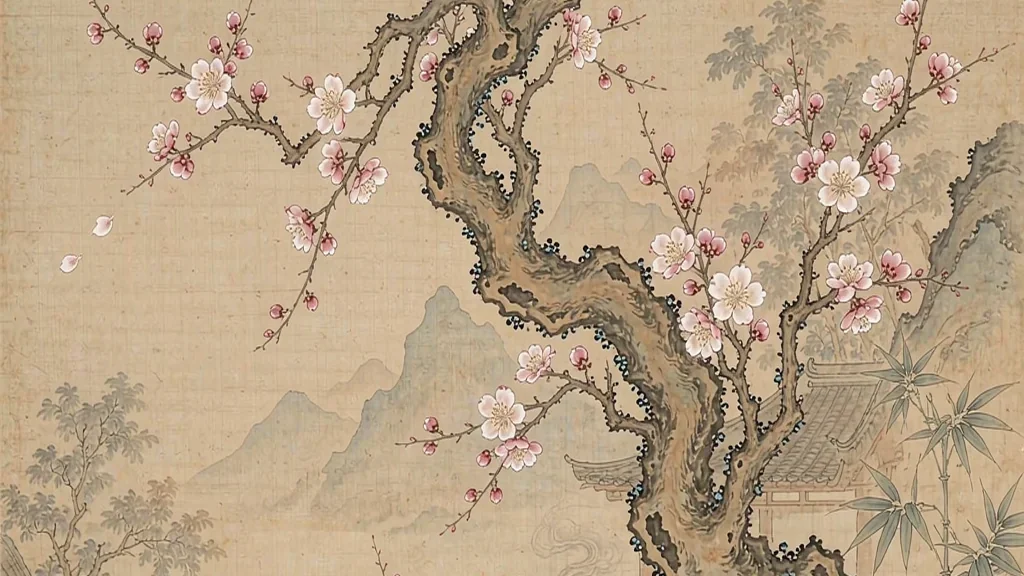
The plum blossom is the first flower of the Chinese year and the hardest, opening in the cold before the snow has gone and therefore earning a place at the head of the floral hierarchy as the emblem of courage that needs no warmth. Where the lotus proves virtue by rising from mud and the chrysanthemum by outlasting frost, the plum proves it by arriving early, blooming in the teeth of winter as if to shame the soft flowers of spring. From the recluse Lin Bu, who called the plum his wife, to the steadfast lyric of Lu You, who said its fragrance survives even when the blossom is crushed to dust, the plum carries the Chinese poet's claim that integrity shows itself precisely when support is absent. This article follows the plum through its major poems, its painters, and its place among the friends of the cold season.
The Blossom Before the Spring
The defining fact of the plum in poetry is its time. It flowers in the last cold, sometimes against snow, so that to write a plum is to write of a bravery the other flowers cannot claim. The southern airs and the later lyrics return to this earliness as a kind of moral precocity: the plum speaks before it is safe, and its white or red against the white snow is the image of a voice raised in a hard season. The poet who favors the plum aligns himself with the early and the lone.
This timing also gives the plum a courtly use. At a New Year gathering the first plum was a token of renewal and of favor hoped for after a cold interval, and poems presented on such occasions used the blossom to hint at loyalty proved through neglect. The flower's calendar, opening when nothing else will, made it the natural figure for the servant who stays useful in the ruler's displeasure.
The Hidden Fragrance and the Snow
The most quoted plum poem is Wang Anshi's quatrain of the few branches in a corner that bloom alone in the cold, and from afar one knows they are not snow because a hidden fragrance comes. The couplet turns on the difference between the visible and the smelled: the blossom looks like snow but betrays itself by scent, and the scent stands for the inner worth that appearance alone cannot show. The poem is a tiny argument for reading beneath the surface, and it is the first plum verse most children learn.
The contrast with snow is the plum's favorite duel. Snow is white but dead; the plum is white and alive, and its faint perfume is the proof of life. Poets returned to this opposition endlessly, using it to say that the true and the false may look alike until you test them by the nose. The hidden fragrance, 暗香, became a fixed phrase for exactly this quiet, unprovable merit.
Lin Bu and the Plum as Wife
The great anecdote of the plum is the life of Lin Bu, a Northern Song recluse of the West Lake who never married and who was said to have taken the plum as his wife and the crane as his son. The story fixes the plum as the companion of the man who has renounced the world, and Lin Bu's own plum poems, with their lines about the slender shadow and the faint scent under the moon, set the standard for the refined, slightly cold beauty the flower should have in verse.
Lin Bu matters because he made the plum the flower of chosen solitude rather than of office. The official used the plum to claim loyalty in neglect; the hermit used it to celebrate a freedom that needed no ruler. The same blossom thus serves two opposite lives, the courtier's patience and the recluse's ease, and the poetry keeps both readings available without deciding between them.
Lu You and the Fragrance That Survives
The Southern Song poet Lu You wrote a famous lyric on the plum in which the flower falls, is trampled into mud, and ground to dust, yet its fragrance stays as before. The image is a defiant answer to persecution: the body of the loyal man may be destroyed by the slanderous crowd, but the scent of his name cannot be. Lu You, who spent a frustrated life urging resistance to the north, loaded the plum with his own unbroken purpose, and the poem became a motto of the unconquerable reputation.
The crushed plum also speaks to the larger Chinese taste for the trace. As with the censer's smoke and the poem's rhyme, the plum's scent is valued because it outlives the visible flower. Lu You's dust is the extreme case, proving that even total destruction leaves the fragrance, and the reader is meant to take the lesson personally, as a charge to outlast one's own ruin.
The Plum in Ink Painting
No flower passed into painting more naturally than the plum, and the ink plum became a distinct genre practiced by gentlemen and professionals alike. The bare branch with a few open buds could be drawn in a few strokes, and the sparseness suited the literati ideal of saying much with little. Painters such as the Song master Yang Wujiu made the ink plum a vehicle of personal feeling, and the custom of inscribing a poem on the picture joined the two arts in one small surface.
The painted plum and the written plum reinforce each other's meaning. The white in the painting is the snow or the paper's ground; the dark strokes are the branch and the resolve. A poem on a plum picture typically points at the very absence the brush has left, completing the work by naming what is not shown. The plum is therefore the meeting point of calligraphy, poetry, and painting, the three perfections in one spray.
The Three Friends of the Cold
The plum belongs to the grouping called the Three Friends of the Winter, the 岁寒三友: pine, bamboo, and plum. These are the plants that stay green or bloom when the rest of the garden fails, and together they stand for the company of the steadfast. A poem on the three friends is a poem about loyalty among the few, the pine for endurance, the bamboo for flexibility, the plum for early courage, and the set let the writer praise a circle of like-minded men.
The grouping also appears in decorative art and on the scholar's objects, so that the three friends presided over the study much as the Four Gentlemen did. To write of them was to declare one's allegiance to the minority who hold in the cold, and the plum, as the only one that flowers, supplied the group its note of active hope against the pine's and bamboo's mere persistence.
The Plum and the Exiled Official
Because the plum blooms in hardship, it became the emblem of the official sent away to a cold post. A poet recalling the plum of his native garden while stationed in the south was using the flower to measure the distance from home and the steadiness of his own character. The plum of the capital and the plum of the exile are the same blossom read in two weathers, and the contrast let the writer state both his loss and his pride.
This exilic plum connects directly to the old Chu ci stance of the wronged servant. The flower proves that virtue does not wait for favorable conditions, and the exiled man, like the plum, is most himself when most deprived. The image is economical and dignified, which is why it recurs across a thousand years of complaint poems that never quite complain.
The Plum as Bride and Beloved
Beyond the recluse and the official, the plum also figures the beloved, especially in the southern lyrics where the white blossom stands for a woman's skin and the fragrance for her presence. The plum branch brought indoors becomes a substitute wife during separation, and the falling petals mark the approach of parting. The flower thus moves between the registers of chastity and desire, serving both the hermit who loves no woman and the lover who loves one too far away.
The dual life is not a contradiction but a sign of how plastic the plum is. Its cold purity can figure the unworldly gentleman or the untouchable beauty, and the poet exploits the overlap, so that a poem apparently about a flower may be, for the knowing reader, about a person. The plum's whiteness is ambiguous on purpose, chaste and erotic at once.
The Plum in the Lyric and the Calendar
In the ci lyric the plum often opens the seasonal sequence, the first sign entered in the poet's diary of the year. A lyricist noting the early bud is also noting the state of his own heart at the year's start, hopeful or wary. The plum's appearance in the music of the banquet and the chamber gave it a social as well as a moral life, and the same flower that figured the hermit also decorated the New Year song.
The calendar role ties the plum to the whole system of seasonal verse, in which each flower marks a month and each month a mood. The plum's January place means it carries the weight of beginnings, and the poet writing it is always, faintly, writing a New Year's resolution in petals, a promise to be early and unbroken through the cold to come.
The Plum's Lasting Cold Courage
The plum remains the flower of resilience in modern Chinese verse and speech, its hidden fragrance still the standard phrase for quiet merit. To call a person an old plum tree is to praise a toughness earned by years, and the blossom against snow is still the image for hope that ignores the weather. The flower's long career shows how a single plant can hold a whole ethics of timing, that the best witness is the one who speaks when no one else will.
What the plum finally gives the poet is the image of virtue as earliness. It does not wait for the warm chorus of spring but opens alone in the cold, and that alone is its argument. The Chinese verse returns to the plum every January because the flower is the yearly proof that integrity is not a group achievement but a single branch blooming in a corner, indifferent to the snow and faithful to its hidden scent.
❓ Frequently Asked Questions
Why is the plum a symbol of courage?
It blooms in the last cold, often against snow, so it figures virtue that appears early and alone, without the support of warm season.
What is Wang Anshi's plum quatrain about?
It says a few branches bloom alone in cold and are known from snow by their hidden fragrance, arguing that true worth shows by scent not sight.
Who took the plum as his wife?
Lin Bu, a Northern Song West Lake recluse who never married and was said to have made the plum his wife and the crane his son.
What does Lu You's plum lyric mean?
Even when the blossom is trampled to dust its fragrance stays, a defiant image of reputation surviving ruin and slander.
What are the Three Friends of Winter?
Pine, bamboo, and plum, the plants that endure or bloom when the garden fails, standing for the company of the steadfast.
How did the plum enter painting?
The ink plum became a genre where a few strokes of a bare branch with buds showed restraint and feeling, often with a poem inscribed.