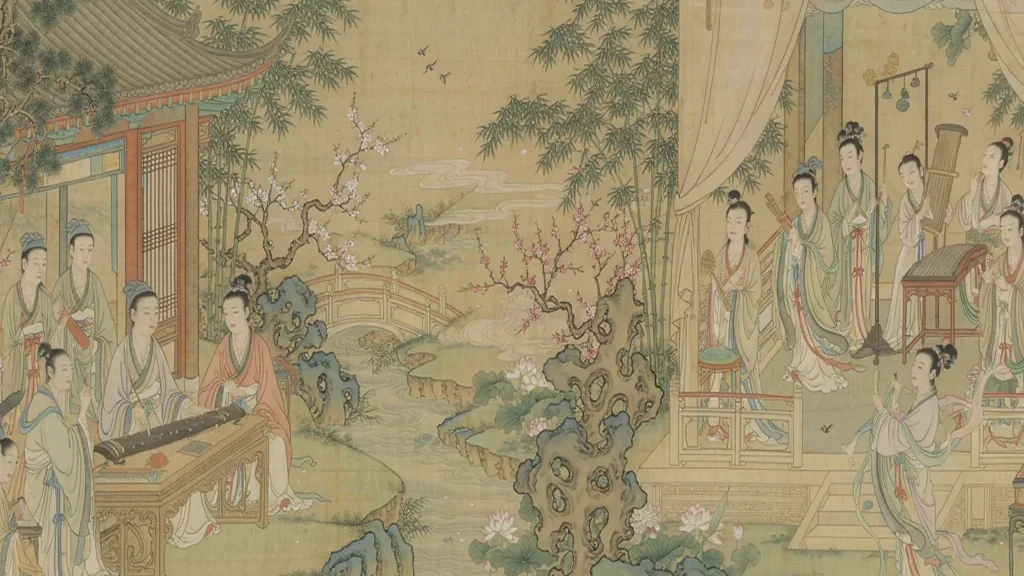
The relationship between Chinese poetry and music is not peripheral but foundational: for most of its long history the Chinese poem was not primarily a silent printed object but a text composed to be sung, chanted, or accompanied by string and wind instruments. The very word shi and the related forms ci and qu each emerged from specific musical contexts, and the disappearance or transformation of tunes left visible traces in prosodic structure. To understand Chinese poetry is therefore to understand a tradition in which meter, tone, and melody were originally entangled, where the line length of a lyric was dictated by the rhythmic requirements of a song, and where the decline of one musical mode could precipitate the birth of a new poetic genre. This essay traces that entangled history from the anonymous dance songs of antiquity to the literate lyricism of the late imperial age.
The Musical Roots of the Book of Songs
The Shijing, or Book of Songs, the oldest extant collection of Chinese poetry, was fundamentally a songbook. Its three hundred and fifteen pieces were grouped by the tradition into the feng (airs or folk songs), the ya (court hymns), and the song (eulogies), categories that originally reflected musical performance contexts rather than purely literary themes. The folk airs were sung by common people at gatherings and courtships; the hymns accompanied aristocratic ritual; the eulogies were performed in ancestral temples. Confucius famously urged that the songs could be summed up by a single phrase about an untroubled mind, but his own tradition also credited music with moral power, claiming that correct music produced orderly society and that corrupted tunes bred disorder.
Early music theory held that the pitch standards, the bells and pitch pipes of the court, governed cosmic and political harmony. When the Lushi Chunqiu and later the Yueji or Record of Music discussed sound, they treated melody as a direct expression of the heart moved by the world. Poetry, in this framework, was the verbal trace of that musical movement, which is why the classical formulation describes song as arising when words are insufficient and is prolonged into melody.
The Yuefu and Court Music Offices
In the Han dynasty the imperial Music Bureau, known as the Yuefu, institutionalized the link between poetry and song. Established in the early Han and expanded under Emperor Wu, the bureau collected folk songs from the regions, composed ceremonial hymns for state rites, and set texts to music performed with drums, pipes, and strings. The ballads gathered by the bureau, many dealing with the hardships of conscript labor, war, and separated lovers, were prized for their directness and became a permanent subgenre called yuefu. Later poets from Cao Cao to Li Bai would imitate yuefu titles and tunes deliberately, reviving ancient song forms centuries after the original melodies were lost.
The survival of yuefu as a poetic mode long after its music vanished shows how thoroughly musical identity was baked into the verse. A poet composing in a yuefu title was consciously echoing a song, even when writing a silent literary text. The form thus preserved a musical memory as a structural skeleton of line lengths and refrains.
The Rise of the Lyric Ci
The ci lyric, which flourished from the late Tang through the Song dynasty, represents the most explicitly musical major genre in Chinese poetry. Each ci was written to a fixed tonal pattern called a cipai or tune title, and the length of lines, their pauses, and their tonal requirements were determined by the demands of an actual melody. Originally, ci were song texts for entertainers in banquet and pleasure quarters, sung to the accompaniment of the flute and the stringed pipa. The tune titles such as Shuidiao Getou or Ru Meng Ling often no longer described the content of the words, having become purely formal labels indicating how the piece should be sung.
Because the tune dictated structure, a single tune title could carry vastly different poems, much as a modern composer's melody can bear many lyric sets. The great Song lyricists, among them Liu Yong, Su Shi, and Li Qingzhao, exploited this tension between fixed musical frame and free emotional content, bending the song form toward high literary art. Su Shi in particular helped elevate ci from entertainment to a serious vehicle for reflection, though he still respected the underlying rhythmic discipline.
The Qu Drama and Northern Songs
In the Yuan dynasty the qu form, associated with northern drama and the musical theater of the period, became a further poetic genre rooted in song. Qu were written to tune patterns drawn from contemporary popular music and opera, often with freer line lengths and the permitted insertion of colloquial exclamations and extra syllables. The sanqu, or non-dramatic lyric qu, allowed poets like Guan Hanqing and Ma Zhiyuan to write witty, colloquial, and often satirical songs that remained performable. The famous closing line of Ma Zhiyuan's tiny octave about the old vine and the lean horse at dusk shows how a song could compress an entire melancholy landscape into a sung moment.
The qu reminds us that the boundary between poetry and musical theater was porous in late imperial China. Many of the most beloved lines were originally aria texts, and their literary survival depends on notation systems and performance manuals that imperfectly preserved the melodies.
Tone, Pitch, and Prosodic Structure
Even when Chinese poetry detached from live music, it retained a musical substratum in its attention to linguistic tone. Classical Chinese is a tonal language, and the regulated verse of the Tang, the lüshi and jueju, required strict alternation of level and oblique tones, a rule that was essentially a transcription of melodic contour into the spoken word. A poet composing an octave had to balance these tones much as a musician balances pitch, and the resulting texture is audible when the poem is chanted. The tone rule is the clearest evidence that prosody in China remained a kind of internalized music.
The level and oblique distinction also explains why translation into non-tonal languages inevitably flattens Chinese verse: the melodic play of the original is lost. Readers of the source language still hear, in regulated poetry, a ghost of the music that shaped it.
Instruments and Poetic Occasion
Certain instruments recur as actors within poems themselves. The qin, a seven-string zither, was the instrument of the gentleman and the hermit, its pure quiet tones suited to solitude and friendship; poems about playing the qin for a single listener or none at all became a topos of refined isolation. The pipa, a pear-shaped lute, appears in narrative poems such as Bai Juyi's Pipa Xing, where a chance encounter with a skilled female musician triggers a meditation on exile and lost fortune. The dizi flute and the konghou harp also punctuate the verse as sounds that mark dawn, parting, or longing.
These instruments were not mere props but participants in the poem's emotional argument. The sound of a particular instrument could summon a region, a season, or a lost companion, proving how thoroughly the musical and the literary were interwoven in the imagination of the poets.
Decline of Tunes and Literary Survival
A recurring pattern in this history is the death of the melody and the afterlife of the text. Tunes that once governed line lengths were forgotten, yet the formal patterns survived as literary conventions, so that later poets composed in the shape of songs they could no longer hear. This produced a curious archive in which structure memorializes music. Scholars of later ages, puzzled by archaic tune titles, compiled massive reference works matching titles to prosodic grids, effectively reconstructing the skeleton of a lost sound world.
The phenomenon invites a larger reflection on orality and textuality. Chinese poetry, despite its deep musical origins, was eventually preserved through writing, and the written form gradually became autonomous. Yet the memory of song never fully disappeared, resurfacing whenever poets deliberately imitated ancient airs or when performers revived old lyrics with new melodies.
Modern Echoes and Reconstruction
In the modern period, as vernacular free verse displaced the tonal and tune-based forms, the explicit musical bond weakened, but it did not vanish. Contemporary composers still set classical poems to new music, and recording artists routinely perform Tang quatrains and Song lyrics as songs, proving the original singability of the texts. Scholars using early notation and oral tradition have even attempted reconstructions of how certain ci or yuefu might have sounded, though such efforts remain speculative given the incomplete evidence.
The endurance of the poem-as-song in popular culture confirms that the Chinese reader has never fully accepted the poem as a silent object. To encounter a Tang quatrain is still, for many, to hum a tune, and the ancient claim that poetry begins where words fail and melody begins remains intuitively true.
❓ Frequently Asked Questions
Was Chinese poetry originally sung?
Yes, the earliest collections like the Book of Songs were songbooks, and forms such as yuefu, ci, and qu all arose from musical performance.
What is a ci tune title?
A cipai is a fixed melodic pattern that determines a lyric's line lengths and tones, surviving as a formal label after the tune was forgotten.
How did tone rules make poetry musical?
Regulated verse required alternating level and oblique tones, giving the spoken line a melodic contour audible in chanting.
Which instruments appear most in poems?
The qin zither, the pipa lute, and the dizi flute recur as emotional actors marking solitude, parting, and longing.
Why did tunes disappear but poems remain?
Written texts outlasted oral melodies, so formal patterns survived as literary conventions even after the songs could no longer be heard.
Is poetry still set to music today?
Yes, contemporary composers and performers continually set classical poems to new music, confirming their original singability.