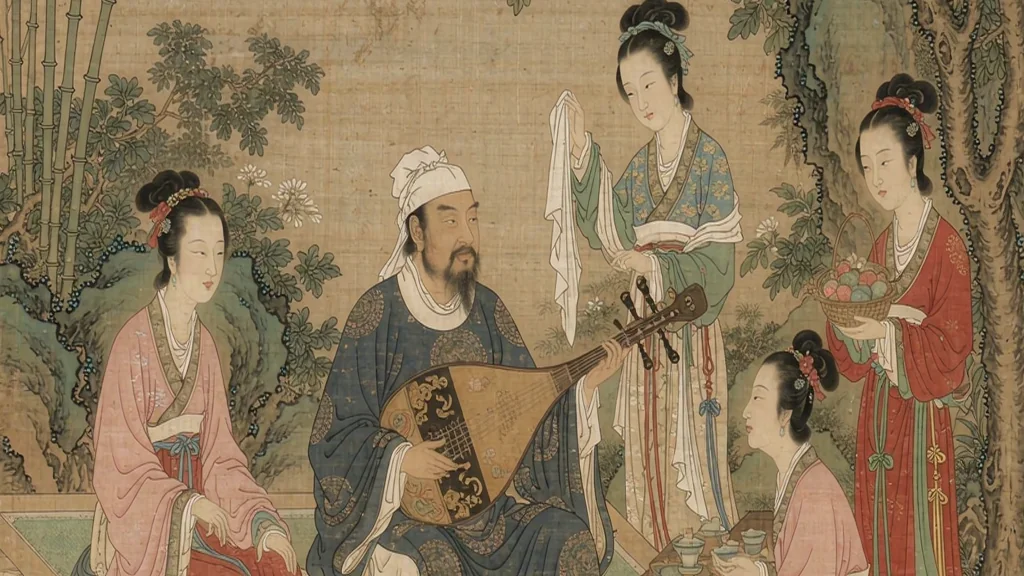
When the Mongols conquered China and established the Yuan dynasty (1271–1368), the entire structure of Chinese society was shaken. The civil service examinations were suspended for decades, and the scholar-official class — the very class that had produced the Tang and Song literary masters — found itself marginalized and powerless. Out of this dislocation emerged a new poetic form: sanqu (散曲), or 'scattered songs,' a vernacular, colloquial lyric form that reflected the tastes of a society in flux. Sanqu was the poetry of the street, the marketplace, and the wine shop — direct, irreverent, often bawdy, and utterly unlike anything that had come before in Chinese literature.
What is Sanqu? Form and Origins
Sanqu is a type of lyric poetry that emerged from the Yuan dramatic tradition (zaju, 杂剧). When playwrights wrote arias for their characters, they used a flexible metrical form set to popular melodies. Eventually, poets began writing these lyrics independently of drama — and sanqu was born. The form has two subtypes: xiaoling (小令, 'short lyric'), a single song to one tune, and santao (散套, 'scattered suite'), a sequence of songs to different tunes joined together as a set.
Unlike ci poetry, which had become increasingly literary and refined, sanqu retained its connection to popular speech. Its language is colloquial, its vocabulary includes slang and dialect words, and its range of subjects includes not only conventional poetic topics but also satire, complaint, social criticism, and even jokes. The sanqu poet speaks not as a scholar-official performing literary decorum but as a common person commenting on life in all its messiness.
Guan Hanqing: The Playwright-Poet
The greatest figure in Yuan drama and sanqu is Guan Hanqing (关汉卿, ca. 1240–1320 CE), a playwright who is said to have been a doctor by profession and a writer by passion. His sanqu are audacious in their frankness. In one famous poem, he writes about his own aging body with grim humor: 'My teeth are gone, can't bite through vegetable roots; / my eyes are dim, can't see the road's ruts; / but there's one old tooth left in my skull — / it's in the way when I want to curse!'
Guan Hanqing's best-known sanqu suite, 'I Will Not Bow Down' (不伏老), is a defiant declaration of the dissident artist's indomitable spirit. He compares himself to a stubborn copper pea that cannot be steamed, pounded, fried, or boiled into submission. The poem's bravado is unmistakable, but beneath it lies the pain of a scholar who has seen his world turned upside down. Guan Hanqing used sanqu to assert that the poet's voice cannot be silenced, even when the poet's class has been destroyed.
Ma Zhiyuan and the Autumn of the Soul
Ma Zhiyuan (马致远, ca. 1250–1321 CE), known as 'the Master of Autumn,' is famous for a single xiaoling that is one of the most celebrated short poems in Chinese literature. To the tune 'Sky-Clear Sand' (天净沙), he writes: 'Withered vines, old trees, evening crows; / small bridge, flowing water, people's houses; / ancient road, west wind, lean horse. / The setting sun goes down — / a heartbroken man at the edge of the world.' Twenty-eight characters, each a concrete image, no verbs until the final line — and the cumulative effect is overwhelming loneliness.
The poem works by pure juxtaposition. The first three lines present nine images, each one stripped of commentary: the dead vine, the old tree, the crow at dusk. These traditional emblems of decay and ending precede the apparently peaceful image of 'small bridge, flowing water, people's houses.' But the traveler on the ancient road cannot enter those houses; he is forever outside, watching the smoke rise from others' chimneys. Ma Zhiyuan's poem became the definitive expression of the traveler's melancholy, and its tune title is still instantly recognizable to any educated Chinese person.
The Sanqu Voice: Satire and Social Critique
One of the sanqu's distinctive contributions to Chinese poetry is its capacity for direct social satire. Yuan dynasty poets used the form to mock corrupt officials, lament social injustice, and criticize the hypocrisy of conventional morality. A famous example is Zhang Yanghao's (张养浩, 1270–1329 CE) 'Hill of Youth' (山坡羊): 'Peaks and mountains, / waves and billows — / the rise and fall of dynasties scattered along the Tong Pass. / I watch, my heart breaks. / The Qin palaces, / the Han palaces — / a thousand years, gone in a single morning. / The people suffer, / the people suffer.' The poem ends with the devastating refrain repeated twice: 'The people suffer.'
Sanqu satire was not limited to politics. Poets mocked religious pretension, literary affectation, and their own failures. The tone is often self-deprecating: the sanqu poet is a figure of fun, a drunkard, a failure, a lazy dreamer. This persona — the 'unworthy scholar' — was a deliberate inversion of the dignified Confucian ideal. By making themselves ridiculous, sanqu poets claimed the freedom to speak truth that their social betters could not.
The Decline and Rediscovery of Sanqu
After the Yuan dynasty, sanqu gradually declined as a major literary form. The Ming and Qing dynasties restored the civil service examinations and the dominance of shi and ci poetry. Sanqu seemed too vulgar, too colloquial, too linked to the 'barbarian' Yuan period for the Confucian establishment. Yet the form never died completely. Later poets occasionally turned to sanqu for its satirical energy, and the form influenced the development of vernacular literature and drama.
In the twentieth century, sanqu was rediscovered by Chinese literary historians who appreciated its social realism and its connection to popular speech. The May Fourth reformers, who were themselves seeking to break away from classical forms, found in sanqu a precedent for a vernacular poetry that was not ashamed of being direct, funny, and politically engaged. Today, sanqu is studied as a vital part of the Chinese literary heritage, a reminder that Chinese poetry has always had room for the irreverent, the colloquial, and the unashamedly personal.
The Qupai System: Tunes as Templates
Every sanqu is headed by a qupai, or tune title, that fixes its meter, line lengths, and pauses, much as a cipai does for ci. A poet chose a tune whose mood matched the subject, then filled its pattern with new words. Because many tunes came from the northern and southern drama of the day, the sanqu singer could perform a lyric the public already knew by ear. The system allowed enormous freedom of language while keeping a clear musical skeleton. Scholars later catalogued hundreds of these tune titles, and the same qupai could carry a love lyric, a joke, or a bitter satire, proving that form and feeling were separate layers in Yuan song. Because the tunes were shared across poems, a single qupai became an open form that hundreds of writers could answer in turn, like a musical prompt passed from hand to hand.
Theater and Sanqu: The Zaju Connection
Sanqu was born inside the zaju, the Yuan northern drama in which actors sang arias between spoken scenes. Playwrights such as Guan Hanqing wrote those arias as sanqu, and only later did poets detach the lyrics from the plays and compose them on their own. The bond shows in the form's performative energy: sanqu expects a voice, a tune, and an audience, not silent reading. Even when printed, a sanqu reads like a script for performance, with its abrupt shifts and spoken asides. This theatrical DNA is why the form feels so alive and why it flourished in the same circles that produced the great Yuan dramas. Guan Hanqing, the towering playwright of the age, filled his works with sanqu arias so vivid that they survive as poetry in their own right. By the late Yuan the separation of aria from stage was so complete that writers spoke of 'scattered tunes' as a genre apart, which is precisely what the name sanqu means.
Sanqu's Echo in the Vernacular Tradition
Though sanqu faded as high literature, its spirit fed later Chinese writing. The Ming and Qing novel and drama kept its colloquial directness and its taste for satire, and the May Fourth reformers of the twentieth century admired its vernacular courage. A sanqu poet's willingness to write in the language people actually spoke, and to mock the powerful, became a precedent for modern free verse. Today the form is studied as a link between classical poetry and the living speech of ordinary Chinese. Its lesson, that a poem can be funny, plain, and politically sharp at once, has never stopped mattering. Folk singers in teahouses kept the melodies alive even after the literate world turned away, so the tunes never fully died. Modern composers have reset old sanqu texts to new music, reminding listeners that the form was song before it was scripture, and that its plain speech still carries a charge.
❓ Frequently Asked Questions
📝 Chinese Vocabulary
散曲 — : Sanqu; scattered songs of the Yuan dynasty
小令 — : Xiaoling; short sanqu lyric
关汉卿 — : Guan Hanqing; Yuan playwright and sanqu master
马致远 — : Ma Zhiyuan; Yuan poet famed for autumn-themed sanqu
散套 — : Santao; a sanqu suite linking several tunes into one long performance
张养浩 — : Zhang Yanghao; Yuan poet and official famed for his satirical sanqu on dynastic rise and fall
山坡羊 — : Shanpo Yang; a popular sanqu tune title used for reflective and satirical lyrics
杂剧 — : Zaju; the Yuan dramatic form from which sanqu arias developed
🎉 Fun Facts
- Ma Zhiyuan's 'Sky-Clear Sand: Autumn Thoughts' is the most famous quatrain-like poem of the Yuan dynasty, often memorized alongside Tang masterpieces.
- Sanqu was performed by singers in teahouses and entertainment districts — it was the 'pop music' of the Yuan dynasty.
- Guan Hanqing's best known play, 'The Injustice to Dou E' (窦娥冤), is still performed in Chinese opera today.
- A sanqu suite, or santao, could chain many different tunes into a single long performance, like a song cycle.
- The Mongol rulers suspended the civil examinations for nearly forty years, pushing many gifted scholars toward theater and sanqu instead of office.
- Zhang Yanghao's 'Tong Pass' sanqu ends by repeating 'the people suffer' twice, and the line is still quoted in China today.