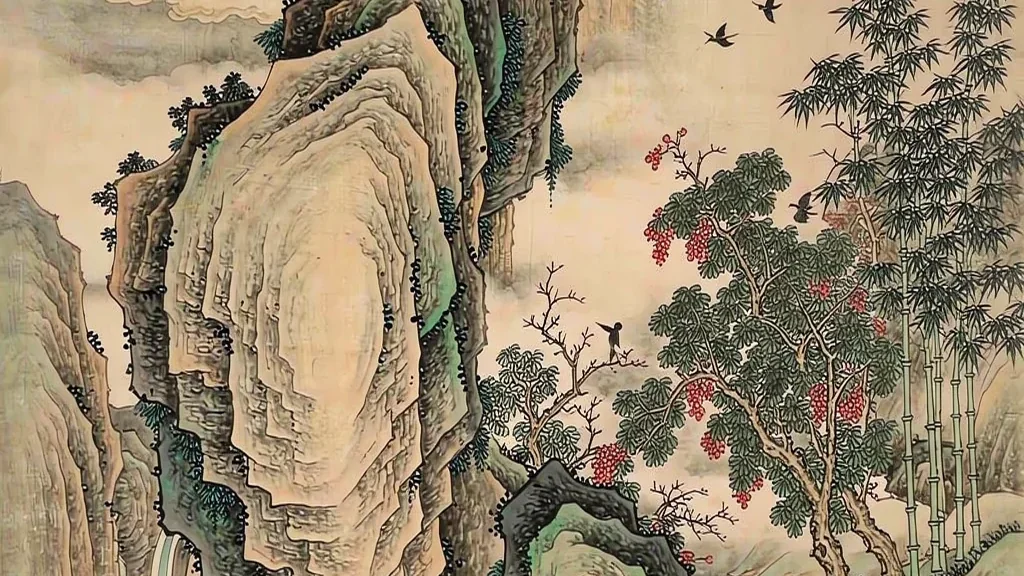
When the great Tang dynasty collapsed and the Song dynasty rose to replace it, Chinese poetry found a new voice. The shi forms — gutishi and jintishi alike — had been the dominant mode for centuries, but as the Tang faded into memory, poets began turning to a more flexible, more intimate, more musical form: the ci (词), or lyric poetry. Written to fit existing melodies, with lines of irregular length that followed the contours of a tune rather than a fixed meter, the ci opened up possibilities of expression that the regulated verse had never allowed. It was poetry for singing, poetry for the boudoir and the banquet hall, poetry that could be tender, playful, erotic, or sorrowful — and it produced some of the most beloved poems in all of Chinese literature.
From Music to Text: The Origins of Ci
The ci originated during the Tang dynasty as song lyrics written to popular tunes from Central Asia. The name ci (词) simply means 'words' — words for a melody. Early ci were sung by courtesans and entertainers in the pleasure quarters of Chang'an and Luoyang, and they dealt with conventional themes of love, parting, and the beauty of ladies. The form was considered light entertainment, not serious literature. No respectable scholar-official would admit to writing ci.
But the form proved irresistible. Leading Tang poets like Li Bai, Bai Juyi, and Liu Yuxi tried their hand at ci, though most of their early ci survive only in doubtful attributions. The form truly flourished during the Five Dynasties period (907–960 CE), when the court of the Southern Tang kingdom — especially the ruler Li Yu (李煜, 937–978 CE) — produced some of the earliest masterpieces of ci poetry. Li Yu's fall from emperor to prisoner gave his poems a poignancy that transcended their courtly origins.
The Tune Titles and Their Fixed Patterns
Every ci poem is written to a specific tune title (词牌, cipai), such as 'Silk-Washing Stream' (浣溪沙), 'Dreamlike Song' (如梦令), or 'Beautiful Lady Yu' (虞美人). Each tune title has a fixed pattern of line lengths and rhyme scheme, derived from the original melody. Some patterns have as few as sixteen characters; the longest have over two hundred. The poet chooses a tune title and then composes new words to fit its pattern.
The relationship between words and music gradually changed. Over time, the original melodies were lost, and ci became a purely literary form — but the tune titles remained, and the patterns they imposed continued to challenge poets. Writing ci meant working within a predetermined rhythmic structure that was completely different from the symmetrical eight-line lüshi. The irregular line lengths — a line of three characters followed by a line of nine, a sudden shift from seven to four — gave ci its characteristic sinuous, conversational quality.
The Wanyue and Haofang Schools
Chinese critics traditionally divide ci into two stylistic schools: the wanyue (婉约, 'graceful and restrained') school, which prizes subtlety, elegance, and emotional indirection; and the haofang (豪放, 'bold and unrestrained') school, which favors expansive gestures, heroic themes, and unguarded emotion. The wanyue school, centered on poets like Li Qingzhao (李清照, 1084–1155 CE) and Liu Yong (柳永, 987–1053 CE), is the older and more orthodox tradition. Its poems are often set in boudoirs or gardens, spoken in a female voice, and filled with images of spring flowers, autumn moons, and the quiet anguish of separation.
The haofang school, associated above all with Su Shi (苏轼, 1037–1101 CE) and Xin Qiji (辛弃疾, 1140–1207 CE), broke the conventions by writing ci about history, politics, philosophy, and heroic ambition. Su Shi declared that ci should 'express the full range of human experience,' and he filled his poems with mountains and rivers, wine and friendship, laughter and tears. Xin Qiji, a military commander who never achieved his political ambitions, poured his frustrated heroism into ci that roar with energy and lament. The wanyue-haofang distinction is not absolute — many poets wrote in both styles — but it remains a useful way of understanding the range of ci poetry.
Li Qingzhao: The First Lady of Ci
Li Qingzhao (李清照) is the most famous female poet in Chinese history, and her ci are among the most personal and emotionally powerful in the language. She began writing as a young woman in a cultivated family, celebrated her happy marriage to the scholar Zhao Mingcheng, and then endured the trauma of the Jin invasion of 1127, which forced her into flight and cost her husband his life. Her ci are often divided into a 'happy period' — bright, playful poems of garden life and young love — and a 'sad period' — poems of exile, widowhood, and bitter memory.
One of her most famous ci, to the tune 'Slow, Slow Song' (声声慢), begins with a cascade of fourteen monosyllabic characters: 'Search, search; seek, seek; / chill, chill; / sad, sad; / pain, pain.' No English translation can reproduce the effect of these syllables in Chinese, which capture the physical and emotional sensation of bereavement with an immediacy that still takes the breath away. Li Qingzhao's technical brilliance — her mastery of sound effects, her ability to use colloquial language within strict patterns — and her unflinching self-revelation have made her the most beloved woman poet in Chinese history.
Su Shi and the Expansion of Ci
Su Shi (苏轼), also known as Su Dongpo, transformed ci from a minor genre into a vehicle for the full range of poetic expression. His famous 'Prelude to Water Melody' (水调歌头) — written on the Mid-Autumn Festival when he was drunk and missing his brother — asks the moon: 'When will the bright moon appear? / I raise my cup and ask the blue sky.' The poem moves from celestial speculation to earthly affection, from the desire to escape the world to the acceptance of human limitation. It is one of the most beloved poems in the Chinese language.
Su Shi's ci broke formal boundaries as well. He introduced prose vocabulary and philosophical arguments into a genre that had been limited to lyrical emotion. He wrote ci about historical battles, about fishing, about dreaming of his dead wife, about the absurdity of official life. His contemporary critics complained that his ci did not sound like ci — that they were too rough, too unmusical. But later generations recognized that Su Shi had not destroyed the ci form but expanded it, proving that it could contain the same range as the older shi poetry.
The Legacy of Ci
The ci continued to be written through the Yuan, Ming, and Qing dynasties, though it gradually lost its connection to music. Some Qing dynasty poets, like the early Qing master Nalan Xingde (纳兰性德, 1655–1685 CE), revived the wanyue tradition with fresh intensity. Nalan's ci — melancholy, elegant, and deeply personal — have attracted a large following in contemporary China, where he is often compared to Li Yu for his tragic sensibility and verbal delicacy.
In the twentieth century, ci faced the same challenges as other classical forms. Yet it proved remarkably adaptable. Today, ci remains a living form. Online communities dedicated to ci composition attract thousands of members, and the tune titles of the Song masters continue to generate new poetic utterances. The ci, born as entertainment for courtesans, has proven itself one of the most durable and flexible forms in Chinese literary history.
The Southern Tang Cradle of Ci
Although ci traces back to Tang tunes, the form reached artistic maturity in the brief, troubled Five Dynasties period, above all at the court of the Southern Tang. There the ruler Li Yu and his circle wrote ci of unprecedented subtlety, and Li Yu's own fall, from emperor to captive of the Song, turned light court lyrics into poems of devastating personal loss. His later works, written in confinement, trade ornament for naked grief and showed that ci could carry the weight of tragedy, not just flirtation. This southern, late-tenth-century moment matters because it proved the form's range before the Song masters expanded it further. The Southern Tang thus stands as the cradle where ci grew from entertainment into art, a small kingdom whose music outlived its politics and seeded the great Song flowering that followed.
When the Tunes Were Lost
A curious fate befell ci: the melodies that gave it birth gradually disappeared, yet the form thrived. As the original songs faded from performance, poets kept the tune titles and their fixed patterns of line length and rhyme, treating them as purely literary scaffolds rather than musical scores. A writer choosing Silk-Washing Stream or Beautiful Lady Yu was obeying a rhythmic skeleton with no sound attached, composing silent songs. This separation from music freed ci to become a written art of great refinement, but it also changed how the poems worked, the irregular lines now please the eye and the inner ear rather than the voice. The lost tunes are why modern ci is read, not sung, even though every pattern still remembers a melody that once carried it.
❓ Frequently Asked Questions
📝 Chinese Vocabulary
词 — : Lyric poetry; verse written to fixed melodic patterns
词牌 — : Tune title; the name of the melody pattern for a ci poem
婉约 — : Graceful and restrained style of ci poetry
豪放 — : Bold and unrestrained style of ci poetry
李清照 — : Li Qingzhao; China's most famous female poet of ci
苏轼 — : Su Shi, the poet who expanded ci into bold, wide-ranging subjects.
李煜 — : Li Yu, the last ruler of Southern Tang whose prison poems deepened ci.
声声慢 — : Slow, Slow Song, the tune of Li Qingzhao's famous bereavement poem.
🎉 Fun Facts
- Li Qingzhao is one of the few Chinese poets whose biography is as well known as her verse — her tragic life story has been adapted into films and television dramas.
- There are over 800 documented tune titles (cipai) in the ci tradition, though only about 100 were commonly used.
- Su Shi wrote his famous Mid-Autumn ci in 1076 CE while serving as governor of Mizhou. He was drunk when he wrote it — or so he claims in the preface.
- The ci began as entertainment for courtesans in Tang pleasure quarters before scholars embraced it as serious art.
- When the original tunes were lost, ci survived as a purely literary pattern, yet the tune titles still dictated line lengths and rhymes.
- Li Yu, the defeated ruler of Southern Tang, turned the ci from courtly play into profound personal lament after he was captured.