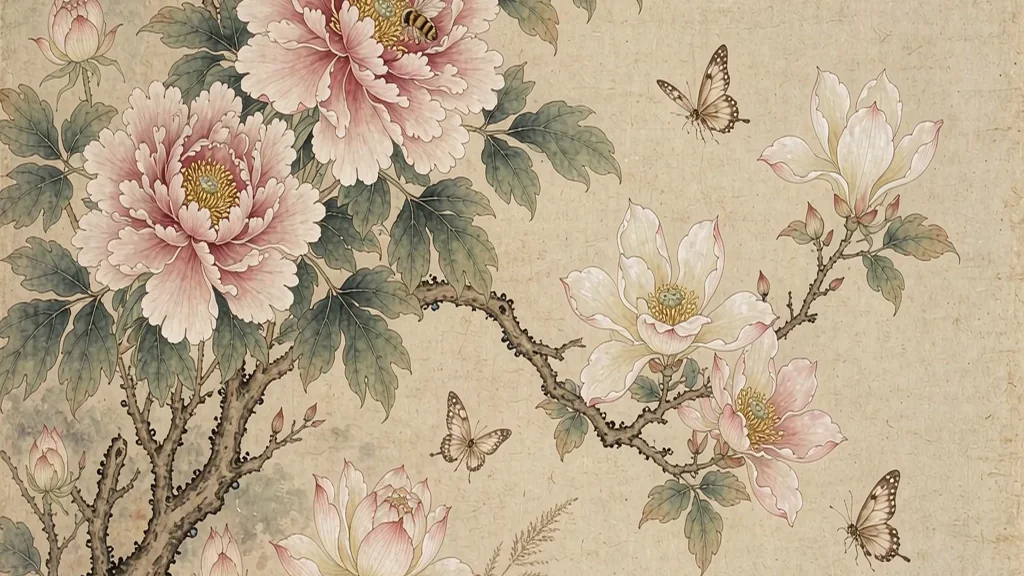
Flowers are among the oldest and most crowded subjects in Chinese poetry, a language within the language in which dynasties of writers lodged their ideas about virtue, beauty, time, and loss. Where a Western poet might reach for the rose, the Chinese lyricist moved among plum, orchid, chrysanthemum, lotus, peony, and a host of lesser blossoms, each with its own season, its own moral coloring, and its own convention of comparison. To read a flower in a Chinese poem is rarely to read a flower only; it is to read a judgment about the person who favors it, the season that frames it, and the transience that threatens it. This article surveys the major flowers of the Chinese poetic tradition, the symbolic system they formed, and the ways poets used blossom and withering to think about the brief and precious life of feeling.
The Flower as Moral Emblem
The single most important habit of Chinese flower poetry is the habit of reading character into the plant. A flower is chosen not for prettiness alone but for the lesson its growth seems to teach. The plum blooms in snow and so figures courage; the chrysanthemum resists frost and so figures retirement; the lotus rises from mud and so figures uncorrupted virtue; the orchid grows in hidden valleys and so figures the unworldly gentleman. This is not casual metaphor but a shared code, learned from childhood, that lets a poem compare a friend to a flower and be understood as a precise ethical statement.
The code hardened into the grouping known as the Four Gentlemen, the 四君子: plum, orchid, bamboo, and chrysanthemum. Though bamboo is not a flower, the set shows how thoroughly the plant world was moralized, and how a poet could be praised or blamed by the simple choice of which bloom to cultivate. To write a chrysanthemum was to ally oneself with Tao Yuanming and the life of withdrawal; to write a peony was, by contrast, to risk the charge of worldliness.
The Book of Songs and the First Flowers
The 诗经 already uses flowers as tokens of affection and of the passing year. Its singers compare women to blossoms, gather flowers as excuses for meeting, and note the peach in full bloom as a figure for a bride's fertility and beauty. The famous line about the peach tree young and its flowers bright is the ancestor of every later poem that ties a woman's marriage to a flowering tree. These early uses are earthly and cheerful, concerned with matching, harvest, and the body, rather than with the austere virtue of later ages.
What the 诗经 establishes is the principle that the plant world is a vocabulary for human relations. The folk poets did not yet sort flowers into a moral hierarchy; they simply reached for whatever was in season and let the blossom carry the feeling. Later centuries imposed doctrine on this inherited instinct, but the instinct itself, that flowers speak for people, is as old as Chinese verse.
The Peach Blossom and the Hidden Land
The peach blossom acquired a unique narrative role through the tale of the fisherman who wandered into a grove of blooming peaches and found a hidden community untouched by the troubles of the world. This story, fixed in prose by Tao Yuanming, became a perennial subject for poetry: the peach stream marks the threshold of utopia, and the falling petals trace the path that the seeker can never quite find again. The flower here is not a moral emblem but a sign of a lost possibility, a paradise that opens only by accident.
Poets returning to the peach blossom spring meditate on the cruelty of memory, that we can visit the happy place once and then spend a life trying to return. The drifting petals on the water became an image of opportunity slipping past, and the peach grove joined the willow and the lotus as a plant loaded with the whole weight of absence and desire.
The Orchid and the Hidden Gentleman
The orchid, especially the autumn orchid of the south, was elevated by Qu Yuan and the 楚辞 into the flower of the loyal but rejected servant of the state. Growing unseen in a empty valley, the orchid figures the gentleman whose worth is not recognized by his age. Confucius himself was said to have compared his own unrecognized virtue to a orchid blooming alone, and the comparison gave later officials a dignified way to lament neglect without complaint.
The orchid's fragrance, which travels without being seen, made it a natural figure for influence and reputation that outrun the person. A poet retiring in disgrace could plant orchids and claim that, like the flower, his name would be carried on the wind regardless of office. The orchid thus solved a problem for the Chinese literatus: how to assert worth while appearing to renounce it.
The Chrysanthemum and the Recluse
No flower is more tied to retirement than the chrysanthemum, and no retirement is more famous than that of Tao Yuanming, who is said to have loved the flower above all and to have gathered it by his eastern fence while the southern mountain looked on. The line about picking chrysanthemums and gazing at the distant hills became the motto of the leisure life, quoted by every later poet who wished to signal that he had chosen the garden over the court.
The chrysanthemum blooms late, holding out against the first frosts, and this hardiness let it stand for the steadfastness of the man who will not bend to power. Yet it is also a flower of ease and wine, the companion of the idle afternoon, so that to write a chrysanthemum was to claim both principle and pleasure. The flower sits at the exact intersection of the moral and the sensual that Chinese floral poetry loved.
The Peony and the Taste for Splendor
The peony, the flower of riches and honor, occupied the opposite pole from the orchid and the chrysanthemum. Luoyang was celebrated for its peonies, and Tang poets wrote of the city's flower feasts as spectacles of wealth and imperial favor. The peony could be praised frankly for splendor, or blamed, by austere writers, as the emblem of a decadent taste for show. Its very popularity made it suspect to the morally serious, who preferred the lotus or the plum.
Li Bai wrote peony lyrics for the court in which the flower and the emperor's favorite beauty are made to mirror each other, the blossom standing in for a face. These poems show the peony at its most worldly, a flower of the palace and the banquet. The contrast between the peony of the capital and the chrysanthemum of the cottage is one of the deepest structures in Chinese flower poetry, a class distinction written in petals.
Flowers and the Beauty of Women
Beyond doctrine, flowers supplied the standard vocabulary for praising and mourning women. A face is a flower, a crowd of palace ladies is a garden in spring, and the early death of a beloved is a blossom cut by frost. The comparison cuts both ways: just as women are likened to flowers, flowers are adorned with feminine names and biographies, so that a peony has a temperament and a plum a pride. The court poetry of the southern dynasties refined this into an art of exquisite surface, where the flower and the courtesan are almost impossible to tell apart.
This interchange fed a current of sadness, because the flower's brevity is also the woman's. The poem that opens with a beautiful blossom usually closes with its falling, and the fall stands for the passing of youth, the end of favor, or the emptiness of the pleasure quarter at dawn. The flower thus became the chief instrument for what might be called the poetry of vanity, the reminder that all show is brief.
Flowers and the Cycle of the Year
Because each major flower owns a season, the sequence of blossoms became a calendar of feeling. Plum opens the year in cold, peach and peony fill the warm middle, lotus rules the height of summer, chrysanthemum closes the autumn, and the bare branches of winter return the poet to patience. A writer could date a mood by the flower in view, and anthologies were sometimes arranged by season so that the reader moved through the year in verse as in a garden.
The seasonal system also trained poets in restraint. To write of the plum in midsummer would break the contract with the reader, who expected each flower in its time. The discipline of matching flower to season is part of the larger classical discipline of fitting feeling to occasion, and the flower calendar is one of the ways Chinese poetry taught its writers to be temperate and exact.
Flower Festivals and Social Verse
Some flowers anchored public holidays that generated their own poetry. The double ninth, falling in the ninth month, was a chrysanthemum festival of climbing and wine; the spring outings of the third day gathered people among new blossoms. Poems written for these occasions mix description with the sociable duty of matching a friend's rhyme, so that the flower is at once a sight and a pretext for the game of verse. The social flower poem shows the plant doing communal work, binding a circle of friends in shared form.
Even in festival verse the underlying seriousness shows. The double ninth poem often admits a note of mortality, the climbers aware that they climb toward the cold, and the chrysanthemum cup is raised against time. The flower festival is therefore never merely merry; it is a merry acknowledgment of brevity, and the blossom is the agreed symbol by which a whole society agrees to be briefly sad together.
The Flower in Later Lyric and Painting
In the Song and Yuan the flower passed fully into the lyric and the painted album, where a single branch could carry a whole argument about integrity or transience. Li Qingzhao and other lyricists used falling blossoms to mark the inward weather of grief, while painters such as those of the literati school treated the plum or orchid as a self-portrait in ink. The flower became the meeting point of poetry, painting, and calligraphy, the three arts combining on one surface.
In the end the Chinese flower poem is less about botany than about attention. To dwell on a blossom is to practice the virtue of noticing, and to note its passing is to accept the condition of life. The long conversation among poets about which flower is best is finally a conversation about what kind of person one wishes to be, and the garden of Chinese verse is planted with those choices.
❓ Frequently Asked Questions
Why do Chinese poems treat flowers as moral emblems?
Each blossom's season and growth were read as character: plum for courage, chrysanthemum for retirement, lotus for purity, orchid for the hidden gentleman.
What are the Four Gentlemen?
The Four Gentlemen are plum, orchid, bamboo, and chrysanthemum, a set of plants moralized as models of the principled person.
Which flower stands for the recluse?
The chrysanthemum, fixed by Tao Yuanming's image of picking it by the eastern fence while gazing at the southern hills.
What does the peach blossom symbolize?
Beyond the bride in the Book of Songs, the peach grove marks the lost utopia of the fisherman who finds a hidden world he cannot return to.
Why is the peony associated with splendor?
Luoyang's peony feasts made it the flower of wealth and honor, prized by the court yet distrusted by morally austere writers.
How do flowers mark the seasons in poetry?
Plum opens the cold year, peach and peony fill spring, lotus rules summer, chrysanthemum closes autumn, letting poets date mood by bloom.