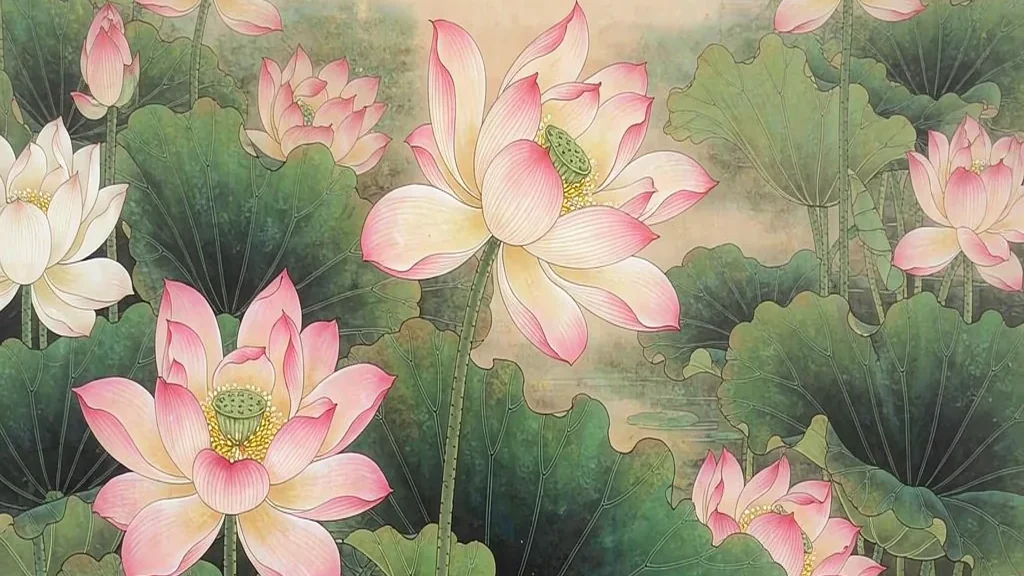
The lotus has occupied a uniquely luminous place in Chinese poetry for more than two thousand years, serving as a sustained metaphor for moral purity, religious awakening, feminine beauty, and the bittersweet passage of summer. Growing from mud yet opening immaculate above the water, the flower offered classical poets a perfect image through which to assert that integrity survives contact with a corrupt world. From the anonymous singers of the 诗经 to the metaphysical verses of the Song dynasty, the lotus recurs as a token of quiet virtue and of longing, its punning sound linking it to love and to the solitary integrity of the rejected official. This article traces the lotus through the major centuries of Chinese verse, the key poems that fixed its symbolism, and the cultural habits of reading and writing that kept the flower blooming on the Chinese page.
The Lotus in the Book of Songs
The earliest surviving Chinese poetry already treats the lotus as a plant entwined with courtship and desire. In the 诗经, the anonymous folk songs collected and edited across the early first millennium before the common era, the lotus appears among the water plants gathered by young men and women during seasonal outings. These songs are not allegories of Confucian virtue but lively records of riverine labor and flirtation, and the lotus is woven into that warm, earthly texture. The flower's place in the water margins made it a natural companion to the scenes of gathering reeds, rushes, and lotus seeds that structure many of the southern airs.
What matters for later poetry is that the 诗经 established the lotus as a plant of the boundary between land and water, a zone of meeting and parting. That spatial imagery persisted: the lotus pond became a place where lovers meet and where the poet sits apart from the court. The seeds and roots gathered in those early songs also anticipate the later poetic habit of reading the lotus as something to be possessed, consumed, and remembered, a tangible token of an absent person.
The Pun Between Lotus and Love
A central thread in the reception of the lotus is phonetic. The word for lotus, 莲 (lián), is a near homophone of 怜 (lián), meaning to pity, to cherish, or to love. Across the medieval yuefu ballads and the love poems of the southern courts, this pun allowed poets to write outwardly about gathering lotus while inwardly voicing tenderness. A line that seems merely to describe plucking a lotus pod can therefore carry a confidential charge of affection, and readers trained in the convention heard the second meaning automatically.
This wordplay is especially dense in the 西洲曲, a long southern lyric in which a woman moves through the seasons thinking of her distant lover, and in the many short yuefu on the theme of lotus gathering. The convention demonstrates how Chinese poetry could be at once public and private: the surface describes a harmless pastoral act, while the pun transmits feeling that courtly decorum might otherwise suppress. The lotus thus became a coded language of love long before it became a symbol of the sage.
Qu Yuan and the Lotus as Integrity
The transformation of the lotus into an emblem of moral incorruptibility is bound up with the memory of Qu Yuan, the wrongly exiled poet-official of the state of Chu. In the 离骚 and related Chu ci poems, the speaker clothes himself in fragrant plants and flowers to mark his separation from a foul court. Although Qu Yuan's preferred plants are orchids and mugwort, the underlying gesture of using aquatic and fragrant vegetation to figure integrity shaped every later flower poem, the lotus included.
Medieval and later poets who compared themselves to the lotus rising clean from mud were heirs to this Chu ci stance. The lotus let them say, without crude complaint, that they had been slandered and removed yet remained unsullied. The image is economical: a single flower condenses a whole autobiography of service, betrayal, and self-possession. It is no accident that the lotus became the favorite flower of officials who had fallen from favor and retired to the riverside.
Zhou Dunyi and the Essay on the Love of the Lotus
The single most influential prose statement on the lotus is Zhou Dunyi's 爱莲说, the short essay of the Northern Song that ranks the flower above the peony, beloved of the worldly, and above the chrysanthemum, cherished by the recluse. Zhou's famous line declares that the lotus is loved by few among gentlemen because it emerges from silt yet is not stained, washes in clear ripples yet is not flirtatious. This sentence became a fixed definition, quoted by poets and painters for the next millennium whenever they wished to name the lotus as the flower of the principled man.
The essay matters for poetry because it supplied a compact theology of the flower that verse could assume rather than argue. After Zhou Dunyi, a poet could simply mention the lotus and expect the reader to supply the whole apparatus of moral reading. The essay also fixed a contrastive system, peony for wealth, chrysanthemum for withdrawal, lotus for engaged yet uncorrupted virtue, that organized countless later comparisons among flowers and among people.
Yang Wanli and the Summer Pond
The Southern Song poet Yang Wanli wrote some of the most celebrated lotus lines in the language, above all the couplet from his poem on departing the Jingci Temple at dawn, in which he says the lotus leaves stretch to the sky in endless green and the lotus flowers against the sun are a red unlike any other. These lines are prized for their sheer visual amplitude, the way they enlarge a familiar temple pond into a boundless field of color. Yang Wanli's eye is comic and exuberant, and his lotuses are worldly pleasures rather than austere emblems.
Yang Wanli's treatment shows the lotus at the opposite pole from Zhou Dunyi's moralism. Here the flower is summer itself, generous and slightly excessive, a justification for the leisure of the scholar gazing from a pavilion. The coexistence of these two readings, the lotus as virtue and the lotus as delight, is characteristic of Chinese floral poetry, which rarely fixes a single meaning but lets the same blossom carry doctrine and appetite at once.
The Lotus and Buddhist Imagery
Buddhism, which entered China across the first centuries of the common era, gave the lotus a second and overlapping symbolism. The flower that rises clean from the waters became the standard image of the awakened mind and of the Buddha's seat, the lotus throne. Poets who were also lay Buddhists, or who wrote for monastic friends, could invoke the lotus to suggest release from the cycle of birth and death, the cool stillness beyond the heat of passion.
The overlap with the Confucian reading is instructive. Both traditions value the lotus precisely because it is not stained by the element that nourishes it, but the Buddhist version points toward detachment and the Confucian toward engaged integrity. A single verse could therefore speak to two audiences, the courtier and the monk, and the lotus became one of the few images equally at home in a birthday poem for a retired minister and in a meditation written on a temple wall.
Li Qingzhao and the Lotus of Absence
The great Song lyricist Li Qingzhao uses lotus imagery to register loss and the slowing of time. In her famous 如梦令 she recalls an evening of wine among the lotus, and in other lyrics the fading lotus marks the end of a season shared with a husband now absent. For Li Qingzhao the lotus is less a moral sign than a measure of intimacy and its disappearance; the pond in autumn, with its broken leaves, becomes a picture of a household emptied by war and separation.
Her use belongs to the broader lyric habit of reading the flowers as a calendar of feeling. The full bloom corresponds to presence and youth, the withering to mourning and age. Because Li Qingzhao writes from a woman's perspective seldom attested in earlier verse, her lotuses also quietly revise the flower's long association with male official virtue, returning it to the register of private affection that the early yuefu had known.
The Lotus in the Lyric of Li Bai and Su Shi
Li Bai, the archetypal romantic of the High Tang, treats the lotus as an ornament of wine, music, and beautiful company, as in his gathering among the lotus by the river, where the flowers and the drinkers mirror one another in the water. Su Shi, the supremely versatile Song polymath, writes lotus poems that mingle botanical observation with philosophical ease, noting the flower's place in the garden of the retired official and its fitness as a subject for casual contemplation. Both poets show how effortlessly the lotus could be domesticated into the pleasures of friendship.
What unites these very different poets is the assumption that the lotus beautifies retirement. Whether the context is a Tang banquet or a Song garden, the flower signals a life lived at one remove from the pressures of office. The lotus pond is, in this sense, a literary device for declaring leisure without admitting failure, a way of turning enforced absence from court into chosen communion with nature.
Lotus Seeds, Roots, and the Poetics of Taste
Beyond the blossom, Chinese poetry attends to the edible parts of the plant: the seeds with their bitter green hearts, and the crisp white rhizome. The bitter core of the lotus seed became a small figure for the residue of sorrow inside sweetness, a conceit that appears in love lyric and in the poetry of parting. The rhizome, cut open to show its regular chambers, was sometimes read as a model of centered emptiness, a near cousin to the Daoist and Chan taste for hollowness.
This material attention keeps the lotus grounded in the senses. Even at its most allegorical, the flower remains a thing one gathers, eats, and presents. The poet who compares himself to a lotus is not only invoking an idea but recalling the cool weight of a seed pod in the hand and the taste of a root pulled from the mud, and that sensuous memory is part of the image's persuasive force.
The Lotus in Gardens and Painting
By the late imperial period the lotus was a fixture of the scholar's garden, planted in specially constructed ponds so that its brief season could be enjoyed from a waterside studio. Garden treatises and the poems written in such gardens treat the lotus as a test of restraint: it must be allowed to spread yet not to choke the water, to be seen yet not too easily. The flower's annual disappearance also trained the owner in acceptance of cycles, a lesson the poetry is quick to draw.
The lotus passed naturally into painting, where it shares with poetry the same symbolic charge, and many poems were composed as inscriptions on lotus pictures. The relationship between the two arts means that the literary lotus cannot be separated from its visual one; a reader seeing the word in a poem is also seeing, in the mind's eye, the ink lotus of the painters, and the conventions of each medium reinforce the other across the centuries.
Modern Echoes and Lasting Symbolism
In the twentieth and twenty-first centuries the lotus remains a living symbol, invoked in new poetry, in the names of restaurants and journals, and in the self-presentation of people who wish to claim integrity without arrogance. The flower's ancient pair of meanings, purity and love, continues to make it useful for writers negotiating between public duty and private feeling. Its presence in the diaspora, on everything from festival floats to community newsletters, shows how portable the image has become.
The endurance of the lotus is finally a matter of structure. The plant literally enacts the central Chinese poetic move of finding the moral in the natural, the lasting in the perishable. A flower that opens at dawn and is gone by autumn is an ideal vehicle for verse that wants to say both that virtue is fragile and that it returns, year after year, clean from the same dark mud. That double assurance is why the lotus has never stopped blooming in Chinese poetry.
❓ Frequently Asked Questions
Why is the lotus a symbol of purity in Chinese poetry?
Because it grows from mud yet opens above the water unstained, the lotus naturally figures integrity that survives a corrupt environment, a reading fixed by Zhou Dunyi's essay.
What is the pun connecting lotus and love?
The word for lotus, lián, sounds like the word for to cherish or love, lián, so gathering lotus could secretly voice tenderness in yuefu and court lyrics.
Who wrote the most famous prose work about the lotus?
Zhou Dunyi of the Northern Song wrote Ai Lian Shuo, the Essay on the Love of the Lotus, which ranks the flower above the peony and chrysanthemum.
How did Buddhism use the lotus image?
Buddhism adopted the flower as the seat of the Buddha and as an image of the awakened mind rising clean from the waters of suffering and rebirth.
Which poet wrote the famous dawn lotus couplet?
Yang Wanli of the Southern Song wrote the lines about endless green lotus leaves reaching the sky and red flowers unlike any other against the sun.
How did Li Qingzhao use lotus imagery?
She used the full and fading lotus to mark presence and absence, reading the flower as a calendar of intimacy lost to war and separation.