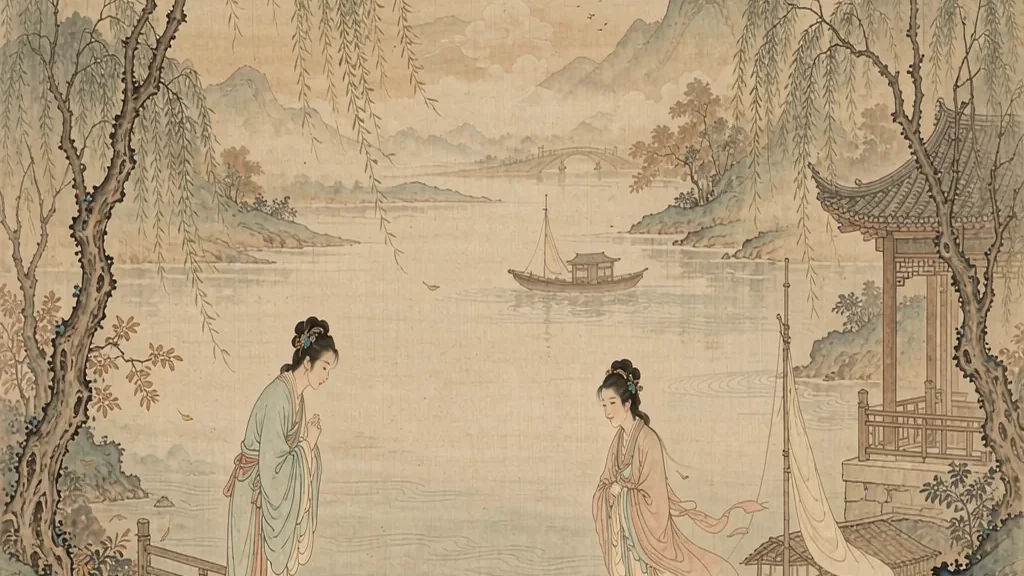
Separation, or líbié, is one of the great emotional subjects of Chinese poetry, rivaled only by the moon and the passing seasons in frequency and intensity. In a society where office required constant travel between the capital and the provinces, where wars conscripted husbands and sons for years, and where friends were scattered by assignment and exile, parting was not an occasional sorrow but a structural condition of educated life. The Chinese poetic tradition responded by developing a rich repertoire of departure poems, or songhbie, composed at the moment of farewell and often exchanged in chains of answering verse. These poems turned the pain of leave-taking into a refined art, complete with conventional settings, plants, and gestures. This essay explores the social roots of separation poetry, its typical scenes and symbols, and its most celebrated examples.
The Social Roots of Parting
The frequency of separation poetry is explained by the mechanics of imperial administration. A successful man of letters expected to serve in a sequence of posts far from home, and the examination and appointment system continually redistributed talent across the vast realm. Friends made in the capital might be posted to the south, to the frontier, or to a remote prefecture, sometimes for decades. Families, too, were divided by official duty and by the frequent wars on the borders. Under these conditions, saying farewell was a recurring ritual, and the poem became the means of carrying the absent friend's presence forward in words.
The emotional weight of parting was amplified by the slowness of travel and the rarity of news. A departure might mean years without contact, so the farewell poem had the gravity of a possible last meeting. This is why even routine postings could inspire lines of real anguish.
The Roadside Farewell
The typical separation poem is set at the edge of town, where the traveler's cart or boat waits and the friends share a last cup of wine. The poet watches the figure recede along the road or down the river, and the poem often closes by fixing that vanishing point in the landscape. The pavilion of parting, a structure built just outside the city wall for this purpose, is a recurring stage prop, as is the riverside bend where boats depart. These locales gave the abstract sorrow a concrete geography that later poets could invoke by allusion.
The act of watching the traveler leave, rather than the journey itself, is the poem's true subject. The speaker remains rooted while the other moves away, and the enlarging distance becomes a measure of feeling. The road or river thus functions as the physical trace of separation.
The Willow and the Gift of a Branch
No symbol is more identified with Chinese parting than the willow. Its drooping branches resemble the gestures of one who lingers and looks back, and its name liu puns on the verb "to stay," making the tree a verbal charm against departure. The custom of breaking a willow branch and presenting it to the traveler is attested in poetry and ritual, a small physical token encoding the wish that he remain. A riverside lined with willows became almost synonymous with leave-taking, and to mention the willow was to summon the whole scene of farewell.
The willow's seasonal green also ties separation to spring, so that the two themes reinforce each other: the traveler leaves just as the world returns to life, and the abundance of renewal only sharpens the loneliness of the one left behind. The plant is at once consolation and reproach.
Wine, Tears, and the Last Cup
The farewell poem routinely features a parting cup of wine, drunk standing in the dust of the road. The shared drink is a last communion, a way to delay the moment of turning away. Tears are mentioned frankly, and the image of a sleeve raised to the eyes is common. Yet the tone is usually controlled rather than wild; the convention favors dignified sorrow, a restraint that makes the feeling more poignant than open weeping would. The poet performs grief with composure, which is itself a social grace.
Associated with the cup is often a wish for the traveler's safe journey and a hope, sometimes resigned, of meeting again. The poem thus ends not in despair but in a courteous blessing, preserving friendship across the distance it laments.
Separation and the Moon
Because the moon is visible from every place at once, it became the natural mediator of separation, the one thing shared by those who cannot meet. Poets console themselves that though a thousand miles divide them, the same moon shines on both, a consolation that is also a quiet wound. The bright moon over the river at parting is a set piece, and many quatrains close beneath it. The moon's roundness additionally evokes the reunion that absence denies, especially when the farewell falls near a festival.
The pairing of separation and moon is so frequent that the two images are almost inseparable in the reader's mind. To write of parting without the moon would feel, to a traditional audience, like omitting the very light that makes absence bearable.
Frontier and Military Separation
A particularly harsh variant is the separation of the conscript soldier from his family, voiced in the yuefu ballads and frontier poetry. The wife left at home addresses the moon or the passing geese, asking them to carry a message to the man at the passes; the soldier replies in a matching song of cold and loneliness. These poems register the human cost of empire in domestic terms, turning geopolitics into a letter never delivered. The frontier moon, the blowing sand, and the unplayed qin at home compose a geography of forced separation.
The gendered structure of such poems, the woman within and the man without, gave the tradition a stable emotional geography. The inner chamber and the outer desert are the two poles of a single sorrow stretched across the realm.
Notable Farewell Poems
Among the most beloved separation poems is Wang Wei's quatrain seeing a friend off to the north, where the poet declares that beyond the Yangguan pass there will be no old acquaintance, a line so famous it became a song title in its own right. Another enduring example is the riverside farewell in which the endless green hills and the single boat trace the geometry of parting. Li Bai's lines sending a friend downstream describe the solitary sail vanishing into the blue mountain while the river runs long, an image of distance absorbing the beloved. These poems show how a single occasion could yield lines quoted for a thousand years.
The durability of such farewells rests on their perfect calibration of public occasion and private feeling. They are occasioned by a real departure yet speak to every departure, which is why they survive as the language of goodbye itself.
Legacy in Later Lyric and Today
The separation topos migrated smoothly into the ci and qu, where the parting could be internalized as the lover's leave-taking or even as separation from a vanished past. Li Qingzhao's later lyrics turn the absence of a dead husband into a permanent farewell that no road or river can close, stretching the convention toward elegy. In modern Chinese, the vocabulary of parting remains saturated with these classical images, and farewell cards or speeches still echo the willow and the moon. The poem of separation thus remains a living grammar of goodbye.
To read the separation poems is to recognize that Chinese poetry made a ritual of the most ordinary pain, teaching that to name a leave-taking well is itself a way of staying connected to the one who goes. The road may end at the horizon, but the poem carries the friend a little further.
❓ Frequently Asked Questions
Why is separation so common in Chinese poetry?
Imperial postings, wars, and slow travel made parting a recurring structural condition of educated life.
What does the willow symbolize?
Its drooping form suggests lingering, and its name puns on "stay," so a branch was given to wish the traveler to remain.
Where are farewell poems set?
Typically at the city-edge pavilion or riverside bend, where the poet watches the friend recede down road or river.
How does the moon relate to parting?
As the one thing visible to both absent friends, the moon consoles yet wounds by marking the distance it cannot close.
Which farewell poem is most famous?
Wang Wei's line that beyond Yangguan pass no old acquaintance remains became a song title in its own right.
Is the topos still alive?
Yes, modern farewells still echo the willow and moon, and the convention lives in lyric and elegy alike.