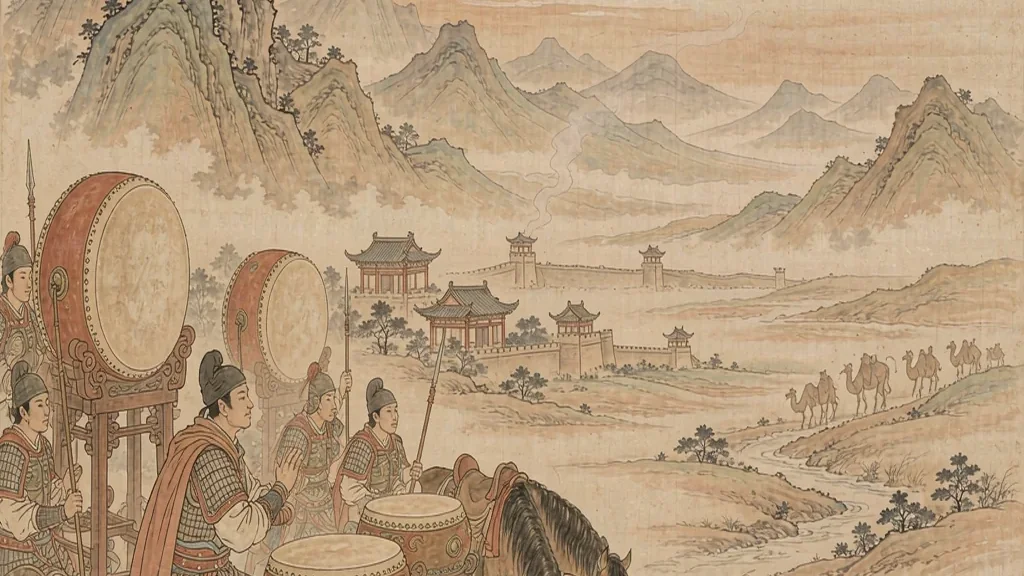
For the Tang dynasty soldier stationed at a lonely garrison on the edge of the Gobi Desert, poetry was not a refined entertainment — it was survival. Far from the capital, surrounded by vast emptiness and the constant threat of attack, frontier poets wrote about what they saw and felt with a directness that the court poets in Chang'an could never match. The frontier poetry (边塞诗, biansai shi) of the Tang dynasty is the most visceral and dramatic strand of Chinese classical poetry: a poetry of wind-scoured deserts, frozen rivers, desperate battles, and the aching homesickness of men who might never see their families again.
The Geography of Frontier Poetry
The Tang empire stretched from Central Asia to the Korean peninsula, and its frontiers were guarded by a network of garrisons, watchtowers, and walled towns. The most famous frontier region was the Hexi Corridor, the narrow passage through Gansu province that connected China proper with the Western Regions. Poets stationed at the Jade Gate Pass (玉门关), the Yang Pass (阳关), and the Loulan outpost wrote about a landscape that was utterly different from the green hills and rivers of central China: deserts of yellow sand stretching to the horizon, snow-capped mountains that never thawed, and a wind that could strip the flesh from a man's bones.
The frontier poets wrote about this landscape with both wonder and terror. Cen Shen (岑参, 715–770 CE), one of the greatest frontier poets, describes the desert in terms of surreal excess: 'The desert sands are yellow, the sky is yellow too; / the wind howls and the clouds are dark. / In the camp, a Tartar boy plays his flute, / and the tears of the soldiers fall like rain.' The frontier landscape was not a site of spiritual contemplation, as in shanshui poetry, but a protagonist in a drama of survival. It was beautiful, but its beauty was deadly.
Wang Changling and the Military Spirit
Wang Changling (王昌龄, 698–756 CE) is perhaps the most famous frontier poet of the Tang. His series of poems titled 'On the Frontier' (从军行) captures both the heroism and the tragedy of military life. One of his most famous poems: 'The bright moon of Qin, the pass of Han — / ten thousand miles, men on campaign have not returned. / But if the flying general of Dragon City were here, / the Tartar horses would not dare cross the Yin Mountains.' The poem compresses centuries of frontier history into four lines: the moon that shone on Qin and Han now shines on Tang, and the soldiers of all three dynasties share the same fate.
Wang Changling was also a master of the frontier women's perspective — the wives and mothers left behind. In 'The Complaint of the Spring Boudoir,' he writes: 'A young wife in her chamber does not know sorrow; / in spring, she climbs the green tower, dressed in finery. / Suddenly she sees the color of the willows by the road / and regrets sending her husband off to seek fame.' The poem pivots on a single moment of insight: the beauty of spring becomes unbearable when it reminds the wife of her absent husband. The frontier was not only where the soldiers were; it was also the emptiness in every home that had sent a man to war.
Cen Shen: The Epic Vision
Cen Shen (岑参) served for many years on the northwestern frontier as an aide to military governors, and his poems are filled with the specific details of life in the garrison towns. His 'Song of Running Horse River' is a panoramic description of a frontier encampment: 'Look at the wind! It blows the rocks from the desert — / the boulders tumble all the way to the foot of the mountains. / In the ninth month, the Tianshan Mountains are covered with snow; / for a thousand miles, nothing but the cold of early winter.' Cen Shen's poems have the quality of reportage; he seems to be writing from the scene, recording what he sees with a reporter's eye.
But Cen Shen was also capable of extraordinary lyricism. His 'Song of the White Snow — Seeing Off Secretary Wu on His Return to the Capital' transforms a farewell scene into a vision of supernatural beauty: 'The north wind rolls the white grass and breaks it; / on the eighth month, the Tatar sky is covered with snow. / Suddenly, as if a spring wind came in the night, / ten thousand pear trees bloom.' The snow on the trees is compared to pear blossoms — a simile that reverses the normal order, making the harsh present beautiful by recalling a gentler season. It is one of the most famous images in Chinese poetry.
Gao Shi and the Realities of War
Gao Shi (高适, 704–765 CE), another major frontier poet, was more explicitly critical of the military establishment. His famous 'Song of Yan' (燕歌行) describes the suffering of ordinary soldiers while their generals live in luxury: 'The men of the frontier have always been hard as iron — / they wear their armor, and tears fall. / In the commander's tent, beautiful girls dance and sing; / the soldiers fight and die, their blood stains the grass.' The contrast between the general's pleasure and the soldier's death is devastating.
Gao Shi's poems also address the strategic folly of overextension. He writes about the endless campaigns against the Turks, the Tibetans, and the tribes of the Western Regions, campaigns that drained the empire's resources and destroyed its families. His poetry is a reminder that the frontier was not only a place of heroic adventure but also a theater of horrific waste. The Tang empire, for all its glory, was sustained by the blood of common soldiers, and Gao Shi refused to let his readers forget it.
The Legacy of Frontier Poetry
Frontier poetry continued to be written after the Tang, though the political context changed. During the Song dynasty, when China faced powerful northern enemies like the Khitan and the Jurchen, frontier poetry took on a more defensive, elegiac tone. Song poets wrote about the lost northern territories with bitter nostalgia, imagining the garrisons and passes of the Tang as symbols of a greatness that could never be recovered. The frontier became a place of memory rather than experience.
In the modern period, frontier poetry has found new relevance. During the Second Sino-Japanese War (1937–1945), Chinese poets revived the frontier tradition to express patriotic resistance. The landscape of the northwest — the deserts and mountains that had inspired Wang Changling and Cen Shen — became once again a setting for poems about courage, sacrifice, and the defense of home. The frontier tradition reminds us that Chinese poetry has always been capable of facing the hardest realities: war, death, exile, and the vast, inhuman spaces of the earth.
The Voices Left Behind: Frontier Women's Poetry
The frontier was not only where soldiers stood; it was also the emptiness in the homes that sent them. Tang poets gave voice to the wives and mothers left behind, most famously in Wang Changling's poem of a young wife who, seeing spring willows, suddenly regrets urging her husband to seek fame. These boudoir lament poems invert the frontier scene: the same willow that marks a departure becomes, from home, a sting of loss. Such poems matter because they complete the geography of war, showing that every garrison on the edge of the desert corresponded to a doorway in the heartland where someone waited. Later male poets used the woman's voice to hint at their own political neglect, but at its plainest the form records a real and gendered cost of the frontier system, the quiet grief of those who never left home.
Frontier Songs as Music and Performance
Many frontier poems were not silent reading matter but songs. The Liangzhou Lyrics and similar tune-titles were sung to melodies imported from the Western Regions, and the form's brevity suited performance by musicians at banquets and camps. This musical origin shaped the verse: tight lines, strong openings, and refrains that could be carried by a voice. Soldiers and officers alike composed to these tunes, so the frontier sound was a blend of Chinese metrics and Central Asian scales. The performance context also explains the genre's emotional directness; a song had to land at once, without the slow buildup of a long poem. Hearing a frontier tune at a distant capital, a courtier could feel the cold of the border in a few bars. The music and the verse were one art, and the desert reached the palace as much through the ear as through the page.
Snow, Desert, and the Poetics of the Extreme
Frontier poetry is defined by its landscapes of excess: yellow deserts, snow that never leaves the peaks, winds that strip flesh from bone. Cen Shen's image of ten thousand pear trees blooming in a sudden snow is the best known, but the whole genre trades in such extremes, using nature as a protagonist rather than a backdrop. The point was not mere description; the harsh setting measured the soldier's endurance and the smallness of human plans against vast space. A frozen river or a dust storm becomes a moral weather, indifferent to glory and grief alike. This poetics of the extreme gave Chinese poetry some of its most physical lines, verses you feel on the skin. By pushing setting to its limit, the frontier poets discovered that the emptiest places could carry the heaviest feeling, and that the desert, more than the garden, could teach a reader about courage and loss.
❓ Frequently Asked Questions
📝 Chinese Vocabulary
边塞诗 — : Frontier poetry; verse about military border life
王昌龄 — : Wang Changling; the leading Tang frontier poet
岑参 — : Cen Shen; Tang poet known for epic desert descriptions
玉门关 — : Jade Gate Pass; iconic frontier garrison in Tang poetry
高适 — : Gao Shi; a major frontier poet who criticized the waste of war and the comfort of generals.
从军行 — : Songs of the Army, or On the Frontier; Wang Changling's famous series on military life.
阳关 — : Yang Pass; the western departure point beyond which lay the distant frontier.
凉州词 — : Liangzhou Lyrics; a song-form set to Western Regions tunes and used for frontier themes.
🎉 Fun Facts
- Wang Zhihuan's 'Ascending the Stork Tower' — 'The white sun sets behind the mountains; / the Yellow River flows into the sea' — is one of the most frequently memorized poems in China.
- The Yang Pass (阳关) was so famous as a departure point that a tune title 'Farewell at Yang Pass' was created and became a standard piece for the qin (zither).
- Cen Shen served as a military secretary on the frontier for about ten years, giving his poems an authenticity that armchair poets could not match.
- Wang Changling's frontier series invokes the flying general of legend, a Han commander whose name became a standing wish for a defender who could keep the border safe.
- Tang frontier garrisons communicated with beacon fires and signal towers, images that poets turned into symbols of isolation and sudden alarm.
- The Liangzhou Lyrics were set to melodies from the Western Regions, so the frontier sound itself mixed Central Asian music with Chinese verse.