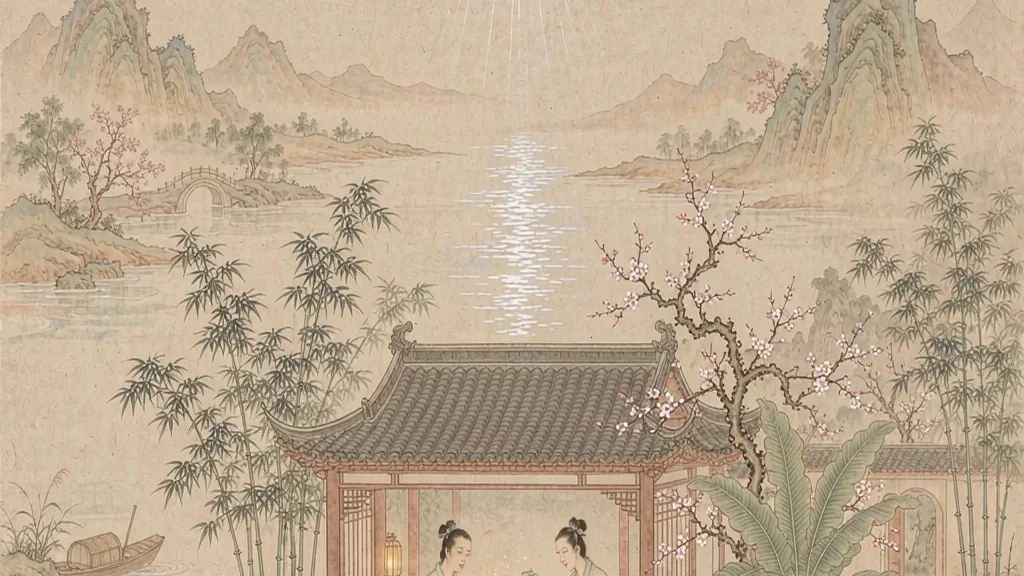
The moon is arguably the single most recurrent image in the entirety of Chinese poetry, a celestial object so densely charged with meaning that almost no major poet escaped its pull. Across more than two thousand years, the moon has functioned as a silent witness to parting, a mirror of longing between separated lovers, a marker of the passage of time, a companion to the lone drinker, and a bridge between the living and the dead. Its cool silver light, its cyclical fullness and waning, and its universal visibility made it the perfect emblem for feelings that exceed any single place or person. This essay surveys the moon's many roles in Chinese verse, from the folk songs of antiquity through the great Tang lyricists to the nostalgic lyrics of the Song, showing why a single heavenly body could carry so much of the Chinese imaginative world.
The Moon in the Earliest Songs
Even in the Shijing, the moon appears as an image of emotional disturbance rather than mere scenery. One well-known poem uses the sight of the moon to express anxiety and restless longing, establishing the idea that the moonlit night intensifies feeling rather than soothing it. The moon's regular phases also made it a natural calendar and a quiet measure of absence: a lover gone one full moon might be hoped for by the next. These early associations were simple but durable, providing the seedbed for later elaboration.
In the Chu-ci or Songs of Chu, the shamanistic poetry of the south, the moon is bound up with mythic figures and nocturnal journeys of the soul. The moon goddess and the toad or rabbit in the moon enter the symbolic repertoire, lending the orb a supernatural dimension that courtly and folk verse would later absorb in diluted form.
The Moon as Witness of Separation
The dominant social function of the moon in Chinese poetry is to register separation. Because the moon is visible from every location at once, it became the perfect token of shared experience between people who cannot meet: a husband stationed at the frontier and his wife at home, two friends parted by official postings, a wanderer far from his native village. The poet consoles himself with the thought that though miles divide them, the same moon shines on both. This trope is crystallized in a famous Tang line wishing that distant people might share the beauty of the moon despite separation, a sentiment so common it became proverbial.
The double-edged comfort of the moon is precisely its power. It soothes by promising shared light yet wounds by reminding the speaker of the very distance it cannot close. Poems of parting routinely close beneath the moon, the orb hanging over the road, the river, or the pavilion where friends say farewell.
The Moon and the Lone Drinker
Li Bai, the most celebrated romantic poet of the Tang, made the moon his constant companion. In his well-known quatrain on the moon and wine, he declares that among the revelers only the moon and his shadow remain, and he invites them to drink so that the three may keep each other company in the spring. The moon here is anthropomorphized as a friend who never fails, a silent drinking partner for the solitary wanderer. In another poem, the moon over the river becomes the object of a childlike wonder that opens the famous meditation on homesickness, where the bright moonlight on the floor is mistaken for frost.
Li Bai's moon is at once intimate and infinitely remote, a figure for the poet's own unanchored genius. His treatment set the template for later poets who would invoke the moon when alone, thereby turning solitude into a kind of elevated communion with the cosmos.
The Moon and the Passage of Time
Because the moon waxes and wanes on a reliable schedule, it became a natural emblem of mutability and the brevity of human life. Poets contrast the eternal moon with the fleeting generations of men, noting that the same orb has looked down on countless dynasties while empires rose and fell. The full moon of the mid-autumn festival, when families are supposed to reunite, sharpened this poignancy: a bright round moon only intensified the sorrow of those forced to spend it apart. Many lyrics use the festival moon as the occasion for regret.
The contrast between changeless heaven and changing earth is a philosophical as well as emotional structure. Under the moon, the poet is prompted to reflect on the smallness of personal grief against cosmic scale, a movement that can either deepen despair or console it, depending on the poem's temperament.
The Moon in Frontier and Exile Poetry
In the poetry of the borderlands, the moon often acquires a harsh, lonely quality. The crescent moon over a desert garrison, the moon reflecting on a saddle or a frozen river, the moon that keeps a sleepless soldier company, all belong to a subgenre obsessed with the costs of imperial expansion. Such moons are cold and indifferent, underscoring the exile's isolation at the edge of the civilized world. The moon over the passes becomes almost a character in its own right, a silent auditor of military labor and longing.
Exile poetry, too, uses the moon to measure distance from the capital and from favor. A poet banished to the south might address the moon as the only thing that travels freely between him and the court he has lost, thereby twisting the shared-moon topos into a complaint about political exclusion.
The Moon and the Dead
Perhaps the most haunting use of the moon is in elegiac poetry, where it mediates between the living and the remembered dead. After the loss of a spouse or friend, the poet may look at the moon and feel the absence more keenly, since the beloved once looked at the same light. The moon becomes a pale ghost of presence, a cold continuity that mocks or sustains the mourning speaker. Li Qingzhao's later lyrics, written after her husband's death, use the moon to register a household emptied of its companion, turning the shared moon into a solitary ache.
This funerary moon draws on the same logic as the separation moon but intensifies it: separation by distance may end, but separation by death is absolute, and the moon's constancy only underscores the finality of loss.
The Mid-Autumn Moon as Cultural Event
By the Song dynasty the mid-autumn festival had become a major occasion for moon poetry, and the full moon of the eighth lunar month was celebrated with the eating of round moon cakes, the drinking of wine, and the composing of lyric songs. Su Shi's famous lyric on the mid-autumn night, addressed to the moon while missing his brother, asks whether the moon must always be full when men are apart, and ends by wishing long life so that loved ones may share the moon's beauty even at a distance. This poem so thoroughly dominates the holiday that later writers struggled to say anything new beneath the same orb.
The festival fixed the moon as a national poetical occasion, ensuring that each year the calendar itself prompted new verses. The moon thus became not only an image but an annual ritual of literary production.
Modern and Comparative Afterlife
The moon's reign did not end with the empire. Modern Chinese poets, even in free verse, return to the moon as a compact symbol of home and loss, and the mid-autumn moon remains a living cultural reference. In comparative terms, the Chinese moon differs from the romantic western moon in its insistence on separation and shared visibility rather than on nightly mystery or goddess personification, though overlaps exist. The endurance of the image suggests that the moon answers a structural need in Chinese poetic feeling: a single stable light against which all movement, absence, and time can be measured.
To read Chinese poetry beneath the moon is to join a conversation stretching across millennia, in which every poet has looked up at the same cold disc and found, mirrored there, the precise shape of his own longing.
❓ Frequently Asked Questions
Why is the moon so common in Chinese poetry?
Its universal visibility made it a token of shared feeling between separated people, while its phases emblematized time and change.
How does the moon express separation?
Poets console themselves that the same moon shines on both friends or lovers, though the comfort is double-edged because it also marks distance.
What did Li Bai do with the moon?
He made it a constant companion, inviting it to drink and using its light to open his famous homesick meditation.
Why is the mid-autumn moon special?
The full moon of the festival celebrates reunion, so its light intensifies sorrow for those forced to spend it apart.
How is the Chinese moon different from the western?
It stresses shared visibility and parting more than nightly mystery or goddess personification, though overlaps exist.
Does the moon appear in modern Chinese poetry?
Yes, free verse poets still use it as a compact symbol of home and loss, and the festival keeps it culturally alive.