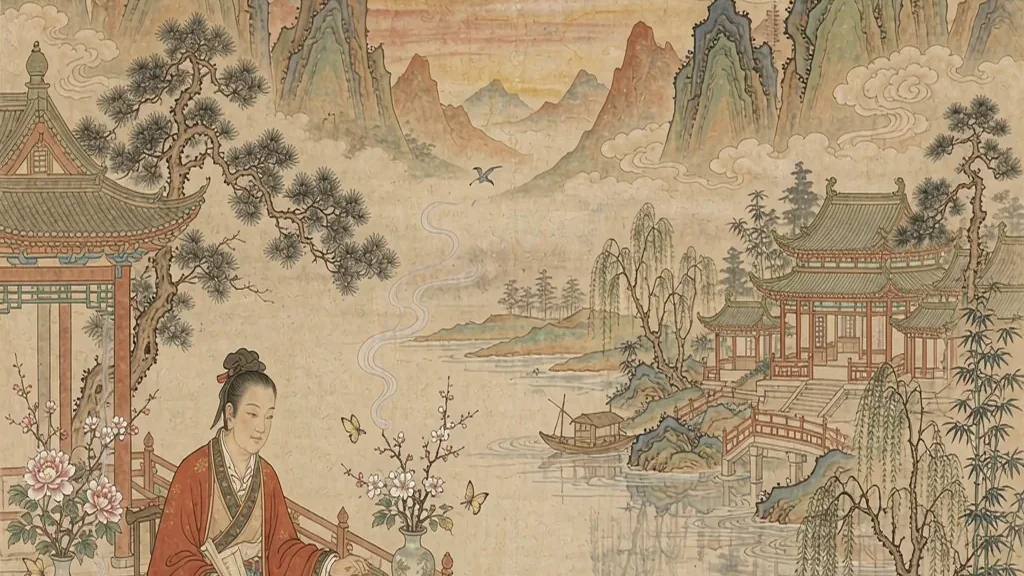
Jintishi, usually translated as "recent-style poetry" or "regulated verse," designates the strict metrical forms of Chinese poetry that crystallized during the Tang dynasty and dominated the classical tradition thereafter. In contrast to the older "ancient-style" poetry, or gushi, which allowed flexible line lengths and free tone patterns, jintishi subjects every character to rules of length, tonal alternation, rhyme, and parallelism. The two principal jintishi forms are the lüshi or regulated octave, and the jueju or quatrain, each available in five-character and seven-character variants. Mastery of jintishi was the mark of a literate elite, a requirement of the examination system, and the medium of countless masterpieces. This essay explains the rules of the form, its historical emergence, its internal architecture, and its immense cultural consequences.
Distinguishing Ancient and Recent Style
The fundamental divide in classical Chinese verse is between gushi and jintishi. Ancient-style poetry, reaching back to the Han and the yuefu, permitted lines of mixed length, did not enforce tonal regulation, and relied on a looser sense of rhythm and rhyme. Recent-style poetry, by contrast, is a Tang invention in the strict sense: though its elements were anticipated in the Southern Dynasties, the full codification of tonal rules belongs to the early Tang. A poet would typically announce which mode he was writing in, and readers expected the constraints of jintishi to be honored exactly. The distinction is not a judgment of value but a classification of formal regime.
Understanding this divide is essential because the two modes produced different kinds of poem. Gushi could be long, narrative, and flexible; jintishi tended toward compression and formal tension. The same poet might use both, choosing the form that suited his occasion. The coexistence of the two regimes gave classical Chinese poetry unusual range.
The Two Principal Forms
Jintishi comprises four standard types. The five-character regulated octave has eight lines of five characters each; the seven-character regulated octave has eight lines of seven characters. The five-character quatrain has four lines of five; the seven-character quatrain has four lines of seven. The octave is the more demanding form, requiring strict parallelism in its middle couplets, while the quatrain relaxes or omits that demand and is prized for brevity. Rhyme falls on the even-numbered lines and the first line may or may not participate, depending on convention.
The brevity of the quatrain, especially the five-character variety, made it the most popular form for inscription, exchange, and casual composition, while the octave was the arena for more sustained argument and description. Both forms share the same tonal logic, so learning the rules of one unlocked the other.
The Tone Rules
The heart of jintishi is the regulation of linguistic tone. Middle Chinese distinguished level tone from three oblique tones, and the rules require that characters alternate between these categories in prescribed positions. In a standard octave, the first couplet establishes a tonal pattern that the second couplet inverts, producing a balanced see-saw of level and oblique across the line. The first character of a line is often flexible, but the second, fourth, and sixth positions are critical, a mnemonic captured in old prosodic sayings. A violation of the tone rule is called a "tone error" and was considered a serious flaw.
Because Chinese is tonal, these rules gave the recited poem a measurable musical contour. Modern non-tonal translations inevitably lose this dimension, which is why jintishi often sounds flat in translation even when its imagery is preserved. The tone rule is the single feature that most defines the form.
Parallelism and the Couplet
Beyond tone, the regulated octave demands that its middle two couplets be parallel, meaning the words of one line correspond grammatically and semantically to those of the next. Noun balances noun, verb balances verb, and the two lines present a matched pair of images or ideas. A famous example balances a fleeing bird against a leaping fish, or a river's end against the rise of a mountain. Parallelism is not mere decoration; it structures the poem's thought, forcing the poet to develop ideas in symmetric pairs.
The discipline of parallelism explains much of the characteristic texture of Tang verse. It rewards precision and economy, since each character must earn its place in a balanced structure. Poets who excelled at parallelism, such as Du Fu, turned the constraint into a source of brilliance, packing each couplet with layered reference.
Historical Emergence
The elements of jintishi were prepared during the Southern Dynasties, when critics like Shen Yue formulated the "four tones and eight defects" theory linking tone to musical euphony. The early Tang court poets, especially the so-called Four Paragons, completed the codification, and by the High Tang the form was fully naturalized. Its rise coincided with the maturation of the examination system, which eventually required candidates to compose regulated verse, embedding the form in the machinery of state recruitment. What began as an aristocratic refinement became a bureaucratic necessity.
This institutional anchoring helps explain why jintishi so thoroughly dominated later poetry. Generations of candidates drilled the forms, and the habit of thinking in regulated lines outlasted the examinations themselves. The form became second nature to the literate class.
Du Fu and the Perfection of the Form
No poet is more associated with jintishi than Du Fu, who is often called its supreme master. He exploited the octave's tightness to encompass public catastrophe and private grief within a single balanced structure, writing of war, famine, and exile in lines that obey every rule while conveying overwhelming feeling. His ability to load a regulated couplet with historical allusion without breaking its music is considered the high point of the form. Later critics held him up as the model precisely because he showed that strict regulation need not limit emotional range.
Du Fu's example settled the question of whether jintishi could bear serious subject matter. Before him, some doubted that a courtly game could carry grief; after him, the form was accepted as equal to any theme, from frontier violence to the death of a child.
Craft and the Examination System
Because jintishi was tested in the civil service examinations, manuals of prosody proliferated, teaching candidates the permissible tonal templates and forbidden fault patterns. These manuals treated poetry as a technical subject with correct and incorrect answers, a striking rationalization of literary art. Success in the exam could launch a career, so the ability to produce flawless regulated verse had practical consequences far beyond aesthetics. The form thus became a social ladder as well as an art.
The downside, noted by some critics, was a tendency toward formulaic composition by candidates more interested in passing than in beauty. Yet the same system trained a vast pool of competent versifiers, ensuring the form's survival and continual practice across the empire.
Legacy and Modern Reception
Jintishi remained the prestige form through the Song, Yuan, Ming, and Qing, even as the ci and qu offered alternative musical genres. Practically every major later poet composed in the regulated forms, and anthologies organized by form taught readers to appreciate tonal and parallel craft. In the modern period, the abandonment of classical forms in favor of vernacular free verse ended jintishi's dominance, but it survives in school recitation, calligraphy, and the occasional deliberate composition by traditionalists. Its rules are now studied as a refined cultural heritage rather than a living requirement.
The enduring fascination of jintishi lies in its paradox: a poetry of extreme constraint that produced extreme freedom of expression. To read a perfect octave is to witness order and feeling occupying the same breath, a reconciliation that the Chinese tradition has long regarded as the summit of literary art.
❓ Frequently Asked Questions
What is jintishi?
It is the regulated verse of the Tang, subject to strict rules of line length, tonal alternation, rhyme, and parallelism, unlike free ancient-style poetry.
What are its main forms?
The eight-line lüshi octave and the four-line jueju quatrain, each in five-character or seven-character versions.
What is the tone rule?
Level and oblique tones must alternate in fixed positions, giving the recited line a musical contour audible in chanting.
Why is parallelism required?
The middle couplets of an octave must mirror each other grammatically, structuring thought in balanced pairs of image or idea.
How did exams shape the form?
Candidates had to compose regulated verse to pass, so the form became both a social ladder and a drilled habit of the elite.
Who mastered it best?
Du Fu is considered the supreme master, showing that strict regulation could carry the gravest public and private feeling.