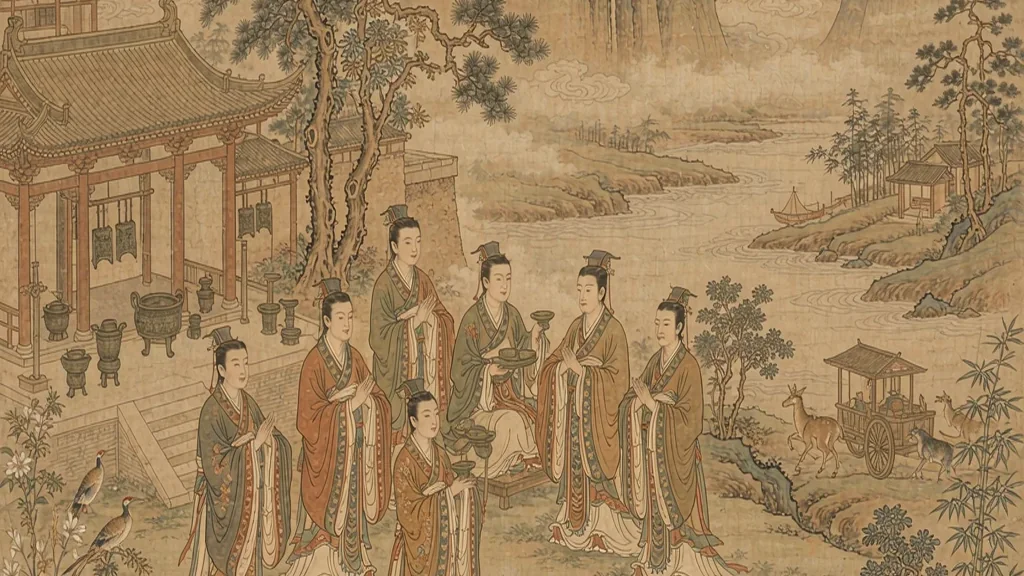
Long before the Tang poets perfected their regulated verses, before Li Bai drank himself into immortal stanzas and Du Fu ground his teeth through civil war, Chinese poetry had already been singing for over a thousand years. The classical shi (诗) tradition — the broad category of "old-style verse" that preceded the strict prosody of the Tang — is the deep soil from which all later Chinese lyric poetry grew. Its origins are as ancient as the Chinese written language itself, woven into the rituals of Zhou dynasty courts and the songs of common people working in the fields.
The Book of Songs: Poetry Before Individual Poets
The earliest surviving collection of Chinese poetry is the Shijing (诗经, Classic of Poetry), compiled around 600 BCE but containing poems composed as early as the eleventh century BCE. This anthology of 305 poems was supposedly edited by Confucius himself, who is said to have remarked that the Shijing could 'summarize all three hundred poems in one phrase: think no evil.' The poems fall into four categories: feng (风, folk songs from fifteen states), ya (雅, courtly songs), song (颂, hymns for ancestral sacrifices), and fu (赋, narrative expositions). What strikes a modern reader is how fresh these poems remain — women gathering plantain, soldiers marching home, lovers meeting by the city wall, all rendered in four-character lines that feel direct and unadorned.
The Shijing established conventions that would last for millennia: the use of natural imagery as emotional correlatives (the weeping willow for parting, the crying osprey for longing), the four-character line as the default meter, and the practice of beginning with a natural image before turning to human emotion — a technique later Chinese critics called bi (比, comparison) and xing (兴, affective image). Confucius taught his disciples that the Shijing was essential for moral cultivation, diplomatic discourse, and understanding the natural world. No subsequent Chinese poet could write without the Shijing echoing in the background.
The Songs of Chu and the Lyric Tradition
If the Shijing represents the Confucian, collective voice of Chinese poetry, the Chuci (楚辞, Songs of Chu) is its Taoist, individualist counterpoint. Centered on the figure of Qu Yuan (屈原, 343–278 BCE), a minister of the Chu kingdom who drowned himself in despair over his ruler's corruption, the Chuci introduced a radically different poetic style: longer lines of irregular meter, shamanistic imagery of spirit journeys and celestial flights, and an intensely personal voice suffused with political grievance and mythological grandeur.
Qu Yuan's masterpiece, Li Sao (离骚, Encountering Sorrow), is a sprawling allegorical poem in which the poet, rejected by his king, undertakes a cosmic journey in a chariot drawn by dragons, seeking a worthy beloved in the celestial realms. The poem's lush descriptions of fragrant herbs (symbols of moral virtue), its gender-bending persona (Qu Yuan speaks as a spurned woman), and its refusal to compromise with corruption created a template for the 'frustrated scholar-official' trope that would dominate Chinese poetry for two thousand years.
The Chuci also introduced the sao (骚) style, named after Qu Yuan's poem, which freed poets from the four-character constraint of the Shijing. Its influence on later fu rhapsodies, Tang classical poetry, and even the lyric ci form cannot be overstated. The Dragon Boat Festival, still celebrated today, commemorates Qu Yuan's suicide — a measure of how deeply this poet entered Chinese cultural memory.
Han Dynasty Music Bureau and the Five-Character Line
During the Han dynasty (206 BCE–220 CE), the imperial Music Bureau (yuefu, 乐府) collected folk songs from across the empire, many of which survive in the collection known as Han yuefu. These anonymous poems mark a crucial development in Chinese poetry: the shift from four-character lines to five-character lines (wuyan, 五言), which would become the dominant meter for classical poetry for the next millennium. The additional syllable gave poets more rhythmic flexibility and allowed for greater syntactic variety.
Many Han yuefu poems are narrative ballads with tragic themes — the most famous being 'The Peacock Flies Southeast,' a 350-line tale of a young wife driven to suicide by her mother-in-law. Others depict the hardships of war, the sorrow of parting, and the bitterness of poverty. The yuefu tradition established the principle that poetry could speak for the common people, giving voice to those who would otherwise be voiceless. Later poets like Li Bai and Du Fu would write 'new yuefu' poems in explicit imitation of this tradition.
The Jian'an Poets and the Rise of Individual Style
The late Han and the Three Kingdoms period saw the emergence of China's first identifiable literary circle: the Jian'an poets (建安七子, Seven Masters of the Jian'an period), centered around the warlord Cao Cao and his sons Cao Pi and Cao Zhi. These poets wrote during a time of devastating civil war, and their poetry reflects the era's violence and uncertainty. But they also turned to the pleasures of wine, friendship, and literary conversation as consolation.
Cao Zhi (曹植, 192–232 CE) is often considered the greatest poet of this period. His 'Seven-step Poem' — composed, according to legend, in the time it takes to walk seven steps — is a political allegory of brotherly persecution that every Chinese schoolchild still memorizes. Cao Pi (曹丕), the first emperor of the Wei dynasty, wrote the first work of Chinese literary criticism, 'On Literature' (典论·论文), which argued that literature was 'a great enterprise for governing the state and an immortal achievement.' The Jian'an poets elevated the status of the individual poetic voice, paving the way for the great Tang poets who followed.
The Wei-Jin Period: Tao Yuanming and the Return to Nature
The most influential poet of the Six Dynasties period was Tao Yuanming (陶渊明, 365–427 CE, also known as Tao Qian), a minor official who famously retired from government service, declaring that he 'would not bow for five pecks of rice a year.' His retreat to a simple farming life produced some of the most beloved poems in the Chinese language — poems about planting beans under the southern mountain, drinking wine by his rustic hut, and reading books by candlelight.
Tao's poetry is remarkable for its plainness. Unlike the ornate court poetry of his contemporaries, Tao wrote in a deceptively simple style that seemed to require no effort. His 'Drinking Wine' series captures moments of quiet transcendence: 'I built my hut beside a busy road / yet hear no sound of carriage or horse. / You ask me how this can be? / A distant heart makes the place remote. / Picking chrysanthemums by the eastern fence, / I see the southern mountain in the distance.' This quality of relaxed awareness — of finding profundity in the ordinary — made Tao Yuanming the model for what Chinese critics call 'natural and unaffected' poetry. The great Song dynasty poet Su Shi considered Tao the greatest Chinese poet of all, surpassing even Li Bai and Du Fu.
The Legacy of Classical Shi
The classical shi tradition established the foundations on which all later Chinese poetry was built: the moral seriousness of the Shijing, the individual passion of Qu Yuan, the narrative directness of Han yuefu, the personal voice of the Jian'an poets, and the natural simplicity of Tao Yuanming. When Tang poets wrote their regulated verses, they understood themselves as heirs to this millennia-old tradition. Even the most innovative Tang poet was constantly in dialogue with the past, alluding to old poems, imitating ancient styles, and measuring himself against the masters of earlier ages.
The classical shi tradition also established the social role of the poet in Chinese culture. The poet was not merely an entertainer but a moral voice, a historian, a friend, a recluse — someone whose words mattered to the community. This sense of poetry as a serious moral and social practice, inherited from the earliest songs of the Zhou dynasty, would sustain Chinese poetry through all its transformations. No revolution in poetic form ever abandoned the core conviction that poetry is a way of telling the truth about human experience.
The Nineteen Old Poems and the Mature Line
The Nineteen Old Poems mark the moment five-character verse came of age. Their speakers are travelers, abandoned wives, and aging men who weigh friendship against ambition and life against its brief span. The language is plain but the feeling is deep, and their famous opening, 'Traveling on and on, parting again and again,' set a pattern of restless separation that Tang poets would echo. Because they are anonymous, they read like the voice of an age rather than a person, and their quiet melancholy became a baseline of Chinese lyric tone. Later critics treated them as the pure source of the five-character art, before court ornament and heavy allusion set in. Their influence can be traced line by line through the Tang, when almost every major poet attempted an 'old poem' in their manner. Modern scholars still debate whether the collection is truly Han or slightly later, but its authority within the canon has never been in doubt.
Cao Cao and the Jian'an Spirit
The warlord Cao Cao, father of Cao Zhi, was himself a poet of startling vigor. His short lyrics on the old theme of short is the day, great is the grief mix martial ambition with naked feeling, and his 'Aging on the Stool' declares that a hero's heart need not weaken with age. Around him gathered the Jian'an writers, whose work the critic Liu Xie praised for wind and bone, a clarity and strength born of living through war. This Jian'an spirit valued sincerity over polish and gave later poets a model of engaged, masculine feeling. It stands as the bridge between the anonymous Han ballad and the polished individuality of the Tang. Cao Cao's sons, Cao Pi and Cao Zhi, carried the family gift into the next generation and made the Jian'an name synonymous with literary brilliance. The blend of soldier and singer in Cao Cao himself remained a tantalizing ideal: that a ruler of men might also speak directly to the heart.
❓ Frequently Asked Questions
📝 Chinese Vocabulary
诗经 — : Classic of Poetry; the earliest anthology of Chinese verse
楚辞 — : Songs of Chu; the southern lyric tradition of Qu Yuan
乐府 — : Music Bureau; folk-song collection tradition
陶渊明 — : Tao Yuanming; the great poet-recluse of the Six Dynasties
古诗十九首 — : Nineteen Old Poems; an anonymous Han collection that set the standard for five-character verse
曹植 — : Cao Zhi; Jian'an poet famed for the legendary 'Seven-step Poem'
五言诗 — : Wuyan shi; five-character poetry, the dominant meter of classical Chinese verse for a millennium
风雅颂 — : Feng Ya Song; the three categories of the Shijing: airs, odes, and hymns
🎉 Fun Facts
- The Shijing contains poems about 160 different plants, reflecting the agrarian society of Zhou dynasty China.
- Confucius is said to have personally edited the Shijing down from 3,000 poems to 305.
- Qu Yuan's 'Li Sao' is 372 lines long and mentions 28 different aromatic plants as symbols of virtue.
- The 'Nineteen Old Poems' are all anonymous and are traditionally counted as the model for mature five-character verse.
- Cao Zhi's 'Seven-step Poem' was supposedly composed while he walked seven steps, to answer a brother who threatened his life.
- Tao Yuanming's line about not bending for five pecks of rice became a lasting Chinese idiom for refusing to grovel for a salary.