In the pantheon of Chinese poets, Tao Yuanming (陶渊明, Táo Yuānmíng, 365–427 CE) stands apart. He did not serve in a great court, win an imperial examination, or produce sprawling masterpieces of political philosophy. He was a farmer who wrote about his bean plants, his wine jar, and his chrysanthemums. Yet this farmer-poet of the Eastern Jin dynasty (东晋, Dōng Jìn, 317–420 CE) became one of the most revered figures in Chinese literature — the archetype of the hermit who chooses poverty over servility, and the author of "Peach Blossom Spring" (桃花源记, táo huā yuán jì), China's most enduring vision of utopia. His "fields and gardens" (田园, tián yuán) school of poetry has inspired every major Chinese poet who came after him.
Life on the Farm: The Reluctant Official
Tao Yuanming (also known as Tao Qian, 陶潜) was born in 365 CE into a once-distinguished family that had fallen on hard times. His great-grandfather Tao Kan had been a celebrated general of the Eastern Jin, but by Tao Yuanming's generation the family was reduced to modest farming in Xunyang (寻阳, modern Jiujiang, Jiangxi). He received a classical education and, like every educated man of his era, entered government service in his late twenties. But he found official life humiliating. He served in a series of minor posts — a secretary, a military aide, a county magistrate — each time quitting after a few months, citing the strain of "bowing to petty men" and missing his rural home.
His final resignation in 405 CE is a foundational story in Chinese literary culture. As magistrate of Pengze (彭泽令, péng zé lìng), he was told by a subordinate that he must dress formally to receive a visiting inspector. Tao Yuanming is said to have sighed and replied, "I will not bend my waist for five pecks of rice" (不为五斗米折腰, bù wèi wǔ dǒu mǐ zhé yāo). He resigned the next day, after only eighty days in office, and never served again. The "five pecks of rice" (五斗米, wǔ dǒu mǐ) referred to his official salary, but the phrase became a permanent Chinese idiom for refusing to compromise one's principles for a meager paycheck.
For the final twenty-two years of his life, Tao Yuanming lived on his farm, sometimes prospering, more often suffering from drought, flood, and poverty. His house burned down in 414 CE, and his later poems describe hunger so severe that he "cannot lift the eating bowl with both hands." Yet he never regretted his choice. His series "Drinking Wine" (饮酒, yǐn jiǔ) captures the paradox of his life: "I built my hut within the world of men, / Yet there is no noise of horse and carriage. / You ask me how that can be? / When the heart is far, the place becomes remote."
The Fields-and-Gardens Tradition
Tao Yuanming is the founder of the "fields and gardens" (田园诗, tián yuán shī) school, a poetic tradition that celebrates rural life not as a literary convention but as lived experience. Unlike the idealized pastoral scenes of later poets, Tao's poems are specific, practical, and often unglamorous. In "Returning to Live on the Farm" (归园田居, guī yuán tián jū), he describes his farm with precise detail: "I plant beans at the foot of the southern mountain. / The grass is thick, the bean sprouts are sparse. / I rise at dawn to clear away the weeds, / And return home under the moonlight, carrying my hoe."
What makes these poems revolutionary is their complete lack of self-pity. Earlier yimin (遗民, "left-over subjects") poets had written about withdrawal as a political protest against a fallen dynasty. Tao Yuanming writes about withdrawal as a personal choice — and the result is not heroic suffering but genuine, quiet happiness. The poem "Moving House" (移居, yí jū) describes the simple pleasure of discussing books with a neighbor over a cup of wine; "Reading the Classic of Mountains and Seas" (读山海经, dú shān hǎi jīng) describes a summer afternoon spent scanning myths under a shady tree.
Tao's language is deliberately plain. He wrote in the five-character-old-poetry (五言古诗, wǔ yán gǔ shī) form, avoiding the ornate parallel couplets and dense allusions favored by his contemporaries. This simplicity was not artlessness — it was a philosophical stance. He was deeply influenced by the Daoist classics, especially the Zhuangzi (庄子), which celebrates spontaneity (自然, zì rán) and rejects artificial social conventions. Tao's plain style enacts this philosophy: the words are transparent so the thing itself can be seen.
The Peach Blossom Spring
Tao Yuanming's most famous work is not a poem but a prose piece: "Peach Blossom Spring" (桃花源记, táo huā yuán jì), a brief allegory that has shaped Chinese utopian thought for more than fifteen centuries. The story is deceptively simple: a fisherman from Wuling (武陵) rows up a stream and discovers a grove of peach trees in full bloom. Following the stream through a cave, he emerges into a hidden valley where people live in contented self-sufficiency — their ancestors had fled the chaos of the Qin dynasty (秦, 221–206 BCE) and, unaware of the intervening centuries, have no knowledge of the Han, the Three Kingdoms, or the Jin. They wear strange clothes, farm peacefully, and welcome the fisherman with wine and chicken. When he leaves, marking the path carefully, he finds it impossible to return. The peach blossoms have disappeared, and the hidden valley is lost forever.
The story operates on multiple levels. On the surface it is a pastoral fantasy; beneath that, a political allegory — a critique of the violence of the Qin and Jin dynasties. At its deepest level, it is a Buddhist-Daoist parable about the impermanence of perfect moments and the futility of trying to recapture them. The story became so famous that "Peach Blossom Spring" (桃花源) entered the Chinese language as the standard term for an earthly paradise, a utopia glimpsed but never possessed. It remains one of the most memorized texts in Chinese education, and cave systems across China still compete to be recognized as the "real" Peach Blossom Spring.
The Chrysanthemum and the Wine Jar: Tao Yuanming's Legacy
Tao Yuanming's influence on Chinese poetry is comparable to that of the Shijing itself. He established the archetype of the hermit-poet that later writers would constantly invoke. When Li Bai writes about drinking alone under the moon, he is channelling Tao Yuanming. When Su Shi writes poems about farming in exile, he is explicitly imitating "Old Tao" (老陶, lǎo Táo). Wang Wei's nature retreats and Bai Juyi's simple language both owe a debt to Tao's example.
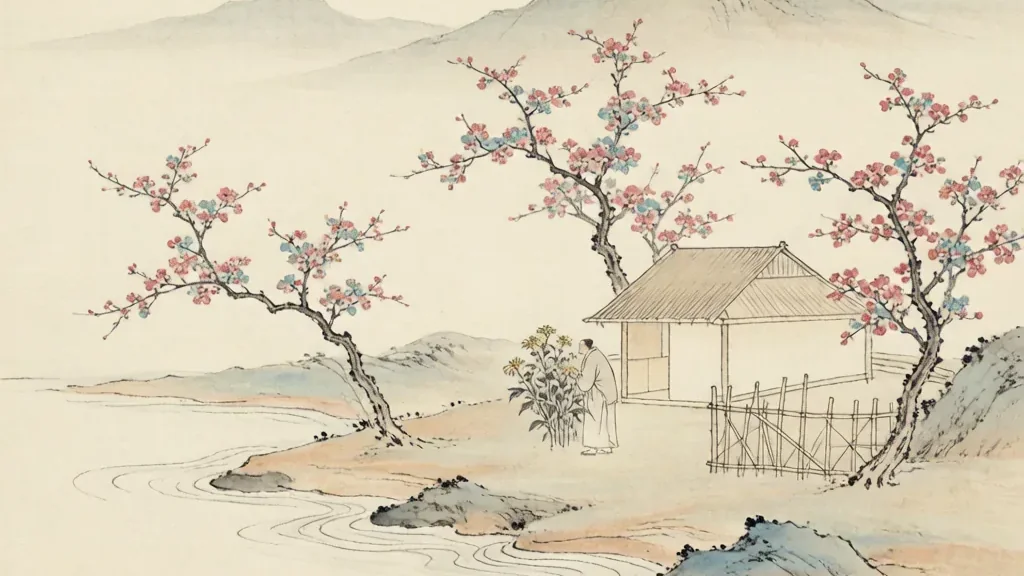
His cultural symbolism is even broader. The chrysanthemum (菊, jú), his favorite flower, became a permanent emblem of reclusive integrity — partly because Tao Yuanming wrote the most famous couplet about it in Chinese literature: "Plucking chrysanthemums by the eastern hedge, / I gaze at the southern mountain in the distance" (采菊东篱下,悠然见南山). The image of Tao Yuanming sitting among his chrysanthemums has been painted, carved, and printed more times than almost any other scene in Chinese art. In Japan, too, Tao Yuanming was revered: the Heian poet Bai Juyi's Japanese admirers often linked the two poets as models of graceful withdrawal. More than anyone else, Tao Yuanming proved that a poet could be great without being a courtier — a lesson that has inspired rebels and recluses from the Jin dynasty to modern China.