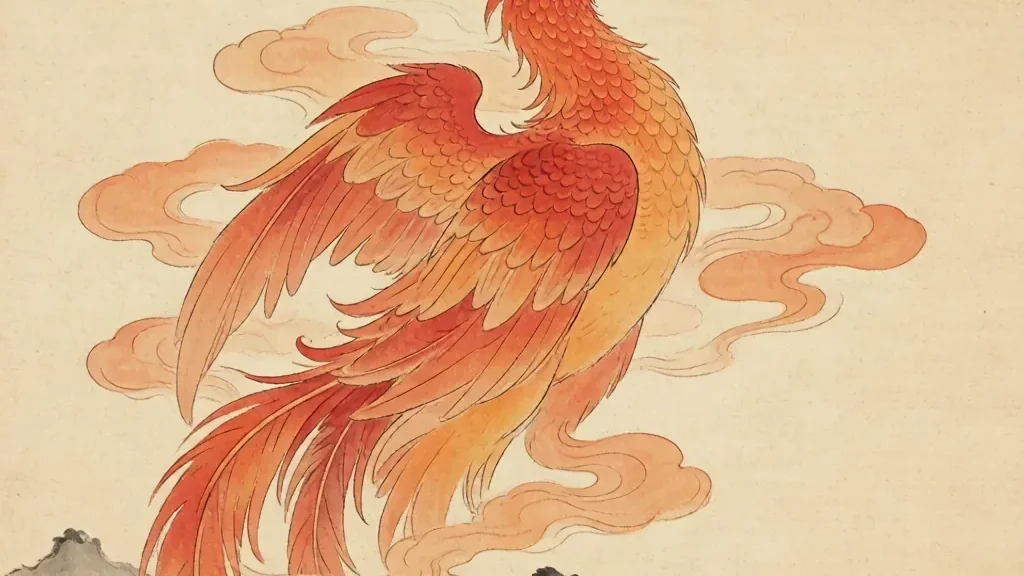
Zhū Què, rendered in English as the Vermillion Bird or the Vermilion Bird, is one of the Four Symbols that anchor the Chinese cosmos, the radiant guardian of the south, the season of summer, and the element of fire. Unlike a ordinary bird, Zhū Què is a mythological entity of stellar and directional power, a phoenix-like being whose red plumage and fiery nature place him among the supreme emblems of imperial and celestial order. Alongside the Azure Dragon of the east, the White Tiger of the west, and the Black Tortoise of the north, the Vermillion Bird completes the quartet that watches over the four cardinal directions and the cycles of the year. To know Zhū Què is to understand how the Chinese imagination mapped the heavens, the seasons, and the virtues onto a single blazing figure of the south.
The Four Symbols and the Cardinal Directions
The system of the Four Symbols, known in Chinese as the Si Xiang in one context and as the four celestial guardians in another, organized the visible sky and the earthly realm into four protective powers. The Azure Dragon governed the east and spring, the White Tiger the west and autumn, the Black Tortoise the north and winter, and the Vermillion Bird the south and summer. Each was linked to an element, a color, a season, and a host of subordinate associations, forming a compass of meaning that touched architecture, astronomy, burial practice, and state ritual. Zhū Què's southern fire made him the counterpart to the watery north, and his red stood opposite the black of the tortoise in a balanced cosmic pair.
This quartet derived much of its structure from the observation of the night sky. Ancient astronomers divided the heavens into four palaces, each associated with a season and marked by a constellation pattern. The southern palace was the Vermillion Bird, and the stars within it were imagined as the outline of a fiery bird in flight. The system thus joined naked-eye astronomy to mythology, giving ordinary people a story to tell about the turning of the heavens above.
The Vermillion Bird and the Element of Fire
Fire is the element assigned to Zhū Què, and with it come the qualities of heat, light, transformation, and upward movement. Summer is his season, the time when the sun stands high and life reaches its fullest vigor, and the south is his direction, the quarter of warmth and growth. In the logic of the Five Elements, fire overcomes metal and is overcome by water, so the Vermillion Bird's southern blaze was naturally balanced by the Black Tortoise's northern flood. This balancing act was not merely poetic; it informed medicine, feng shui, and court ceremony, where maintaining harmony among the elements was a matter of state and personal well-being.
The bird's red color is not accidental. Red in Chinese culture signals prosperity, joy, and protective energy, and the vermilion shade in particular was associated with the south and with imperial brightness. To paint or carve Zhū Què in red was therefore to invoke not only fire but good fortune and the sanctioned radiance of legitimate rule, which is why his image adorned gates, roofs, and ritual objects meant to channel beneficial power.
Appearance and Distinctive Features
Zhū Què is typically portrayed as a magnificent bird with plumage in shades of red and orange, often with a long flowing tail and an aura of flame. He is frequently conflated in popular understanding with the Fenghuang, the Chinese phoenix, though careful tradition distinguishes the two: the Fenghuang is a more general emblem of harmony and queenly virtue, while Zhū Què is a specific directional and stellar guardian with a defined cosmic office. In art, the Vermillion Bird may be shown with a crest, outstretched wings, and feathers that seem to emit light, capturing the sense of a creature made of living fire rather than mere flesh.
The bird's beauty carries meaning. A guardian of the south should inspire not only awe but attraction, drawing beneficial summer energy toward the places and people under his protection. His splendor thus functions as a kind of magnetic virtue, and his image was placed where that virtue was wanted, above southern gates, on the southern walls of tombs, and in the ritual décor of the summer solstice observances.
Role in Astronomy and the Southern Palace
In the star lore of ancient China, the sky south of the celestial equator was grouped into the Vermillion Bird mansion, one of the four celestial animal divisions used by astronomers and astrologers. The relevant stars were visualized as parts of the bird, such as his body, wings, or tail, and their risings and settings helped mark the agricultural calendar. Officials tasked with calendrical science watched these constellations to time planting and harvest, so Zhū Què was not only a mythic figure but a practical tool of seasonal regulation that affected the food supply of the realm.
The southern palace also figured in the matching of terrestrial and celestial order. Just as the bird ruled the southern sky, the emperor's southern rites and the southern orientation of certain spaces echoed his domain, creating a cosmic symmetry in which heaven and earth mirrored each other. This mirroring was a core principle of Chinese cosmology, and Zhū Què was one of its clearest expressions.
Position in Tomb and Temple Decoration
The Vermillion Bird frequently appears in the decoration of tombs, where the four guardians were painted or carved to protect the deceased and to align the burial with cosmic order. A famous example type is the wall paintings of Han dynasty tombs, where Zhū Què appears with the other three symbols in procession, each at his proper direction. Such imagery assured the soul a harmonious passage and situated the grave within the universe rather than outside it. Temples and palaces likewise used the four creatures on ridge tiles and beams, with the south-facing elements bearing the bird's image.
In feng shui, the sitting and facing of a building were described in the language of the four creatures, with the Vermillion Bird representing the open bright space in front, the "bright hall" that welcomed beneficial energy. A well-sited house or tomb thus had a "Black Tortoise behind, Azure Dragon on the left, White Tiger on the right, and Vermillion Bird in front," a formula that translated the mythic quartet into everyday spatial practice.
Connection to the Fenghuang
The frequent blending of Zhū Què with the Fenghuang reflects their shared fiery, birdlike grandeur, yet the distinction matters for accurate understanding. The Fenghuang is a composite auspicious bird symbolizing virtue and the union of yin and yang, often paired with the dragon as a symbol of imperial marriage and harmony. Zhū Què, by contrast, is a fixed occupant of the southern sky with a specific office among the Four Symbols. Popular art sometimes lets the two merge, but scholarly and ritual contexts keep them separate, with the Vermillion Bird holding his place in the directional system while the phoenix ranges more freely as a general emblem of good omen.
Understanding the difference helps readers navigate Chinese symbolism without collapsing distinct traditions into one. Both birds radiate red and fire, but one is a cosmological guardian and the other a moral-aesthetic ideal, and the richness of the culture lies precisely in maintaining such nuanced roles.
Modern Cultural Presence
Today Zhū Què survives in heritage sites, illustrated mythologies, and the continuing use of the four-guardian motif in decoration and design. He appears in literature, games, and popular media that draw on Chinese myth, usually as a powerful fire spirit or guardian, and his name is invoked in contexts from astronomy outreach to branding that wishes to suggest southern warmth and vitality. The Vermillion Bird remains a vivid entry point for learners encountering the Chinese cosmic map for the first time.
Museums display tomb tiles and paintings bearing his image, and scholars study these artifacts to reconstruct how ordinary people and officials alike conceived the universe. Zhū Què therefore continues to perform his ancient function, guiding attention southward and upward, toward the fire and light that have always stood at the heart of Chinese visions of cosmic order.
Zhū Què in Imperial Ritual
The Vermillion Bird's southern and fiery nature made him a natural focus of summer rites performed by the court to honor the season of growth and to seek the favor of heaven. The emperor, as the ritual hub of the realm, conducted seasonal ceremonies at the southern altar, and the bird's imagery framed these observances as alignments with cosmic fire. Music, color, and sacrifice were coordinated to the southern direction, so that the performance of government itself echoed the quartet of guardians and placed the ruler under the bright watch of Zhū Què.
This ritual use tied the mythic bird to the legitimacy of the throne. By acting in harmony with the southern guardian, the emperor demonstrated that his rule mirrored the order of heaven, and the Vermillion Bird became a silent witness to the covenant between cosmos and court. The red banners and southern orientation of these rites were not decoration alone but a claim that the state moved with the turning year.
❓ Frequently Asked Questions
What is Zhū Què?
Zhū Què is the Vermillion Bird, a guardian of the south, summer, and fire among the Four Symbols of Chinese cosmology.
How is Zhū Què different from the Fenghuang?
The Fenghuang is a general auspicious phoenix symbolizing harmony, while Zhū Què is a specific southern stellar guardian.
What element is associated with the Vermillion Bird?
He is linked to fire, the south, and summer in the system of the Five Elements and four directions.
Where does Zhū Què appear in art?
He appears on tomb walls, temple ridge tiles, and ritual décor, often at southern orientations.
What are the other three symbols?
They are the Azure Dragon of the east, the White Tiger of the west, and the Black Tortoise of the north.
Why is the Vermillion Bird red?
Red signals fire, summer, prosperity, and protective energy, all proper to his southern office.