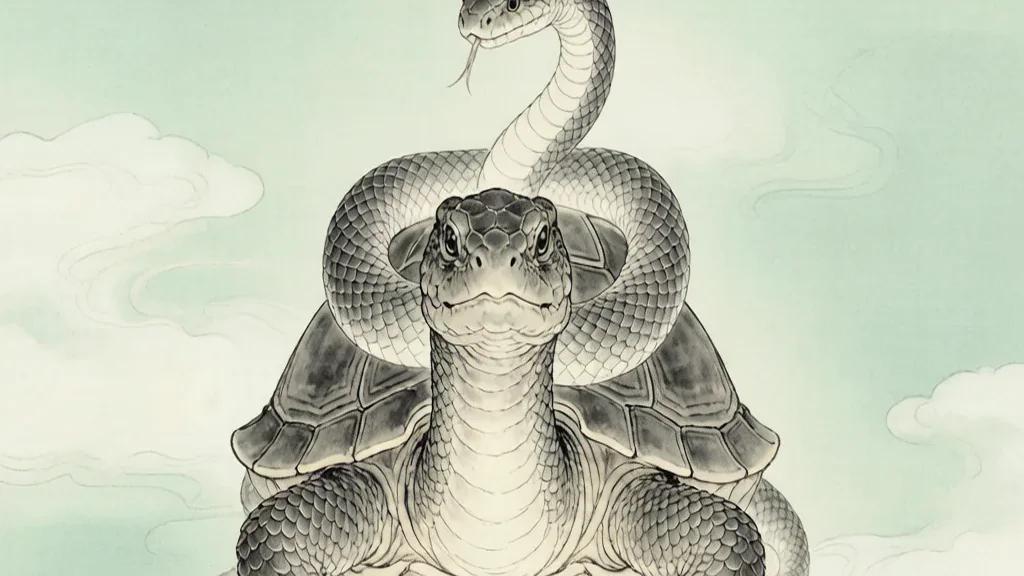
Xuanwu, written with characters meaning "black" and "warrior" and often rendered as the Black Tortoise or the Black Tortoise-and-Snake, is one of the Four Symbols that structure the Chinese cosmos, the guardian of the north, the season of winter, and the element of water. Unlike a simple animal, Xuanwu is typically shown as a tortoise entwined with a snake, a composite emblem of endurance and fluidity, stillness and motion, that anchors the dark and watery quarter of the universe. Alongside the Azure Dragon of the east, the Vermillion Bird of the south, and the White Tiger of the west, the Black Tortoise completes the celestial quartet that watches over the directions and the turning year. To know Xuanwu is to understand how the Chinese imagination gave the north a living guardian, one who later also became a revered deity of protection and long life.
The Four Symbols and the Northern Direction
The system of the Four Symbols organized the heavens and the earth into four protective powers, each linked to a direction, a season, an element, and a color. The Black Tortoise ruled the north and winter, the time of rest and hidden growth, and the element of water, the dark and yielding force that overcomes fire. His black color set him opposite the red of the southern Vermillion Bird, and his watery nature balanced the southern blaze in a paired cosmic opposition. Ancient astronomers grouped the northern stars into theBlack Tortoise mansion, visualizing them as the shell and coiled snake of the creature, so that Xuanwu was at once a mythic guardian and a practical marker of the northern sky.
This quartet joined naked-eye astronomy to mythology, giving observers a story for the turning heavens. The northern palace was the Black Tortoise, and its stars helped mark the calendar and orient the builder and the traveler. Xuanwu thus stood at the meeting point of science and symbol, a figure through whom the cold dark north became intelligible and guarded.
The Tortoise and the Snake
Xuanwu's defining image is the union of a tortoise and a snake, the slow earthbound reptile joined with the quick coiling serpent. The tortoise contributes longevity, stability, and the patient endurance associated with the northern winter, while the snake contributes the fluidity, transformation, and watery association proper to the element of water. Together they express a complete idea of the north: a stillness that is not death but dormancy, a darkness that hides the seeds of renewal. The snake wound around the shell is one of the most recognizable emblems in Chinese symbolism, appearing on tiles, tombs, and ritual art.
The pairing also carries a sexual and cosmic charge in some interpretations, the two creatures representing complementary forces entwined, yet in popular use the image is chiefly read as a protective guardian of the north. The essential point is synthesis: Xuanwu is not merely a tortoise nor merely a snake but the two as one power, a reminder that the northern quarter holds both rest and the latent energy of coming spring.
Element of Water and the Season of Winter
Water is the element assigned to Xuanwu, and with it come the qualities of darkness, cold, nourishment, and the quiet power of the depths. Winter is his season, the time when the world withdraws and gathers strength underground, and the north is his direction, the quarter of shadow and storage. In the logic of the Five Elements, water overcomes fire and is overcome by earth, so the Black Tortoise's northern flood was naturally balanced by the Vermillion Bird's southern flame. This balancing informed medicine, feng shui, and ritual, where harmony among the elements was a matter of personal and state well-being.
The black color is not mournful but foundational. Black in Chinese cosmology is the color of the north and of water, the deep source from which things emerge and to which they return. To paint or carve Xuanwu in black was to invoke the nourishing dark, the soil and stream that sustain life through the cold, and his image was therefore a reassurance rather than a portent of gloom.
Role in Astronomy and the Northern Palace
In the star lore of ancient China, the sky north of the celestial equator was grouped into the Black Tortoise mansion, one of the four celestial animal divisions used by astronomers and astrologers. The relevant stars were visualized as parts of the tortoise and snake, and their risings and settings helped regulate the calendar, especially the observances of winter. Officials tasked with calendrical science watched these constellations to time the rhythms of rest and preparation, so Xuanwu was both a mythic figure and a practical tool of seasonal regulation affecting agriculture and ritual.
The northern palace also figured in the matching of terrestrial and celestial order. Just as the creature ruled the northern sky, the emperor's northern rites and the northern orientation of certain spaces echoed his domain, creating a cosmic symmetry in which heaven and earth mirrored each other. Xuanwu was one of the clearest expressions of that mirroring.
Connection to the God Zhenwu
Beyond his role as a directional symbol, Xuanwu developed into a major Daoist deity, often called Zhenwu, the Perfected Warrior, a god of the north who subdued demons and protected the state and the individual. In this devotional form he is shown as a armored warrior trampling a tortoise and a snake, the creatures of his original emblem transformed into foes he has conquered, and he became especially popular in the Ming dynasty, when imperial patronage elevated his cult. The transformation from constellation-guardian to personal savior god shows the flexibility of Chinese myth, in which a cosmic symbol could acquire a devotional life of its own.
Pilgrims to sacred mountains such as Wudang venerated Zhenwu as a patron of protection, health, and the defeat of disorder, and temples dedicated to him dot the landscape. The link between the Black Tortoise symbol and the Perfected Warrior god is a prime example of how Chinese cosmology and popular religion interpenetrated, with the same figure serving both the astronomer's sky and the believer's prayer.
Place in Tomb and Temple Decoration
Xuanwu frequently appears in the decoration of tombs, where the four guardians were painted or carved to protect the deceased and align the burial with cosmic order. Han dynasty tomb paintings show him among the four protectors at his proper northern direction, assuring the soul a harmonious passage. Temples and palaces likewise used the four creatures on ridge tiles and beams, with the northern elements bearing his image, and feng shui formulas described the ideal site as having the Black Tortoise behind, the Azure Dragon on the left, the White Tiger on the right, and the Vermillion Bird in front.
In this spatial practice, Xuanwu represented the supportive ground at one's back, the stable dark mass that lets a person face the bright open south with confidence. The tortoise-and-snake thus became a daily architectural presence, embedded in the way houses and graves were oriented toward the cosmos.
Modern Cultural Presence
Today Xuanwu survives in heritage sites, illustrated mythologies, and the continuing use of the four-guardian motif in decoration and design. He appears in literature, games, and popular media as a water or earth guardian, and his name is invoked in astronomy outreach and in branding that wishes to suggest northern depth and stability. The Black Tortoise remains a vivid entry point for learners encountering the Chinese cosmic map, and his devotional aspect endures in active temples dedicated to Zhenwu.
Museums display tomb tiles and paintings bearing his image, and scholars study these artifacts to reconstruct how people conceived the universe and sought protection within it. Xuanwu therefore continues his ancient function, guarding the north and the winter, the water and the dark, the still foundation beneath the turning year.
Xuanwu and the Practice of Feng Shui
In the spatial art of feng shui, the ideal site is described as being sheltered by the Black Tortoise at the back, flanked by the Azure Dragon and the White Tiger on the left and right, and opened toward the bright Vermillion Bird in front. Xuanwu therefore represents the protective ground and support behind a dwelling or a grave, the stable dark mass that lets the occupant face the future with confidence. Practitioners read hills, buildings, and water as embodiments of these four creatures, turning the cosmic quartet into a practical grammar of placement.
This application shows how thoroughly the Four Symbols entered everyday life. A family choosing a gravesite or a merchant siting a shop could invoke Xuanwu's guarding presence without reciting astronomy, simply by orienting the structure so that a protective rise lay to the north. The Black Tortoise thus moved from the star chart to the building lot, a guardian embedded in the geometry of the home.
❓ Frequently Asked Questions
What is Xuanwu?
Xuanwu is the Black Tortoise, a guardian of the north, winter, and water among the Four Symbols of Chinese cosmology.
Why is Xuanwu a tortoise and a snake?
The tortoise gives longevity and stability, the snake gives fluidity and water, together expressing the northern quarter.
What element is associated with Xuanwu?
He is linked to water, the north, and winter in the system of the Five Elements and four directions.
How is Xuanwu related to Zhenwu?
Xuanwu developed into the Daoist god Zhenwu, the Perfected Warrior who protects and defeats demons.
Where does Xuanwu appear in art?
He appears on tomb walls, temple tiles, and ritual décor, often at northern orientations.
What are the other three symbols?
They are the Azure Dragon of the east, the Vermillion Bird of the south, and the White Tiger of the west.