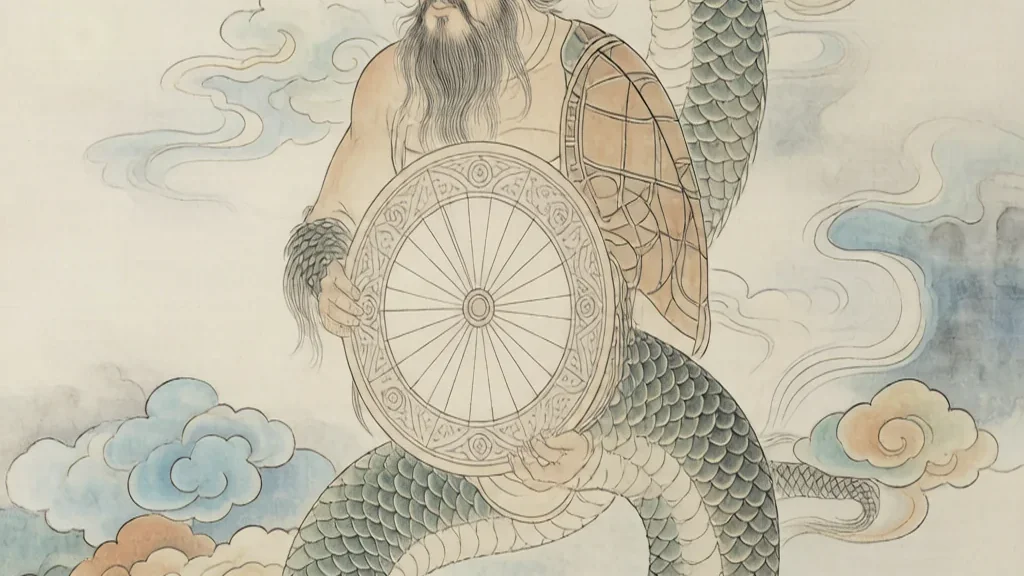
Fuxi, one of the supreme culture heroes of Chinese myth and credited as the first of the legendary Three Sovereigns, is inseparable from the dragon in both image and meaning. He is most often depicted with the upper body of a human and the lower body of a serpent or dragon, a form he shares with his sister and consort Nüwa, and this hybrid shape marks the pair as ancestors whose lineage flows into the dragon, the supreme benevolent power of Chinese cosmology. Beyond his appearance, Fuxi is the civilizing figure who taught humanity the Eight Trigrams, fishing, trapping, and the uses of fire and writing, and his dragon body signals that human civilization itself was seeded by a being touched with the divine serpent-dragon. To study Fuxi is to see how the Chinese tradition rooted the origins of culture in a dragon-tailed ancestor whose gifts made society possible.
Fuxi Among the Three Sovereigns
In the standard scheme of early mythic rulers, Fuxi stands at the head of the Three Sovereigns, the semidivine kings who preceded the great dynasties and laid the foundations of ordered life. He is followed in various lists by figures such as Nüwa and the Fire or Grain Sovereigns, and together they represent the dawn of human culture after the time of primal chaos. Fuxi's place at the front of this line gives him the role of inaugurator, the one who first lifted humanity from a bare subsistence existence into the realm of technique and symbol. His dragon body sets him apart from ordinary mortals while his human head binds him to the people he would teach.
The Three Sovereigns are not historical kings in the modern sense but mythic embodiments of civilizing forces, and Fuxi embodies the force of invention and ordering. By attributing the first tools and signs to a dragon-tailed being, the tradition asserts that culture is a gift from the boundary between the human and the divine, a gift carried into the world on a serpent's tail.
The Dragon-Tailed Form and Nüwa
Fuxi is almost always shown with a serpent or dragon lower body, and in the most famous images he and Nüwa face each other or entwine, his dragon tail crossing hers. Nüwa, his sister and in many versions his wife, is the goddess who molded humanity from yellow clay and repaired the broken sky, and the two together are honored as joint ancestors of the human race. Their shared serpent-dragon form is the visual core of the myth: humanity descends from a brother-sister pair whose bodies already partake of the dragon, which helps explain why the Chinese so often call themselves "descendants of the dragon." The tail is not a monstrous addition but a mark of sacred origin.
The intertwined tails also speak to the union of complementary forces, the male and female, the heavenly and the earthly, that together generate life. In painted and carved scenes from tombs and temples, the couple hold the tools of creation, Fuxi often bearing a carpenter's square and Nüwa a compass, instruments of measure and order that reinforce their role as founders of civilized form.
The Legend of His Birth
One well-known version of Fuxi's birth tells that his mother, Huaxu, conceived him after stepping in the giant footprint of a heavenly being, a motif that marks him as divinely fathered and set apart from ordinary humanity. Other accounts link his conception to a thunder or storm divinity, reinforcing the celestial and dragonlike charge of his nature. Such birth legends are common to culture heroes across the world, and in Fuxi's case they prepare the reader to accept a being who can invent writing and read the patterns of the cosmos. The marvelous birth justifies the marvelous career.
These stories also tie Fuxi to the weather and the sky, realms associated with the dragon, so that his origin, his body, and his mission all point in the same direction: he is a child of heaven sent to order the earth. The footprint and the storm are narrative devices that place him at the crossing of the divine and the human, exactly where a founder of culture must stand.
Invention of the Eight Trigrams
Fuxi's most celebrated intellectual gift is the invention of the Eight Trigrams, the bagua, the set of eight three-line symbols whose combinations underlie the Yijing, the classic of change. According to tradition, he observed the patterns of heaven and earth, the marks on a dragon-horse or a tortoise, and the arrangements of natural things, and from them derived the trigrams that encode the fundamental modes of reality. This act is the founding of Chinese symbolic thought, the moment when the flux of the world was first caught in a system of signs, and it is fitting that a dragon-tailed being performed it, since the dragon links the earthly and the celestial.
The trigrams became the root of divination, medicine, statecraft, and cosmology, a compact notation for the dynamic balance of forces that the Chinese imagined as the substance of the world. By crediting Fuxi with their discovery, the tradition makes the dragon-ancestor the source of its deepest intellectual instrument, so that every later use of the bagua echoes his serpentine gift.
Gifts of Civilization
Beyond the trigrams, Fuxi is credited with a host of civilizing inventions that together amount to the basic toolkit of settled life. He is said to have taught people to fish with nets and to trap animals, to cook food with fire, to keep domesticated animals, and to fashion clothing from hides, replacing the nakedness of the wild. Some accounts add music and the early forms of writing to his résumé, presenting him as a near-universal teacher whose lessons moved humanity from foraging to making. Each gift answers a concrete need, and together they sketch the transition from nature to culture that the hero exists to explain.
The dragon tail does not contradict these practical gifts; rather it sanctifies them. A being partly divine could legitimately originate skills that ordinary people could not have devised alone, and the myth thereby solves the puzzle of how tools and signs first appeared. Fuxi is the answer to the question of beginnings, and his serpent body is the seal on that answer.
Connection to the Dragon Ancestry
The identification of Fuxi with the dragon is the deepest reason for his importance in Chinese identity. Because he and Nüwa are dragon-tailed ancestors of humanity, the dragon ceases to be merely an external symbol and becomes a genealogical claim: to be human in this tradition is already to be kin to the dragon. This mythic kinship informed art, ritual, and self-description for millennia, and it helps explain the warmth with which the dragon is embraced as a national emblem. Fuxi is the hinge of that embrace, the ancestor who first wore the dragon form on his own body.
The serpent-dragon also links Fuxi to water and renewal, since the dragon governs rain and the serpent sheds its skin, and these associations suit a founder of life and culture. His body thus carries a whole cosmology of fertility and transformation, compressed into the image of a tail.
Modern Cultural Legacy
Today Fuxi remains a central figure in the heritage of Chinese myth, honored in temples and festivals, especially in regions that claim his birthplace or cult, and studied by scholars of religion, art, and early history. He appears in illustrated mythologies, in museum displays of tomb art showing him with Nüwa, and in modern media that retell the founding legends for new audiences. The phrase "descendants of the dragon" still echoes his mythic parenthood, and his dragon tail continues to serve as a visual shorthand for the sacred origins of Chinese civilization.
For modern readers, Fuxi offers a founding story in which culture is not a cold acquisition but a gift of the divine-serpent ancestor, a being who taught humans to read the world and to remake it. His enduring presence in art and ritual confirms that the dragon-tailed hero still speaks to a deep need to know where we come from, and why the tools of civilization are worth preserving.
Fuxi in Worship and Festival
Communities that claim Fuxi as a native son or founder have long maintained temples and seasonal festivals in his honor, where his dragon-tailed image is carried, displayed, and invoked as the source of civilization and the ancestor of the people. These observances blend gratitude for his gifts with a recognition of shared descent, and they draw scholars, pilgrims, and performers who keep the founding legend vivid in public life. The rituals affirm the bond between the human and the dragon, enacted before the figure of the serpent-bodied hero.
Such worship also serves a civic purpose, linking local identity to the deepest roots of Chinese culture and offering a focus for celebration of invention, learning, and order. In festival and prayer alike, Fuxi remains what the myth first made him: the dragon-ancestor who taught humanity to read the world and to build a life worth remembering.
❓ Frequently Asked Questions
Who is Fuxi?
Fuxi is a supreme culture hero of Chinese myth, the first of the Three Sovereigns, shown with a human top and a dragon-serpent tail.
Why is Fuxi linked to the dragon?
His lower body is a serpent or dragon, marking him and Nüwa as dragon-tailed ancestors of humanity.
What did Fuxi invent?
He is credited with the Eight Trigrams, fishing nets, trapping, fire cooking, and early writing.
How is Fuxi related to Nüwa?
She is his sister and consort, and together they are honored as joint ancestors of the human race.
What is the birth legend of Fuxi?
His mother Huaxu conceived him after stepping in a giant heavenly footprint, marking his divine origin.
Why is Fuxi important today?
He remains a heritage figure explaining the dragon ancestry and the sacred origins of Chinese civilization.