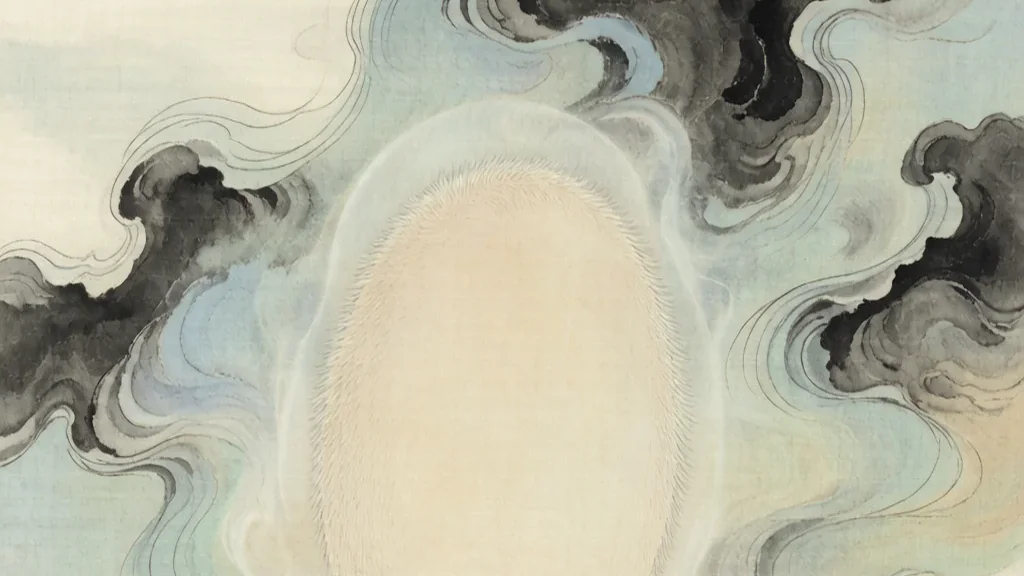
Hundun, written in Chinese as 混沌 and also romanized as hun dun, is the Chinese concept and creature of primordial chaos, the undifferentiated state that existed before the world took ordered shape. As a philosophical idea it names the formless, seamless beginning from which the separated things of the cosmos emerged; as a mythic being it appears both as a placid ruler in the writings of Zhuangzi and as one of the four malevolent beasts punished by the ancient sage kings. The richness of hundun lies in this double life: it is at once the gentle womb of creation and a frightening symbol of disorder that must be cut open and ordered by civilization. This article explores hundun as cosmic chaos, as the beloved lord in the Zhuangzi parable, as a member of the four perils, and as a surviving word in everyday Chinese, where it still means confusion or muddle. Few images in Chinese thought better capture the tension between the comfort of the unformed and the necessity of form.
Hundun as Primordial Chaos
In the Chinese cosmological imagination, the world did not begin with a crafted object but with a boundless, featureless murk in which the later distinctions of heaven and earth, light and dark, and the myriad things were all mixed together. This is hundun, the chaotic unity that precedes separation. The idea appears in several early texts and underlies the common story that the giant Pan Gu, or in some tellings the separation of yin and yang, broke the original unity and let the ordered world unfold.
Hundun is not chaos in the sense of mere random noise; it is better understood as undifferentiated plenitude, a wholeness that has not yet been carved into parts. In this sense it is close to the Daoist esteem for the unnameable and the undivided, the state before labels and boundaries appeared.
The word itself is built from two characters that together suggest a swirling, enveloping obscurity, and the pairing reinforces the picture of a rounded, seamless cloud from which everything else is born.
The Parable of Hundun in Zhuangzi
The most charming literary appearance of hundun is in the Zhuangzi, the Daoist text, where Hundun is a ruler of the center. In the parable, the two emperors of the south and north, named Shu and Hu, are welcome guests in the land of Hundun, and wishing to repay his hospitality, they decide to bore the seven openings into his face so that he can see, hear, eat, and breathe like them. They drill one opening each day, and on the seventh day Hundun dies. The story is a gentle warning that imposed order, however well meant, can destroy a naturally whole being.
This parable turns hundun into a sympathetic figure, a generous host whose very completeness is violated by the urge to make him normal. The names Shu and Hu, meaning sudden and quick, underscore the violence of hurried intervention, while Hundun stands for the slow, seamless way of nature.
For Daoist readers the tale recommends leaving things be, trusting the unforced process of transformation rather than carving the world to fit human expectation. Hundun's death is the price of premature form.
Hundun Among the Four Perils
A very different tradition lists hundun as one of the four perils, the si xiong, the malevolent creatures or peoples that the legendary sage kings Yao and Shun are said to have banished or punished. In this context hundun is described as a chaotic, disordered being, sometimes a beast with a doglike or bearlike body, long hair, and no eyes or ears to speak of, a creature that walks as though it were blind and that devours the good while favoring the bad.
Here hundun stands for political and moral disorder, the confusion that a virtuous ruler must clear away. The contrast with the Zhuangzi parable is stark: the philosopher loves the unformed, while the courtly legend fears it as a social danger to be expelled.
This double status, beloved by Daoists and reviled by Confucian statecraft, shows how one mythic name could serve opposite lessons depending on who was telling the story and why.
The Body of the Chaos Beast
When depicted as a creature, hundun is usually a round, furry blob with no clearly defined features, an image that mirrors its conceptual meaning of formlessness. Some descriptions give it a long coat of hair, a piglike or doglike shape, and legs that seem to move without direction, as though the beast itself did not know where it was going.
The lack of openings is the key visual joke and the key theological point. Just as the Zhuangzi Hundun has no seven apertures, the beast of the four perils has no functional senses through which order might enter, so it remains trapped in its muddle.
Artists who drew the four perils therefore faced the odd task of picturing a thing defined by its lack of pictureworthy features, and they solved it with a comic, baglike shape that readers instantly read as confusion made flesh.
Hundun and the Birth of the World
Beyond philosophy and bestiary, hundun functions in Chinese myth as the raw material of creation. Many origin accounts begin with the united qi of the primal murk and describe how the clear light rose to become heaven while the heavy turbidity sank to become earth. Hundun is the before picture, the cloud that must be opened for the world to appear.
This role links hundun to a widespread human pattern in which creation begins with a cosmic egg or a dark water, a single thing that is split to make many. The Chinese version is distinctive in giving the undifferentiated state a name and even a personality, so that the dawn of order feels like an event in the life of a being.
Reading hundun this way, the death of the Zhuangzi ruler and the banishment of the four perils beast are both echoes of the same primal moment: the moment form is cut from the unformed.
Hundun in Language and Daily Life
The word hundun did not stay in philosophy and myth; it entered ordinary speech as the standard term for confusion, muddle, and disorder. To call a situation hundun is to say it is a muddled, poorly organized mess, and the word carries that meaning in modern Chinese without any need to recall the ancient chaos creature.
The same characters also name the wonton, the filled dumpling, written with different but related characters that sound the same. Folk etymology playfully explains the dumpling as a little packet of original soup, a tasty relic of the primal broth, though scholars trace the food name through its own linguistic path.
Either way, hundun shows the rare fate of a cosmic principle that remained a living, everyday word, so that a person complaining about a chaotic desk is unknowingly invoking the primordial chaos of Chinese myth.
Hundun in Later Art and Thought
Neo Daoist and Buddhist-influenced writers sometimes used hundun to discuss the ground of mind before discursive thought, the silent awareness that precedes distinctions. In this refined sense the chaos is not a problem to solve but the source to return to, a mystical undoing of the seven openings drilled by everyday life.
Painters and poets occasionally evoked hundun through misty, featureless mountain scenes in which forms dissolve into cloud, visually citing the undivided original state without drawing a literal beast. The aesthetic of the vague and the unresolved thus became a quiet homage to chaos.
In the modern period hundun appears in fiction and games as a primordial boss or a symbol of entropy, keeping alive the ancient intuition that the first thing and the last threat may be the same unshaped cloud.
Hundun in Later Daoist and Alchemical Thought
In the centuries after the early texts, Daoist and alchemical writers adopted hundun as a technical image for the undifferentiated ground from which the cultivated self was to be rebuilt. Inner alchemy spoke of returning to the state before the seven openings, a deliberate undoing of the drilling performed by the emperors Shu and Hu, so that the practitioner might recover the original wholeness that the Zhuangzi parable had shown destroyed. The chaos became a method rather than a mere myth.
The world before heaven and earth, the primal qi before its division, was often called hundun in these systems, and the term gave adepts a name for the fertile silence at the root of both cosmos and mind. To dwell in hundun was not confusion but an achieved stillness, the opposite of the muddled everyday usage of the word, a quiet the practitioner sought rather than feared.
Meditation guides and poems therefore used the chaos creature as a positive goal, a striking reversal of the four perils tradition and a sign of how thoroughly the one name had been bent to serve opposite teachings. What the sage kings had expelled, the alchemist embraced, and the same unformed cloud became both the first danger and the final refuge.
❓ Frequently Asked Questions
What does hundun mean?
Hundun means primordial chaos, the undifferentiated state before the world was ordered, and in daily speech it simply means confusion or muddle.
What is the Zhuangzi parable of Hundun?
It is the story of a central ruler named Hundun whose guests bore seven openings into his face to help him, but he died on the seventh day, teaching that forced order can destroy natural wholeness.
Is hundun a good or bad figure?
Both; Daoists treat it as a beloved symbol of unforced wholeness, while the four perils tradition treats it as disorderly evil to be banished.
How is hundun depicted as a beast?
As a round, hairy, featureless creature with no eyes or ears, walking blindly and unable to tell good from bad.
How does hundun relate to creation?
It is the formless primal stuff from which clear heaven and heavy earth separated when the world began.
Does hundun appear in modern Chinese?
Yes, as a common word for chaos or confusion, and through the wonton dumpling whose name sounds the same.