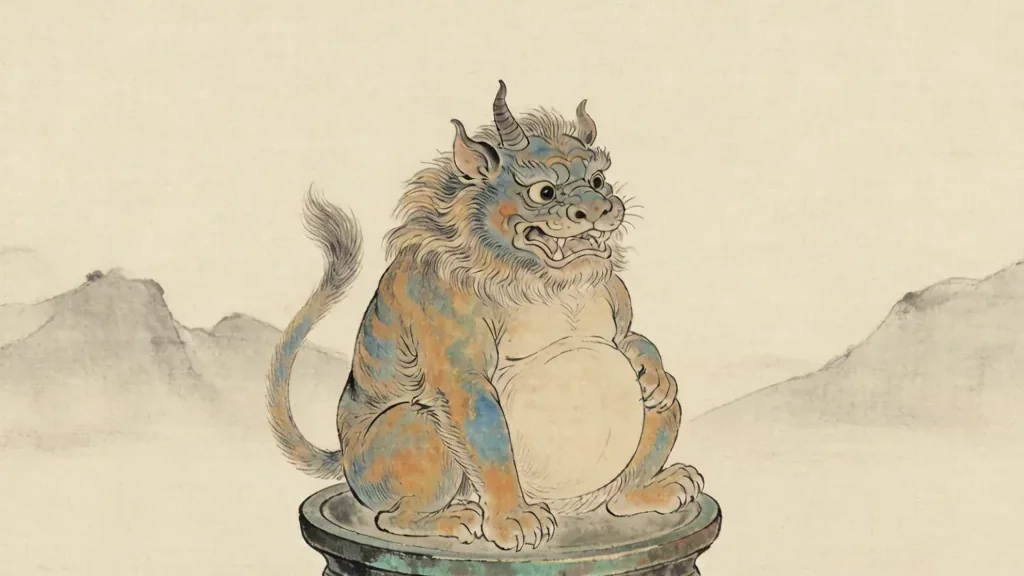
Among the most enigmatic and instantly recognizable motifs in Chinese art history, the Taotie (饕餮) face has stared out from bronze ritual vessels for over three thousand years. This zoomorphic mask design — characterized by two large staring eyes, curling horns, and a gaping mouth often lacking a lower jaw — appears on countless Shang Dynasty (circa 1600-1046 BCE) and Zhou Dynasty (1046-256 BCE) bronzes. The Lüshi Chunqiu, compiled around 239 BCE, describes the Taotie as a creature so gluttonous that it devoured everything, even its own body, leaving only a head. Scholars have debated whether the motif represents a specific mythical beast, a shamanic spirit, or an abstract symbolic device, but its ubiquity on the most sacred objects of early Chinese civilization leaves no doubt about its profound cultural significance.
The Taotie in Shang and Zhou Bronze Art
The Taotie motif reached its zenith during the Shang Dynasty, when Chinese bronze casting achieved an unparalleled level of technical sophistication. The famous Simuwu Ding, the largest known Shang bronze vessel discovered at Anyang in 1939 and weighing 832.84 kilograms, features prominent Taotie faces on all four sides. Archaeologists working at the Yinxu site, the last Shang capital, have unearthed thousands of bronze vessels decorated with Taotie patterns, ranging from massive ritual cauldrons to delicate wine cups. The motif typically appears in a bilaterally symmetrical arrangement, with the face split down the middle when viewed on the vessel's seams. The eyes of the Taotie are invariably the most prominent feature, often inlaid with turquoise or rendered in high relief to catch the flickering light of ritual fires.
The decorative system of Shang bronze vessels was remarkably sophisticated, with the Taotie forming only one element of a complex visual vocabulary. Vessels were typically organized into horizontal register bands, with the Taotie face occupying the most prominent band — usually the central or upper register — while subsidiary motifs filled the remaining space. The leiwen (thunder pattern), consisting of continuous spiral motifs, served as the background filler, creating a textured surface that contrasted with the bold, raised lines of the Taotie. Animal motifs such as cicadas, dragons, and birds often accompanied the Taotie in subordinate registers, each carrying specific symbolic associations. The cicada, for instance, symbolized rebirth and immortality, appearing on wine vessels used in ancestral offerings. This hierarchical organization of decorative elements mirrored the social hierarchy of Shang society itself, with the fearsome Taotie — the most powerful motif — occupying the position of honor.
Bronze casting techniques evolved significantly over the course of the Shang and Zhou dynasties, and the Taotie motif evolved with them. Early Shang Taotie designs were relatively simple, rendered in thin relief lines against plain backgrounds. By the late Shang period, during the reign of King Wu Ding, the motif had become extraordinarily elaborate, with multiple layers of relief creating a sense of depth and movement. The Zhou Dynasty introduced new vessel shapes and modified the Taotie's design, often incorporating it into more complex narrative scenes. The distinctive animal mask continued to appear on bronzes throughout the Western Zhou period but gradually became more stylized and abstract. By the Spring and Autumn period (770-476 BCE), the Taotie had largely given way to more intricate geometric patterns and scenes of hunting and feasting, reflecting the shift from religious ritual to secular display in Zhou bronze culture.
The Taotie Motif: Technical Mastery and Symbolic Language
The creation of Taotie-decorated bronzes represented the pinnacle of Shang metallurgical achievement. Artisans employed the piece-mold casting technique, a uniquely Chinese innovation that involved creating separate clay molds for each section of a vessel. The Taotie face was often divided along the vertical seam of the mold, requiring extraordinary precision to ensure that the two halves aligned perfectly when joined. This technical constraint paradoxically enhanced the motif's visual impact: the seam running through the Taotie's face created a natural bisymmetry that emphasized the creature's staring eyes. Bronze vessels from the reign of King Wu Ding (circa 1250-1192 BCE) exhibit the most refined Taotie designs, with intricate leiwen (thunder pattern) spirals filling the background and contrasting with the bold, raised lines of the beast's features.
The choice of Taotie as the primary decorative motif for ritual vessels was no accident. Shang ritual bronzes were used in ceremonies honoring ancestors, and the Taotie's fearsome visage served multiple symbolic functions. Its staring eyes were believed to ward off malevolent spirits that might interfere with sacrificial offerings, while its gaping mouth — though missing a lower jaw — symbolized the consumption of offerings and their transmission to the ancestral realm. The motif's constant presence on food and wine vessels created a visual connection between the act of eating and the spiritual nourishment of ancestors. Recent research by Chinese archaeologist Zhang Changping has suggested that the Taotie may represent a composite of various animal species — including deer, oxen, and birds — that were sacrificed in Shang ritual practices, making the motif a condensed visual catalog of the Shang sacrificial worldview.
Interpretations: Gluttony, Power, and the Spirit World
The most famous literary account of the Taotie comes from the Zuo Zhuan, which records that the Taotie was one of the four evil creatures banished by the legendary Emperor Shun. The text describes the Taotie as insatiably greedy and avaricious, consuming wealth and food without restraint. This moralistic interpretation has led generations of scholars to view the Taotie motif as a warning against excess. However, the sinologist Sarah Allan proposed an alternative reading in her 1991 work The Shape of the Turtle, suggesting that the Taotie represents a shamanic spirit mask used in rituals to communicate with ancestors. In this view, the fearsome visage was not a cautionary tale but a conduit to the supernatural world, its staring eyes serving as portals through which the living could glimpse the realm of the dead.
The Philosophy of Gluttony: Taotie as a Moral Allegory
The Taotie's association with insatiable appetite gave rise to a rich vein of philosophical reflection in Chinese intellectual history. The Lüshi Chunqiu, compiled under the patronage of Qin Dynasty chancellor Lü Buwei, uses the Taotie as a cautionary example of the dangers of unchecked desire. The text warns that "the Taotie devours everything, but devours even itself in the end" — a metaphor for the self-destructive nature of greed. This theme was developed further by later Confucian scholars, who interpreted the Taotie as a symbol of the corrupting influence of material excess on moral character. The Neo-Confucian philosopher Zhu Xi (1130-1200 CE) referenced the Taotie in his commentaries on the Great Learning, arguing that just as the Taotie consumes itself through insatiable hunger, so too does an unchecked appetite for wealth and power consume the virtuous individual.
The Taotie's philosophical significance extends beyond mere moralizing to touch on fundamental questions about desire, consumption, and the self. In Buddhist-influenced Chinese thought, the Taotie came to represent the cycle of craving and suffering that binds beings to samsara. The creature's inability to stop eating, even when its body has been consumed, mirrors the Buddhist concept of tanha — the thirst or craving that perpetuates suffering. Daoist philosophers drew a different lesson, seeing in the Taotie a warning against the violation of wu wei (effortless action). The Taotie's compulsive consumption represents the opposite of the Daoist ideal: it acts excessively, grasping at everything, and in doing so destroys the balance that sustains life. These multiple philosophical interpretations demonstrate the remarkable versatility of the Taotie as a symbol, capable of embodying different ethical concerns across China's diverse intellectual traditions.
In contemporary Chinese language, the Taotie's legacy lives on through idiomatic expressions that reflect its moral connotations. The phrase "taotie da can" (饕餮大餐) is used to describe a sumptuous feast, but carries an undertone of excessive indulgence that would have been recognized by classical scholars. More pointedly, the term "taotie wu" (饕餮之徒), meaning "a Taotie person," is used to describe a glutton or someone of insatiable greed. Modern Chinese economic discourse has even employed the Taotie metaphor to criticize corporate monopolies that devour smaller competitors. This linguistic persistence demonstrates how an ancient mythological motif continues to shape Chinese moral reasoning about consumption, desire, and restraint in the twenty-first century, bridging the gap between Shang Dynasty ritual practice and contemporary ethical concerns.
Archaeological Discoveries and Scholarly Debates
The study of the Taotie has been a central concern of Chinese archaeology since the field's inception in the early twentieth century. Li Ji, often called the father of Chinese archaeology, conducted the first systematic excavations at Anyang from 1928 to 1937 under the auspices of the Academia Sinica, documenting hundreds of Taotie-decorated bronzes. The discovery of the Sanxingdui site in Sichuan Province in 1986 challenged traditional understandings of the Taotie's geographic distribution, as the site yielded bronze masks with Taotie-like features that were distinct from the Anyang style. In 2003, researchers using X-ray fluorescence analysis on bronzes from the tomb of Fu Hao, a Shang queen and military leader buried around 1200 BCE, confirmed that the Taotie motifs on her vessels were cast using sophisticated piece-mold techniques.
The Taotie's Legacy in Later Chinese Art and Global Culture
Although the Taotie motif largely disappeared from ritual art after the Spring and Autumn period (770-476 BCE), its aesthetic influence persisted through Chinese history. During the Song Dynasty, antiquarian scholars like Lü Dalin catalogued ancient bronzes in works such as Kaogu Tu (1092 CE), the first illustrated catalogue of Chinese antiquities, which included detailed drawings of Taotie designs. Ming and Qing Dynasty decorative arts frequently incorporated archaistic Taotie motifs on ceramics, jade carvings, and furniture. The twentieth-century discovery of Shang bronzes captivated Western modernists: the British sculptor Henry Moore collected photographs of Taotie vessels and incorporated their biomorphic abstraction into his work. In contemporary global culture, the 2016 Zhang Yimou film The Great Wall featured Taotie as monstrous antagonists, and the Chinese tech company Baidu named one of its AI chips the Taotie chip.