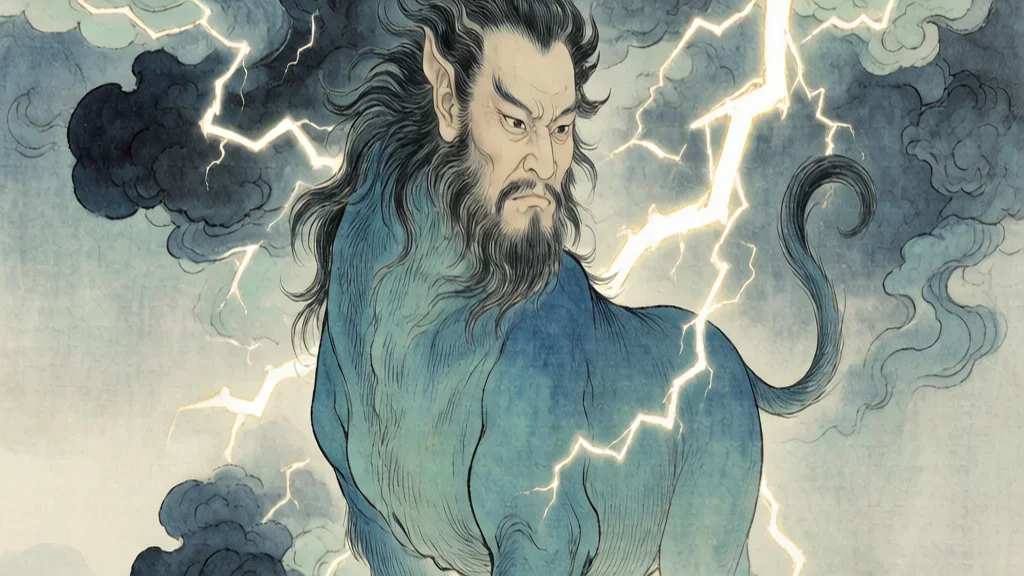
Kui (夔) is the one-legged thunder beast of the Classic of Mountains and Seas whose hide the Yellow Emperor turned into a war drum that terrified his enemies. Part storm-spirit, part bronze-age design motif, and part legendary musician, Kui is one of the few mythic beasts whose name survived both as a monster and as a decorative convention on ancient ritual bronzes. Its single leg, its roar like thunder, and its drum made from living hide together capture how early China imagined the raw sound of power before it was civilized into music and ritual.
The Thunder Beast of Liubo Mountain
The Classic of the Great Wilderness: East (大荒东经) gives the canonical account: far out in the East Sea stands Liubo Mountain (流波山), 7,000 li from the shore, and on it lives a beast "shaped like an ox, with a blue-green body and no horns, with a single leg." When it enters or leaves the water it brings wind and rain; its light is like the sun and moon, and its voice is like thunder — and its name is Kui. The portrait is unambiguous: a one-legged, ox-like storm creature whose very emergence from the sea churns the weather, glowing and bellowing like a living thunderclap.
Kui and the Yellow Emperor's War Drum
The same passage continues with the founding myth of Chinese martial music. The Yellow Emperor (黄帝) captured Kui and made a drum from its skin; he beat it with a drumstick fashioned from the bone of the thunder beast Leishou (雷兽). The sound carried five hundred li and "awed the world" — traditionally used to terrify the rebel Chi You (蚩尤) and his army at the decisive battle of Zhuolu. The story binds Kui's thunder-voice to the first war drum, implying that organized sound itself, weaponized, won the empire its order. Kui's hide literally became the instrument of sovereignty.
From Ox to Dragon: The Bronze-Age Kui Motif
By the Shang and Zhou dynasties the storm-beast had been domesticated into ornament. The "kui dragon" (夔龙, kuí lóng) is one of the most common motifs on ritual bronzes: a slender, coiling dragon shown in profile with a single visible leg, an open, fanged jaw, and a tail curled into a hook. Whether the one leg reflects the beast's myth or is simply how a profile dragon is drawn, the kui pattern became a hallmark of bronze decoration, repeated in bands around ding (鼎) cauldrons and gui (簋) vessels. The wild thunder ox thus entered the vocabulary of court art.
Kui the Music Master of Emperor Shun
A different, human Kui appears in the Classic of History (尚书·尧典), where the sage-king Shun appoints an official named Kui to govern music: "Kui, I charge you with music." Kui replies that when he strikes the stone chimes, "the hundred beasts dance in time." This Kui is a culture hero of harmony, not a storm-beast. Later writers noticed the shared name and sometimes merged the two, but the texts keep them distinct: one is a one-legged mountain spirit of the Shanhaijing, the other a legendary minister of ritual sound. The overlap shows how naturally Kui's "voice like thunder" slid into the idea of music.
Kui in Later Art and Ritual
Beyond bronzes, the kui dragon appeared on jade, lacquer, and architectural friezes, usually as a repeating auspicious band. Because the kui motif reads as both dragon and thunder-symbol, it carried connotations of awakening, vibration, and the life-force that moves the world. Ritual vessels decorated with kui were not merely pretty; they broadcast the owner's link to the founding thunder-drum and, through it, to the Yellow Emperor's victory and the legitimacy of kingship itself.
Thunder, Sound, and the One-Legged Symbol
Kui's most puzzling feature — the single leg — has been read many ways. One reading notes that a dragon drawn in profile shows only one leg, so the "one leg" is an artist's convention mistaken for a fact. Another sees the lone leg as a symbol of singularity and focus: the one support from which all sound and motion issue, just as a drum stands on one frame. Either way, Kui condenses a profound idea — that the universe's first powerful act was not a thing but a sound, and that sound (thunder, drum, music) is the true instrument of order.
Kui in Modern Imagination
Today Kui survives as a recognizable name in Chinese fantasy games and animation, where it is usually rendered as a blue, one-legged dragon-ox whose roar summons storms. Museums label the "kui dragon" pattern on Shang bronzes for visitors, keeping the art-historical Kui alive. And the phrase "Kui drum" (夔鼓) still surfaces in literature as a metaphor for a summons too loud to ignore. From a single cryptic line about a one-legged ox on a sea mountain, Kui became at once a monster, a melody, and a motif.
Kui in Early Cosmography
The Kui story is set at the very edge of the known world. The Classic of Mountains and Seas places the beast on Liubo Mountain, seven thousand li out in the Eastern Sea, a distance so vast it marks the boundary between the familiar land and the wild ocean. This geography is no accident. By putting a one-legged storm creature at the rim of the map, the text frames Kui as a frontier spirit, a being of the threshold where China meets the chaos of water and weather. The mountain's remoteness also explains the wonder: only at the world's edge could a beast glow like the sun and bellow like thunder without being tamed. Read this way, Kui's capture by the Yellow Emperor is a story about the center drawing the edge inward, about civilization taking the raw voice of the outermost sea and turning it into the order of the drum.
❓ Frequently Asked Questions
📝 Chinese Vocabulary
夔 — : Kui; the one-legged thunder beast of the Shanhaijing.
夔龙 — : Kui dragon; the one-legged coiling dragon motif on Shang-Zhou bronzes.
山海经 — : Classic of Mountains and Seas; the source of Kui's description.
黄帝 — : Yellow Emperor; who made Kui's hide into a war drum.
雷兽 — : Leishou; the thunder beast whose bone drummed Kui's hide.
蚩尤 — : The rebel leader defeated by the Yellow Emperor at the battle that founded his rule, using Kui's thunderous drum.
涿鹿 — : The battlefield where the Yellow Emperor defeated Chi You, traditionally the site where Kui's drum was sounded.
雷 — : Thunder; the sound Kui's voice resembled and the force his hide was made to summon.
🎉 Fun Facts
- Kui's war drum was said to be audible for 500 li — roughly 250 kilometers — across the battlefield.
- The "kui dragon" is one of the most common decorative bands on Shang and Zhou ritual bronzes.
- The single leg may be an artist's convention: a dragon in profile simply shows one leg.
- Kui shares its name with a legendary music minister of King Shun, linking thunder and melody.
- Kui's roar was so identified with thunder that later writers described ordinary summer storms as the beast calling from the Eastern Sea.
- Beyond ritual bronzes, the kui motif also appears on later jade and lacquer as a repeating auspicious band, carrying the idea of awakening and vibration.