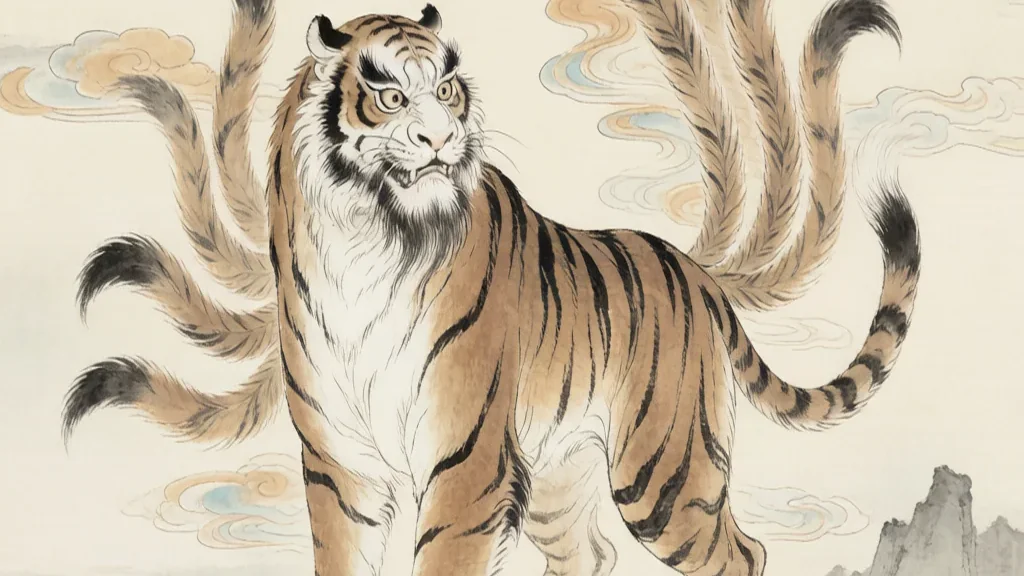
Lu Wu (陆吾, Lùwú) is the tiger-bodied, nine-tailed god who keeps the order of Kunlun, the cosmic mountain where the celestial thearch descends to earth. Named in the Classic of Mountains and Seas as the steward of the Nine Celestial Regions, he is one of the few mythological beings described as a fully divine administrator rather than a mere beast, and his strange, beautiful form made him the archetypal guardian of the world's spiritual center.
The God Who Guards Kunlun
Lu Wu first appears in the "West Mountains" chapter (Xi Shan Jing) of the Classic of Mountains and Seas (Shanhaijing, 山海经), the great Han-era compilation of regional地理 and myth. The text says that Mount Kunlun (昆仑) is the earthly capital of the Supreme Thearch (帝之下都), and that the god Lu Wu governs it. Far from being a wild animal, he is addressed as a shen (神, a god or spirit), a civilized officer of the heavenly bureaucracy charged with maintaining the mountain's sacred order.
In later Taoist and popular lore, Kunlun became the paradise of the Queen Mother of the West (西王母, Xīwángmǔ), and Lu Wu's role as gatekeeper of that realm grew more elaborate. But his oldest identity is precise: he is the warden of the axis where heaven meets earth, the official who keeps the cosmic capital running.
Form and Face: Tiger Body, Nine Tails, Human Visage
The Classic of Mountains and Seas gives Lu Wu a striking, hybrid shape: "a tiger's body and nine tails, a human face and tiger claws" (虎身而九尾,人面而虎爪). The nine tails mark him as a creature of immense auspicious power — the same number that distinguishes the famous nine-tailed fox — while the human face signals intelligence and administrative authority rather than bestial chaos. The tiger claws root him in the predatory majesty of the great cat.
It is worth correcting a common confusion: Lu Wu has nine tails, not nine heads. The nine-headed guardian of Kunlun described elsewhere in the same book is a different figure, the Kaiming beast (开明兽), who sits at the mountain's nine gates. Mixing the two is an easy mistake, because both are man-faced tiger guardians of the same sacred peak.
Keeper of the Nine Celestial Regions
Lu Wu's duty is stated in a single loaded phrase: he "administers the nine regions of heaven and the seasons of the thearch's enclosed park" (司天之九部及帝之囿时). The "nine regions" (九部) describe the full division of the celestial realm, while the "enclosed park" (囿) is the heavenly garden whose planting and timing he supervises. In other words, he is both a territorial guardian and a master of cosmic calendar — the official who makes sure the seasons of paradise turn correctly.
This combination of policing and scheduling explains why Lu Wu reads less like a monster and more like a minister. He does not simply frighten intruders; he actively governs. His nine tails, in this reading, are not just ornament but a sign of his reach across all nine divisions of the sky.
Lu Wu and the Other Kunlun Guardians
Kunlun is crowded with extraordinary wardens, and Lu Wu is best understood beside them. The Kaiming beast (开明兽) is the nine-headed, man-faced tiger who literally mans the nine gates of the mountain's innermost court. Ying Zhao (英招, Yīnghāo), another officer named in the same West Mountains chapter, has a horse's body, a human face, tiger stripes, and bird's wings, and he oversees Mount Huaijiang, a sacred peak neighboring Kunlun. Each creature polices a different stratum of the holy mountain.
What sets Lu Wu apart is rank and function: where Kaiming guards gates and Ying Zhao tends an adjacent peak, Lu Wu administers the celestial regions themselves. The three together show how the Classic of Mountains and Seas imagined a whole bureaucracy of part-animal gods staffing the geography of the sacred world.
Kunlun in Chinese Cosmology
To grasp Lu Wu, one must grasp Kunlun. In early Chinese cosmology the mountain was the pillar at the center of the world, the place where the Yellow Emperor and the celestial thearch held court, watered by the River of Heaven and shaded by the Fusang tree. Later it became the western paradise, home of immortals and of the Queen Mother of the West, who dispensed the peaches of longevity from its orchards.
Lu Wu's post at this axis made him a guardian of the boundary between mortal and divine. Pilgrims, shamans, and souls were all understood to pass through Kunlun's sphere, and the nine-tailed god was the power that decided what could enter and what must stay out — a role that fed directly into the later Chinese idea of the mountain as a gateway to transcendence.
Legacy in Art and Modern Culture
Because his form is so distinctive, Lu Wu has remained a recognizable figure in the visual vocabulary of Chinese myth. He appears in illustrated Shanhaijing manuscripts from the Song through the Qing dynasties, usually drawn as a striped tiger with a calm human face and a fan of nine tails. Modern fantasy art and video games have rediscovered him as a dignified, almost regal guardian rather than a fearsome monster.
He features, for example, as a guardian boss in the acclaimed game Black Myth: Wukong, where his Kunlun heritage is used to signal an encounter with the old, ordered cosmos of the gods. Such appearances show how a creature first recorded two thousand years ago as a heavenly administrator still carries authority on screen today.
Lu Wu in Illustrated Manuscripts
From the Song dynasty onward, the Classic of Mountains and Seas was copied in editions filled with pictures, and Lu Wu was a favorite subject. Illustrators drew him as a striped tiger with a calm, almost courtly human face and a fan of nine tails spreading behind him, a shape both strange and dignified. These images were not casual doodles; they were part of how readers learned the geography of the sacred world, with each beast keyed to a place and a duty. The consistency of the drawing across centuries shows that Lu Wu's form was stable in the visual imagination even as his stories shifted. Modern fantasy art and video games have rediscovered this look, presenting him as a regal guardian rather than a fright. The long line of illustrated Lu Wu is a small record of how China pictured its divine bureaucracy.
The Tiger-Face Guardian Motif
Lu Wu belongs to a wider family of man-faced, tiger-bodied guardians in Chinese myth. The Kaiming beast at Kunlun's gates shares his human face and feline body, and other theriomorphic officers in the same texts mix animal strength with human reason to signal authority. The pattern reflects a simple idea: a face like ours means a mind that can judge, while a tiger's body means a power that can enforce. Lu Wu sits at the top of this type because he adds nine tails and a cosmic brief. Later temple art kept the motif alive in door gods and threshold beasts, where a human face on a powerful body marked a protector rather than a predator. Seen this way, Lu Wu is less a unique oddity than the clearest example of a whole class of guardian meant to look both familiar and formidable.
❓ Frequently Asked Questions
📝 Chinese Vocabulary
陆吾 — : Lu Wu; the nine-tailed, man-faced god who guards Kunlun.
山海经 — : Classic of Mountains and Seas; the early source that describes Lu Wu.
昆仑 — : Kunlun; the cosmic mountain at the center of the world that Lu Wu governs.
九尾 — : Nine tails; the auspicious mark that distinguishes Lu Wu's form.
开明兽 — : The nine-headed, man-faced tiger who mans the nine gates of Kunlun's inner court, distinct from Lu Wu.
西王母 — : The Queen Mother of the West, who later ruled the Kunlun paradise that Lu Wu guards.
英招 — : A winged, horse-bodied officer of the sacred peaks who neighbors Lu Wu in the Kunlun bureaucracy.
帝 — : Thearch, the supreme deity whose earthly capital at Kunlun Lu Wu administers.
🎉 Fun Facts
- Lu Wu has nine tails, while the nine-headed guardian of Kunlun is a different being, the Kaiming beast (开明兽).
- His title "steward of the nine celestial regions" makes him one of the few mythological figures cast as a heavenly bureaucrat.
- Kunlun, the mountain he guards, later became the western paradise of the Queen Mother of the West.
- Lu Wu appears as a guardian boss in the video game Black Myth: Wukong.
- Lu Wu's tiger body and calm human face made him a model for many later man-faced tiger guardians across Chinese myth, not just at Kunlun.
- His duty of scheduling the seasons of the thearch's enclosed park makes Lu Wu an early example of a divine calendar-keeper, linking him to later gods of time and the harvest.