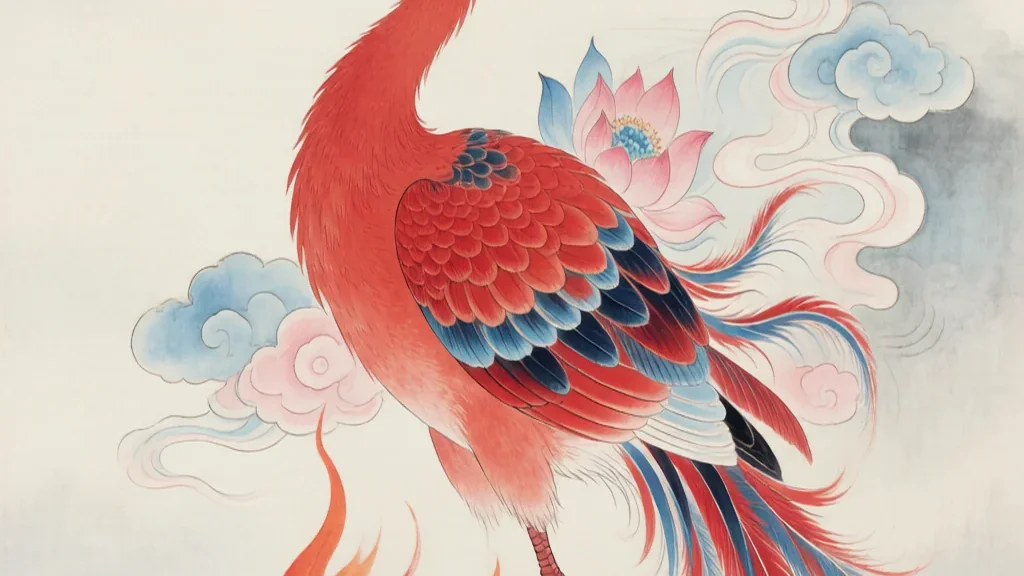
Bi Fang, written with characters meaning "a kind of bird" and pronounced as a clear two-syllable name, is one of the most distinctive omen birds in the classical Chinese bestiary. Described in the earliest geographical mythology as a creature with a single leg, a body marked in red and blue, and a white beak, Bi Fang was believed to appear as a harbinger that warned of approaching fire. Though feared as a portent of conflagration, the bird was also a vivid emblem of the strange and wondrous beings said to inhabit the mountains and skies of the mythical world. To study Bi Fang is to enter the logic of omen belief, in which the appearance of an unusual animal was read as a message about the balance of natural forces and the fate of human settlements.
Sources in the Classic of Mountains and Seas
The primary account of Bi Fang comes from the Shan Hai Jing, the "Classic of Mountains and Seas," a compilation of mythic geography whose layers accumulated from the Warring States period through the Han dynasty. In that text, Bi Fang is placed in a specific mountain range and described as a bird with one leg, blue and red plumage, and a white beak, resembling a crane in general shape. The book is less a single authored work than a collected tradition of regional lore, and its creatures served both as wonder-tales and as a kind of symbolic map of the known and unknown world. Bi Fang's entry belongs to the sections describing the terrain and the spirits that ruled it, which is why his appearance was tied to a particular landscape and a particular omen.
Because the Shan Hai Jing mixed observation of real animals with imaginative invention, scholars debate how literally its descriptions were meant. What is clear is that Bi Fang entered the Chinese imaginary as a fixed type: the one-legged fire bird whose sighting meant danger by flame. Later writers quoted and embellished the original passage, and the bird's reputation hardened into a proverb of warning that ordinary people could invoke when they noticed strange birds near their homes.
Physical Description of the One-Legged Bird
The single most memorable feature of Bi Fang is his solitary leg, a trait so defining that the bird is often identified simply as "the one-legged bird" in later literature. He is said to be clad in feathers of red and blue, colors that themselves evoke fire and sky, and to possess a white beak that contrasts with his bright body. Some descriptions compare his overall silhouette to a crane or a stork, tall and slender, which would make his single supporting leg all the more striking and unnatural to an observer. The combination of crane shape with impossible anatomy marked him as a creature of omen rather than of ordinary nature.
Artists who depicted Bi Fang in later painting and illustration emphasized the lone leg and the vivid two-tone plumage, sometimes adding a flame or smoke near his feet to signal his meaning. The visual shorthand was efficient: a viewer who recognized the one-legged bird immediately understood the warning of fire, just as a viewer who recognized a different beast understood a different prophecy. In a largely non-literate society, such images carried practical information.
Omen of Fire and Calamity
Bi Fang's central role in belief was as a bringer or announcer of fire. His appearance near a village or household was taken as a sign that a blaze might soon break out, and cautious people responded by checking their hearths, clearing dried brush, and guarding against carelessness with flame. The logic of the omen was not that the bird himself set fires, but that his presence marked a disturbance in the elemental balance, a leak of fiery energy into the human world that could manifest as disaster. In this sense Bi Fang was less a cause than a symptom, a living signal of risk.
This kind of omen belief reflected a real vulnerability. In timber-and-thatch communities, fire was among the greatest threats, and any cultural mechanism that encouraged vigilance had practical value. Whether or not people truly believed a one-legged bird caused flames, the association trained attention on fire safety at moments when a strange sighting grabbed the collective mind. Myth here performed the quiet work of public caution.
Relationship to Other Mythic Birds
Bi Fang belongs to a crowded family of auspicious and inauspicious birds in Chinese myth, including the phoenix-like Fenghuang, the Vermillion Bird of the south, and the nine-headed bird of later lore. Where the Fenghuang signaled harmony and the Zhū Què guarded the southern quadrant with fire of a benign cosmic kind, Bi Fang represented fire in its dangerous, untamed aspect. The contrast shows that the Chinese tradition did not treat fire as simply good or bad but distinguished its ordered, life-giving form from its chaotic, destructive form, assigning different birds to each.
Some scholars link Bi Fang to the broader Eurasian motif of the one-legged bird, noting parallels in other traditions where a solitary-legged creature marks a boundary between the natural and the supernatural. Whether through borrowing or independent invention, the one-legged fire bird became a stable figure in the Chinese bestiary, appearing in poetry and commentary as a byword for ill omen long after the original geographical context was forgotten.
Interpretations in Later Literature
After the Shan Hai Jing, Bi Fang surfaced in poetic and encyclopedic writing as a shorthand for strange portents. Poets invoked him to lend an atmosphere of the eerie and the wild, and commentators cited him when discussing the taxonomy of omens. In some contexts his single leg became a philosophical joke about wholeness and deficiency, while in others it remained a Straightforward sign of danger. The flexibility of the figure allowed him to migrate from a local mountain spirit into a general literary symbol without losing his core identity as the fire bird.
Daoist and observational writers sometimes tried to rationalize such creatures, suggesting that reported "one-legged birds" might be misidentified real animals or that the omen reflected natural signs like unusual drought. These attempts at demythologizing show that even in the classical period, readers argued about how to interpret the bestiary, balancing wonder against explanation in a way that modern readers will recognize.
Bi Fang in Art and Visual Culture
From woodblock illustrations of the Shan Hai Jing to later scroll paintings of strange creatures, Bi Fang has been a favorite subject for artists drawn to the bizarre. The challenge of painting a one-legged crane-bird in vivid colors invited creative solutions, and surviving images show a range of styles, some rigid and schematic, others lively and expressive. Such illustrations did more than decorate; they taught viewers to recognize the omen, functioning as a kind of illustrated field guide to the supernatural.
In the modern era, Bi Fang appears in illustrated encyclopedias of Chinese mythology aimed at general readers and children, where he is presented as a fascinating curiosity of the ancient imagination. Reproductions of classical creature illustrations in museums and books keep his image before the public, ensuring that the one-legged fire bird remains part of the shared visual vocabulary of Chinese heritage.
Cultural Meaning of the Fire Omen
Seen broadly, Bi Fang embodies a human preoccupation with warning. The bird gives form to anxiety about catastrophe and, by doing so, offers a way to talk about and prepare for it. A society that personified the risk of fire as a recognizable creature could transmit caution across generations through story rather than through abstract instruction. The one-legged bird thus operated as a mnemonic device, a memorable shape for a memorable lesson about the dangers of carelessness with flame.
At the same time, Bi Fang reveals the Chinese genius for populating the world with meaning. Nothing in the traditional landscape was merely empty; mountains, rivers, and skies teemed with beings whose appearances carried messages. Bi Fang was one voice in that crowded conversation, and his message, watch the fire, was among the most practical of all the omens that the classical bestiary preserved.
Regional Sightings and Folk Responses
Across the farming communities of premodern China, reports of unusual birds near homes were sometimes interpreted through the lens of the Bi Fang omen, and local custom prescribed practical responses to such sightings. Families might inspect their hearths, clear dried leaves from the eaves, and store flammable materials away from sleeping quarters, turning a superstitious warning into prudent fire prevention. The figure of the one-legged bird thus functioned as a seasonal reminder, surfacing in gossip and story precisely when the risk of careless flame was greatest, such as during dry winds or festival lantern season.
The persistence of these responses shows that omen belief was not passive fear but active vigilance. By naming a possible danger in the shape of a recognizable creature, communities gave themselves a shared script for caution, and the story of Bi Fang passed from grandparents to children as a kind of oral safety lesson. In this practical register, the mythic fire bird did real work, protecting households not by magic but by attention.
❓ Frequently Asked Questions
What is Bi Fang?
Bi Fang is a one-legged omen bird from the Shan Hai Jing, marked with red and blue feathers and a white beak, associated with fire.
Why is Bi Fang a sign of fire?
His sighting was interpreted as a disturbance of fiery elemental energy, warning communities to guard against conflagration.
Where is Bi Fang first described?
He appears in the Classic of Mountains and Seas, an ancient compilation of Chinese mythic geography.
How does Bi Fang differ from the phoenix?
The Fenghuang signals harmony, while Bi Fang portends destructive fire, representing its chaotic aspect.
Did people believe Bi Fang caused fires?
He was seen more as a symptom or signal of imbalance than as a direct cause of flames.
How is Bi Fang shown in art?
Artists emphasize his single leg and two-tone plumage, sometimes adding flame or smoke to mark his meaning.