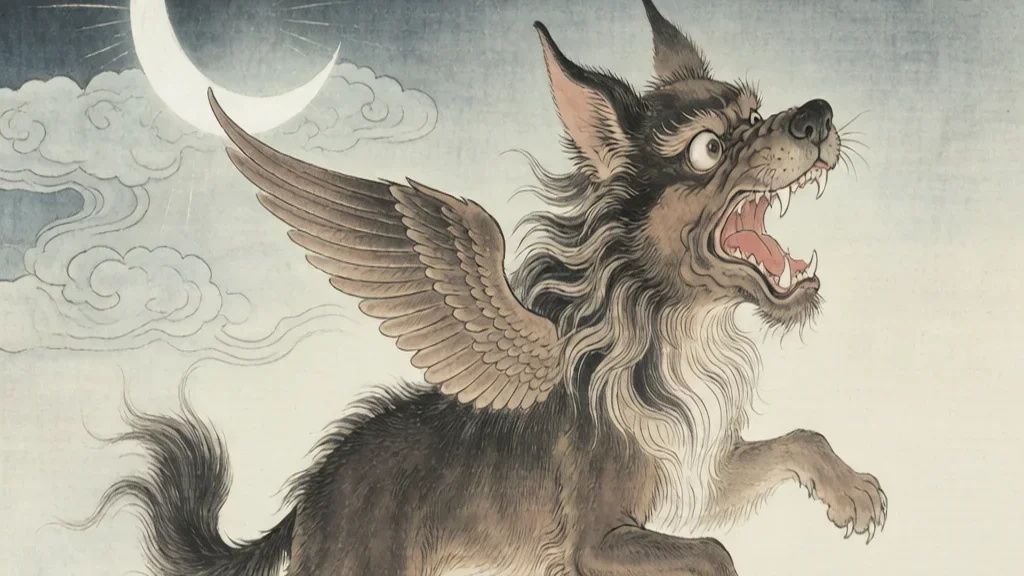
The tian gou, written in Chinese as 天狗 and usually read as tian gou, is one of the more puzzling creatures in the Chinese mythological record because it carries two quite different identities. In the ancient Classic of Mountains and Seas it is a small mountain beast, something like a raccoon dog with a white head, whose cry is said to foretell the coming of floods. In later popular belief, however, the same name came to mean a celestial dog that swallows the sun or the moon during an eclipse, and the phrases tian gou shi ri and tian gou shi yue, the heavenly dog eats the sun and the heavenly dog eats the moon, became the standard folk explanation for solar and lunar eclipses. This article traces both strands of the tradition, explains how a harmless mountain animal turned into a cosmic devourer, and notes how the Chinese tian gou later diverged from the famous Japanese tengu. The tian gou is a useful example of how a single mythic name can accumulate contradictory meanings across more than two thousand years of storytelling.
The Tian Gou in the Classic of Mountains and Seas
The earliest surviving description of the tian gou appears in the Shan Hai Jing, the classical compendium of strange creatures and distant lands compiled over the late Warring States through Han period. There the tian gou is placed among the fauna of a named mountain and is described as resembling a raccoon dog, with a white head, and as making a sound like a cat. The entry notes that when this creature is seen or heard it is an omen of imminent flooding, which already connects the dog with water even in its earliest form.
This humble beginning is important because it shows the tian gou was not originally a sky god or a demon of eclipses. It was a local omens beast, one of dozens in the text whose appearances were read as signs of weather, war, or prosperity. Its white head and doglike shape made it memorable, and its association with flooding planted the seed of its later watery and heavenly career.
Scholars of the Shan Hai Jing point out that many of its creatures blur the line between real regional animals and purely symbolic portents, and the tian gou probably belongs in that ambiguous zone, perhaps rooted in an actual mountain carnivore that later generations reinterpreted.
From Mountain Beast to Eclipse Demon
Some time after the Han period the name tian gou was borrowed to personify the cause of eclipses. The logic was straightforward: an eclipse looks like the sun or moon is being bitten, and a dog is a familiar biter, so a heavenly dog became the imagined eater of the luminaries. The word tian, meaning heaven or sky, fit perfectly because the eaten objects were in the sky. Thus the mountain omen animal and the eclipse demon merged under one label.
This transformation reflects a common pattern in Chinese popular astronomy, where awe-inspiring celestial events were explained through concrete, story-like agents rather than through abstract theory. Ordinary observers did not need to understand the mechanics of the nodes of the moon's orbit; they needed a narrative, and the heavenly dog supplied it.
The eclipse tian gou was feared but also manageable. Because the event was understood as a dog worrying the sun or moon, people responded with noise and violence of their own, beating drums, firing arrows, and shouting to drive the dog away and restore the light.
The Heavenly Dog Eats the Sun and Moon
The phrases tian gou shi ri and tian gou shi yue became household expressions for solar and lunar eclipses. In folktales the dog is sometimes said to be the faithful hound of a deity who has run off with a stolen luminary, and sometimes simply a cosmic pest that must be scolded back into spitting out its prey. The recovered light, when the eclipse ended, was proof that the noisy human response had worked.
This belief was not merely quaint; it shaped real ritual. Chinese courts and communities maintained eclipse-response procedures that combined official astronomy with popular noise-making, and the tian gou story gave those procedures a recognizable face. The astronomer might calculate the timing, but the crowd supplied the drums and the arrows aimed at the sky.
In some regional versions the dog is punished after the fact or is reminded of its place, and the whole episode becomes a small morality tale about cosmic order being briefly disturbed and then restored by human vigilance.
Ritual Responses to Eclipses
Because an eclipse was interpreted as an attack on the celestial bodies, the proper response was to repel the attacker. Historical records describe officials, monks, and villagers alike producing as much sound as possible: striking gongs and drums, ringing bells, burning offerings, and in military contexts even loosing arrows or firing guns toward the heavens. The goal was to frighten the tian gou into releasing the sun or moon.
These practices were remarkably durable. Accounts from the imperial court show elaborate eclipse ceremonies, while local gazetteers record village customs that survived into the modern period. The shared assumption was that the dog understood fear and noise, so a united human outcry could shorten the darkness.
The ritual also had a social function. An eclipse gathered the community into coordinated action at a moment of shared anxiety, and the tian gou gave people a clear enemy to fight together, turning a frightening natural event into a communal exercise.
The Tian Gou and the God Erlang
In some later streams of Chinese folklore the heavenly dog is attached to the entourage of Erlang, the handsome warrior god often shown with a third eye and accompanied by a hunting dog. This linking of a divine hound with the sky dog shows how the eclipse demon could be domesticated into the retinue of a respected deity, softening its menace while keeping the dog identity intact.
The Erlang connection also appears in novels and operas, where the god's dog performs feats of capture and pursuit, echoing the chasing and biting nature of the tian gou. Whether the dog of Erlang is literally the eclipse dog is debated by folklorists, but the overlap in imagery is clear and widely felt.
Through this association the tian gou moved from pure omen to character within a pantheon, a shift that mirrors the general tendency of Chinese myth to absorb lonely strange creatures into the households of greater gods.
Comparison with the Japanese Tengu
Readers familiar with Japan will recognize a similar-sounding name, tengu, but the two creatures diverged long ago. The Japanese tengu became a long-nosed or crow-like mountain goblin, a proud and dangerous shape-shifter associated with sword skills and with misleading travelers, quite different from the Chinese eclipse dog. The shared characters reflect shared early Chinese influence, but the developed legends are distinct.
In China the tian gou never became a sword-wielding mountain imp; it remained, at heart, either a flood-omen animal or an eclipse eater. The Japanese tradition took the "heavenly dog" label and ran with the mountain-spirit side, while the Chinese tradition emphasized the sky and the moon.
This split is a good reminder that mythic names travel and change. The same written characters can mark two very different beings depending on which side of the sea the story developed.
The Tian Gou in Modern Memory
Today the tian gou survives mostly as a colorful way to talk about eclipses and as a minor figure in retellings of classical myth. Science has replaced the dog with orbital mechanics, but the old phrases still surface in literature, comics, and casual speech when someone wants a poetic name for an eclipse. Museums and children's books present the Shan Hai Jing tian gou as one of the text's many odd beasts.
The creature also appears in games and fantasy media, where designers draw on its dual identity to make a monster that is both an omen animal and a sky devourer. This flexibility keeps the name alive even though few people now beat drums during an eclipse.
In the broader story of Chinese mythology the tian gou illustrates how a single name can hold two incompatible pictures at once, a mountain portent and a cosmic dog, without bothering audiences who simply enjoy a good strange tale.
The Tian Gou in Historical Eclipse Records
Imperial astronomers kept careful records of eclipses, and the tian gou narrative supplied the popular frame within which those precise observations were understood by the wider public. The official calendars noted the moment and degree of an eclipse, while storytellers supplied the dog that was doing the eating, so that science and folklore ran side by side across the centuries of Chinese court astronomy.
These records show the durability of the belief across dynasties, with eclipse accounts from the medieval through the late imperial period still reaching for the same heavenly dog to explain the darkened sun or moon. The continuity is a reminder that the tian gou was not a passing fancy but a stable feature of Chinese celestial culture, repeated so often that it became a routine part of the record.
Even as mathematical astronomy grew more exact, the dog remained the household name for the event, and the two ways of knowing the sky, the calculated and the narrated, long coexisted without displacing one another. A court might predict an eclipse to the minute and still beat its drums when the darkness came, because the tian gou was both explained and felt.
❓ Frequently Asked Questions
What is the tian gou?
The tian gou is a Chinese mythic creature with two identities: a white-headed mountain omen beast in the Shan Hai Jing and a heavenly dog believed to eat the sun or moon during eclipses.
Why is the tian gou linked to eclipses?
An eclipse looks like the sun or moon is being bitten, so a dog in the sky became the folk explanation for the event, expressed in the phrases tian gou shi ri and tian gou shi yue.
How did people respond to an eclipse?
Communities made loud noise with drums, bells, and gongs, and sometimes fired arrows skyward, hoping to frighten the dog into releasing the luminary.
Is the tian gou the same as the Japanese tengu?
No; they share written characters and early influence, but the Japanese tengu became a long-nosed mountain goblin, while the Chinese tian gou stayed an omen animal or eclipse eater.
Where is the tian gou first recorded?
Its earliest description is in the Classic of Mountains and Seas, where it is listed among strange regional beasts whose appearances were read as omens.
Does the tian gou appear in modern culture?
Yes, mainly as a poetic name for eclipses and as a figure in children's books, games, and retellings of classical Chinese myth.