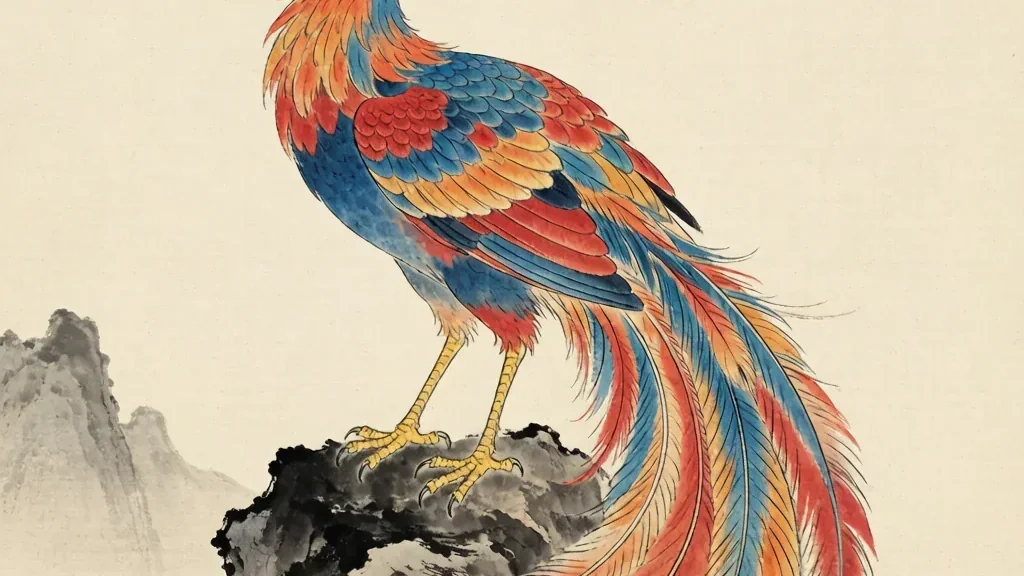
In Western mythology, the phoenix is a solitary creature — a magnificent bird that lives for centuries, bursts into flame, and is reborn from its own ashes. The Chinese Fenghuang (凤凰) shares some of this symbolism of renewal and immortality, but it is a far richer and more complex mythological being. It is the king of all birds, the embodiment of the five Confucian virtues, the symbol of the empress, and — together with the dragon — one half of the most powerful symbolic pairing in Chinese culture. To call the Fenghuang simply a "Chinese phoenix" is to vastly underestimate its significance.
The name "Fenghuang" itself contains two characters: Feng (凤), the male bird, and Huang (凰), the female bird. In the earliest myths, the Fenghuang was understood as a pair — a male and female that together represented the perfect balance of yin and yang. Over time, however, the Fenghuang became associated primarily with feminine energy, especially after the dragon was established as the symbol of the emperor. The dragon and the Fenghuang together — the emperor and the empress, yang and yin, heaven and earth — represent the ideal of cosmic harmony that lies at the heart of Chinese philosophy.
The Anatomy and Symbolism of the Fenghuang
Like the dragon, the Fenghuang is a composite creature, assembled from the most beautiful and auspicious features of various animals. Classical Chinese texts describe the Fenghuang as having the head of a golden pheasant (鸡头), the beak of a parrot (燕颔), the neck of a snake (蛇颈), the back of a tortoise (龟背), the tail of a peacock (鱼尾), and the legs of a crane (鹤腿). Its body is covered in feathers of five colors — red, blue-green, yellow, white, and black — which correspond to the five Confucian virtues.
This five-color plumage is deeply meaningful. The red (赤) represents benevolence (仁), the blue-green (青) represents righteousness (义), the yellow (黄) represents propriety (礼), the white (白) represents wisdom (智), and the black (黑) represents trustworthiness (信). Thus, the Fenghuang is not merely beautiful — it is a living embodiment of moral perfection. In Confucian thought, the appearance of a Fenghuang was considered an omen of great significance, signaling the arrival of a virtuous ruler or an era of peace and prosperity. It was said that the Fenghuang would only appear in a kingdom ruled by a sage king — a belief that made the bird a powerful symbol of political legitimacy.
The Fenghuang and the Empress
The pairing of the dragon and the Fenghuang as imperial symbols became firmly established during the Han Dynasty (206 BCE–220 CE) and reached its peak during the Ming and Qing dynasties. Just as the emperor's robes were embroidered with dragons, the empress's ceremonial robes (凤袍) were embroidered with Fenghuang. Her crown, the Fengguan (凤冠), was an elaborate headdress adorned with gold Fenghuang figures, pearls, and kingfisher feathers, worn during her wedding and on the most important state occasions.
This symbolic pairing extended far beyond the imperial court. In Chinese weddings, the dragon and Fenghuang appear together as symbols of marital harmony. The bride's wedding dress is often embroidered with Fenghuang, while the groom's features dragons. The phrase "龙凤呈祥" — "dragon and phoenix bring auspiciousness" — is one of the most common wedding blessings, expressing the hope that the couple will enjoy a harmonious and prosperous union. Even today, in modern Chinese weddings, the dragon and Fenghuang motif remains ubiquitous, adorning everything from invitation cards to wedding cakes.
The Fenghuang and the Vermilion Bird
In the cosmology of the Four Symbols (四象) — the four guardian creatures of Chinese astronomy — the south is governed by the Vermilion Bird (朱雀). This creature is sometimes conflated with the Fenghuang, but they are distinct beings. The Vermilion Bird is a cosmological guardian, one of four great beasts that protect the cardinal directions, while the Fenghuang is a cultural and moral symbol. The Vermilion Bird is associated with the element of fire and the season of summer, embodying the yang energy of the south.
In Daoist and folk religious practice, both the Fenghuang and the Vermilion Bird are associated with the south and with the color red, but they serve different symbolic functions. The Vermilion Bird guards the southern heavens and appears in astronomical contexts, while the Fenghuang appears as a portent in the human world, its arrival signaling moral virtue and good governance. The distinction, though sometimes blurred in popular culture, reflects the rich layering of Chinese mythological systems.
The Fenghuang in Art and Culture
The Fenghuang is one of the most frequently depicted creatures in Chinese art, appearing in everything from ancient bronze vessels to contemporary fashion. In traditional Chinese painting, the Fenghuang is often shown perched on a paulownia tree (梧桐树), which, according to legend, is the only tree on which it will alight. The paulownia, with its large leaves and fragrant flowers, was considered the noblest of trees, and the image of the Fenghuang in a paulownia tree became a standard symbol of peace, prosperity, and good government.
The Fenghuang also appears extensively in Chinese literature. The Classic of Mountains and Seas (山海经), an ancient geographical and mythological text, describes the Fenghuang as a bird whose appearance presages universal peace. The Tang Dynasty poet Li Bai (李白) wrote of the Fenghuang in his famous poem "Visiting the Ancient Site of the Phoenix Tower in Jinling": "The phoenix once played on the Phoenix Tower; the phoenix is gone, the tower is empty, only the river flows." Here, the Fenghuang becomes a symbol of lost glory and the inexorable passage of time — a melancholy counterpoint to its usual role as a harbinger of good fortune.
In modern times, the Fenghuang remains a popular and versatile symbol. The ancient town of Fenghuang (凤凰古城) in Hunan Province, named after the mythical bird, is one of China's most picturesque tourist destinations. The Fenghuang appears on the flag of Hong Kong Special Administrative Region, and in popular culture, it features in video games, anime, and fantasy literature — a testament to its enduring power as a symbol of beauty, virtue, and renewal.
Phoenix and Dragon
The pairing of dragon and phoenix, long feng cheng xiang, is the supreme Chinese symbol of harmonious union, used at weddings to represent the groom and bride. Because the dragon stands for yang and the phoenix for yin, their combined image expresses balanced marriage and, at the state level, the emperor and empress ruling together. You see the pair on imperial robes, palace beams, and modern wedding invitations, making it one of the most durable design motifs in Chinese visual culture. On a bride's headdress the phoenix confirms her role as the household's radiant center, while the groom's dragon robe answers in kind. The phrase itself wishes that 'the dragon and phoenix bring prosperity,' so the image doubles as a blessing for children and fortune. From Zhou dynasty bronze mirrors to today's red packets, the duo has carried the same message of complementary harmony for three thousand years.
The Five Virtues
Medieval texts assign the phoenix five moral virtues mirrored in its body: its head signifies virtue, its wings propriety, its back rectitude, its breast humanity, and its belly good faith. This Confucian reading turned a beautiful bird into a walking code of conduct, which is why the phoenix adorned the robes of empresses and the insignia of high-ranking women. The symbolism taught that right rule and right character are written on the body of nature itself. A magistrate's wife might wear a phoenix badge not merely as ornament but as a public reminder of the duties her station required. Children's primers used the bird to drill the same five traits, so that recognizing a phoenix became a lesson in being good. The neat mapping of anatomy to ethics made the phoenix unusually useful to teachers and court ritual masters alike.
Phoenix in Art
From Zhou dynasty bronze handles to Tang dynasty mirror backs and Ming porcelain, the phoenix has been a favorite decorative subject across every medium. Craftsmen rendered it with a peacock-like train, a rooster's comb, and a swallow's jaw, blending many birds into one ideal form. In silk and lacquer the phoenix often circles a peony, the 'king of flowers,' to signal prosperity and noble beauty in domestic settings. Tomb murals of the Han show the phoenix descending to a wise ruler, while Buddhist cave ceilings at Dunhuang use it as a heavenly bird among apsaras. The motif traveled the Silk Road and influenced Japanese and Korean phoenix design, yet always kept its Chinese grammar of grace and omen. Whether in jade, cloisonne, or ink painting, the phoenix remains the artist's shorthand for sanctioned splendor.
The Phoenix in Modern Times
The phoenix remains a living symbol in contemporary China, appearing on everything from bridal jewelry to corporate logos that wish to suggest rebirth and grace. Modern designers revisit the phoenix during major events, such as the phoenix-shaped pavilions and dances at national celebrations. Unlike many ancient beasts, the Feng Huang has smoothly moved from imperial omen to a general emblem of feminine dignity and renewal. Pop songs and television costume dramas reuse the bird to signal a heroine's rise, and beauty brands name products after it to promise transformation. At the same time, traditional carvers still produce phoenix panels for ancestral halls, so the old and new meanings coexist. The bird's adaptability, able to stand for both an empress and a startup, explains why it outlasts creatures that belonged to a single era or class.
❓ Frequently Asked Questions
📝 Chinese Vocabulary
- 凤凰 (Fèng Huáng) — The Chinese phoenix, king of all birds, composed of two characters: Feng (male) and Huang (female).
- 龙凤呈祥 (Lóng Fèng Chéng Xiáng) — "Dragon and phoenix bring auspiciousness," a traditional wedding blessing symbolizing marital harmony.
- 凤冠 (Fèng Guān) — The empress's ceremonial crown, an elaborate headdress adorned with gold Fenghuang figures and precious gems.
- 朱雀 (Zhū Què) — The Vermilion Bird, guardian of the south in the Four Symbols, distinct from the Fenghuang but sometimes conflated with it.
- 梧桐树 (Wú Tóng Shù) — The paulownia tree, said to be the only tree on which the Fenghuang will perch.
🎉 Fun Facts
- The Fenghuang's five-colored feathers — red, blue-green, yellow, white, and black — correspond to the five Confucian virtues of benevolence, righteousness, propriety, wisdom, and trustworthiness.
- In ancient times, the Fenghuang was believed to only appear during the reign of a virtuous ruler, making its sighting a powerful political omen — and its absence a damning indictment of the current regime.
- The Fenghuang is actually a pair of birds (male Feng and female Huang), not a single creature — though modern usage typically treats them as one entity.
- The phoenix is said to appear only in times of good government, so its rare sighting was read by historians as a verdict on a ruler's virtue.
- Male and female are distinct: the feng is male and the huang female, though the combined name is now used for the pair and for the bird as a whole.
- The phoenix's feathers are described in the five colors that match the five Confucian virtues, making the bird a walking emblem of moral order.