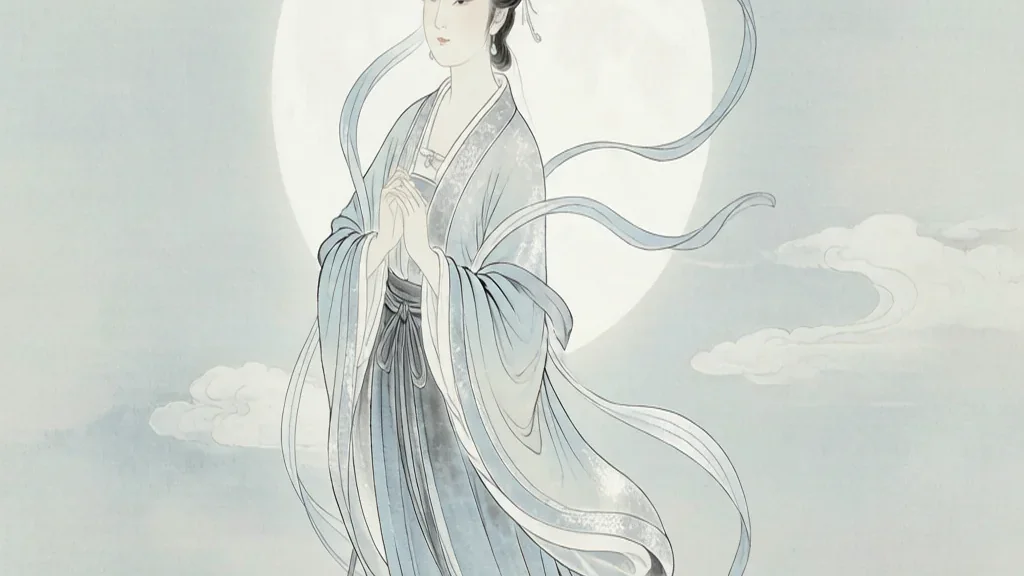
Changxi (常羲), the mother of the moons, is a relatively lesser-known but evocative figure in classical Chinese myth. Recorded in the ancient geographical-mythic compendium the Shanhaijing (Classic of Mountains and Seas), she is the consort of the sun-archer Di Jun and the bearer of twelve moons, one for each lunar month of the year. Her story belongs to a stratum of Chinese cosmology in which celestial bodies are the offspring of divine couples, and her quiet, maternal role balances the more martial and political deities of later tradition.
Sources in the Classic of Mountains and Seas
Changxi appears in the Shanhaijing, a text compiled over centuries from the Warring States into the Han dynasty, which mixes real geography with fantastic creatures and gods. There she is named as the wife of Di Jun and the mother who gave birth to twelve moons, a detail that ties her directly to the lunar calendar.
Unlike the richly developed legends of later goddesses, Changxi's appearances are brief and formulaic, which suggests she belonged to an older, more archaic layer of myth that later compilers preserved without elaboration. Her brevity is itself a clue to her antiquity.
Scholars note that the Shanhaijing often pairs male and female divine parents for the sun and moon, and Changxi's pairing with Di Jun mirrors the sun-mother Xihe, presenting a neat cosmic symmetry between the two great lights.
Mother of the Twelve Moons
The number twelve is significant: a lunar year is reckoned in roughly twelve months, so Changxi's twelve children map the moon's cycles onto the human calendar. Each moon is, in this mythic logic, a distinct being that must be bathed and sent across the sky in turn.
One passage describes Changxi "bathing the moons" in a certain river, an image of tender care that frames the moon's phases as a kind of nurture and renewal rather than mere astronomy. The act of washing the moons also suggests purification and rebirth each cycle.
This maternal framing contrasts with the more abstract, bureaucratic moon deities of later folk religion, preserving an image of the moon as a living family of siblings under a single mother.
Relationship with Di Jun
Di Jun is an archaic supreme god, associated with the eastern sky and with agriculture, who appears in early texts as father to both the suns (by Xihe) and the moons (by Changxi). His household thus governs the two luminaries that measure day and night, time and festival.
The division of Di Jun's consorts—one for the sun, one for the moon—reflects a dualistic ordering of the cosmos in which complementary powers produce the regular rhythms of heaven. Changxi's role is the cooler, nocturnal, receptive half of that pair.
Over time Di Jun's prominence faded as the Jade Emperor and other figures rose, but in the Shanhaijing layer he and Changxi remain central to the generation of celestial order.
Connection to the Lunar Calendar
Chinese timekeeping has always been fundamentally lunar, with months beginning at each new moon and the year adjusted by intercalary months to stay aligned with the solar cycle. Changxi's twelve moons are a mythic expression of this system, personifying the units by which the agrarian year was organized.
Festivals such as the Mid-Autumn Festival and the lunar New Year depend on the moon's phases, so a goddess who "produces" the moons is, in effect, a patron of the calendar itself. Her myth quietly underlies the rhythm of Chinese seasonal life.
The bathing of the moons can be read as the mythic counterpart of the moon's waxing and waning: each month a moon is cleansed, brought to fullness, and then released, only to be followed by the next sibling.
Changxi and the Moon's Gentle Light
Where solar myths tend toward heat, archery, and excess (the famous ten suns who scorched the earth), lunar myth stays soft and measured. Changxi embodies that gentleness: she does not battle but bears and tends, and her children illuminate the night rather than dominate the day.
This gender-coded contrast—active sun, receptive moon—became a durable pattern in Chinese thought, feeding into the yin-yang pairing that structures later philosophy. Changxi stands at the mythic root of the yin principle.
Her calm domesticity also offered an ancient model of feminine divinity that was neither fearsome nor subordinate, but essential to cosmic maintenance.
Comparison with Xihe, Mother of the Suns
Xihe, wife of Di Jun and mother of the ten suns, is Changxi's direct counterpart. The ten suns are said to have once all risen at once and devastated the land until the archer Hou Yi shot down nine of them, a dramatic tale of cosmic correction.
Changxi's moons, by contrast, never rebel; they rotate peacefully, which may explain why her story lacks the excitement of Xihe's. The pairing shows how early myth explained both the orderly and the catastrophic potentials of the heavens.
Together the two goddesses present a balanced cosmology: a solar line that needs heroic restraint, and a lunar line that simply endures and recurs.
Later Folk Transformations
In popular religion Changxi did not develop into a major household goddess the way the Moon Lady (Chang'e) did. Instead, her archaic identity was largely absorbed into or overshadowed by later moon figures, and her name survives mainly in scholarly and literary references.
Some researchers propose links or confusion between Changxi and Chang'e, noting the similar pronunciation and the shared lunar domain, though the two remain distinct in the early texts. The evolution shows how lunar goddesses were consolidated over time.
Nonetheless, in revival-of-interest contexts and in retellings of the Shanhaijing, Changxi is increasingly celebrated as an original, independent lunar deity worth knowing.
Cultural Echoes Today
Changxi occasionally appears in modern Chinese fantasy literature, games, and art that draw on the Shanhaijing bestiary, where her status as moon-mother gives her a serene, majestic presence. Such uses keep the archaic goddess in public imagination.
Her story also appeals to those interested in the pre-Confucian, shamanic stratum of Chinese myth, where nature was populated by divine clans rather than administered by a heavenly bureaucracy. In that frame she is a reminder of an older worldview.
For readers of Chinese mythology, Changxi fills an important gap: she is the quiet source of the moon's reliable, life-giving rhythm.
❓ Frequently Asked Questions
Who is Changxi?
Changxi is a goddess in the Shanhaijing who is the wife of Di Jun and the mother of twelve moons, one for each month of the lunar year.
What does "bathing the moons" mean?
It is a mythic image of Changxi washing and nurturing each moon, often interpreted as symbolizing the moon's purification and renewal through its phases.
How is Changxi different from Chang'e?
Changxi is the archaic moon-mother of the Shanhaijing, while Chang'e is the later Moon Lady who drank the elixir and flew to the moon; they are distinct figures despite similar names.
What is Changxi's connection to the calendar?
Her twelve moon children map onto the twelve months of the lunar year, making her a mythic patron of the Chinese calendrical system.
Who was Di Jun?
Di Jun was an early supreme deity who, with two consorts, fathered both the suns (by Xihe) and the moons (by Changxi), governing the rhythms of heaven.
Why is Changxi less famous than other goddesses?
Her appearances in the source texts are brief, and later folk religion elevated other lunar figures such as Chang'e, leaving Changxi mostly to scholarly and literary memory.