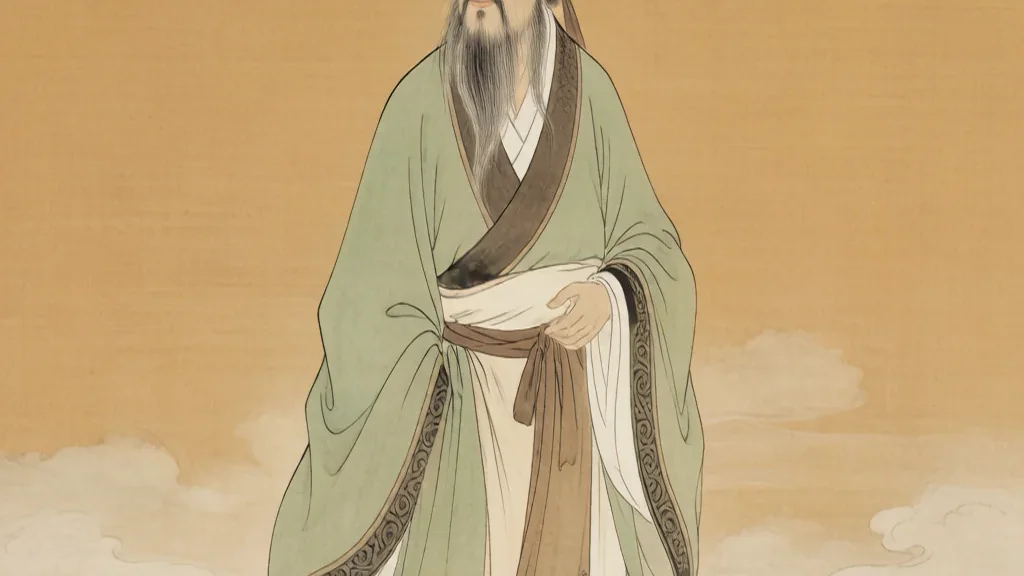
Hua Tuo was a celebrated physician of the late Eastern Han and Three Kingdoms era, remembered as one of the founding figures of Chinese medicine and later honored as a deity of healing. Tales of his skill describe a doctor far ahead of his time: he is credited with using an early form of anesthesia for surgery, with mastering physical exercises that imitate animals, and with treating the great warlords of his age. Because his writings were lost, much of what we know comes through later histories and legend, yet his reputation as the archetypal skilled and compassionate doctor has never faded. In temples of medicine he stands among the divine patrons to whom the sick and the healers pray.
Historical Setting
Hua Tuo lived during a turbulent period when the Han empire was collapsing into the wars of the Three Kingdoms. Medical practice of the time relied on herbal medicine, acupuncture, and moxibustion, and physicians usually traveled between households rather than working in fixed hospitals. It was in this world that Hua Tuo built his fame as a diagnostician and a bold practitioner.
The recorded histories note that he treated both commoners and powerful generals, and that he preferred to cure with the gentlest effective means. His career shows medicine as a perilous profession in an age when displeasing a warlord could mean death — a danger that, in legend, finally caught up with him.
Mastery of Diagnosis
Like his near-contemporary Zhang Zhongjing, Hua Tuo was renowned for pinpoint diagnosis from the pulse and the patient's appearance. Stories tell of him predicting the course of an illness years in advance and advising prevention before symptoms worsened.
One famous episode has him warning a friend that a disorder would erupt later in life unless treated; when the warning was ignored, the prophesied illness duly appeared. Such tales, whether literal or embellished, express the ideal of the physician as one who reads the body's hidden signals with almost supernatural clarity.
The Legend of Mafeisan
Hua Tuo's most astonishing reputation is as the inventor of mafeisan, a "numbing powder" or anesthetic wine given before surgery so the patient would feel no pain. The formula is lost, and scholars debate its ingredients, but the tradition firmly credits him as a pioneer of pain-free operation.
With the patient anesthetized, he is said to have opened the abdomen or chest to remove diseased tissue, then closed and dressed the wound, with recovery in a matter of days. Whatever the historical reality, the story marks him as a symbol of surgical courage in a medical culture that usually avoided the knife.
The Five Animals Frolics
Beyond drugs and the blade, Hua Tuo taught a set of exercises called the Wuqinxi, the "Five Animals Frolics," in which the practitioner mimics the tiger, deer, bear, ape, and bird. He believed that movement, not only medicine, kept the body's vital energy flowing and prevented illness.
He reportedly told a disciple that the flow of fluids in the body must be kept in motion, comparing it to a door pivot that never rots because it is always turning. The Five Animals Frolics survived as a respected health practice and remains practiced today as a gentle form of qigong-style exercise.
Encounters With the Powers of the Age
Legend brings Hua Tuo into the camps of the era's famous warlords. He is said to have treated Cao Cao for a severe headache, proposing trepanation (drilling the skull) — a plan the suspicious ruler took as assassination, leading to the physician's imprisonment.
Another cycle of tales links him to Guan Yu, the warrior who supposedly bore surgery on an arrow wound without anesthesia, playing chess calmly through the ordeal. Whether or not Hua Tuo was truly present, these stories weld his name to the heroism and the danger of medicine at the highest levels of power.
His Lost Writings
It is said that while in prison Hua Tuo tried to pass his medical book to a jailer, who feared involvement and refused; the manuscript was burned, and his teachings survived only through disciples and later writers. This lament for lost knowledge deepened his myth as a master whose full wisdom was never recovered.
Later medical authors claimed his influence, and Qing-dynasty physicians compiled "Hua Tuo's formulas" that may preserve fragments of older practice wrapped in his authority. The recurring theme is that his real contributions were so valuable that later generations kept reaching back to his name.
Deification as a God of Medicine
Because of his extraordinary skill and his compassionate care for the poor, Hua Tuo was gradually drawn into the ranks of divine healers. Alongside figures such as the mythical Shen Nong and the physician-god Baosheng Dadi, he receives worship in temples of medicine where the sick pray for recovery.
In these temples he may be shown holding medical implements or a gourd of drugs, sometimes with other medical gods. Devotees ask not only for cure but for guidance given to the living doctors who treat them — a bridge between human skill and heavenly aid.
Hua Tuo in Popular Culture
Hua Tuo appears in the historical novel "Romance of the Three Kingdoms," where his medical feats and his tragic death at Cao Cao's order are dramatized. The novel fixed his image for many readers as the loyal, brilliant physician betrayed by suspicion.
Opera, storytelling, and later film have carried the same portrait forward. In each retelling he stands for the healer's virtues: precision, boldness, and a concern for the patient above personal safety — qualities that made his deification feel natural to the people.
Legacy in Chinese Medicine
Modern practitioners of traditional Chinese medicine still invoke Hua Tuo as a patron and a model. His name attaches to clinics, to points of acupuncture said to be his specialty, and to the Five Animals exercises taught for fitness and rehabilitation.
Though we cannot recover his lost recipes, his legacy lives in the principle he championed: that good medicine blends prevention, movement, and careful intervention. That balanced vision remains at the heart of how Chinese medicine understands health more than a millennium after his death.
❓ Frequently Asked Questions
Who was Hua Tuo?
He was a physician of the late Han and Three Kingdoms era, famous for surgery, anesthesia, and health exercises, later deified as a healing god.
What was mafeisan?
It was his reputed anesthetic, given as a powder or wine before operations so patients would not feel pain; the recipe is lost.
What are the Five Animals Frolics?
They are exercises imitating the tiger, deer, bear, ape, and bird, meant to keep the body's energy flowing and prevent illness.
How did Hua Tuo die?
Legend says he was imprisoned and executed after a suspicious warlord feared his proposed skull surgery was an attack.
Why was he made a god?
His remarkable skill and care for the poor led people to honor him among the divine patrons of medicine.
Is he still relevant to Chinese medicine?
Yes; his name attaches to clinics, acupuncture points, and the Five Animals exercises practiced for fitness today.