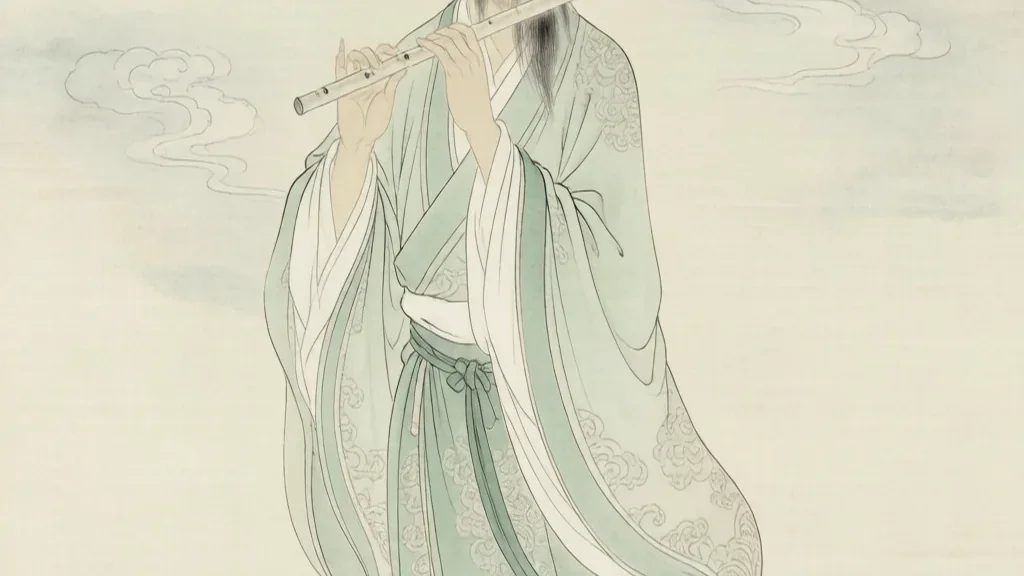
Han Xiang Zi is one of the Eight Immortals (Ba Xian) of Chinese folk religion, the member most closely linked with music, flute-playing, and youthful freedom. In the familiar grouping of eight figures who represent every age and condition of humanity, he stands for the young man and the artist, often shown as a handsome flute-player surrounded by flowers he can magically cause to bloom. His legend is tied to a famous Tang-dynasty scholar, Han Yu, said to be his uncle, and the contrast between the strict Confucian official and his Taoist-leaning nephew became a favorite theme of storytellers. As an immortal, he symbolizes the Taoist ideal of transcending worldly cares through music and lighthearted detachment.
The Eight Immortals
The Eight Immortals are among the most beloved figures in Chinese folklore, each with a distinct attribute and emblem. They include both men and women, rich and poor, old and young, showing that enlightenment is open to all. Their adventures appear in novels, operas, and New Year prints, and their images decorate doorways as bringers of good fortune.
Han Xiang Zi belongs to this company as the musician. While others carry a gourd, a crutch, or a lotus, he carries a flute, and his power is often expressed through sound and through the sudden flowering of plants — gentle, artistic miracles rather than feats of strength.
Historical Root in Han Yu
The figure is loosely based on a real person: a nephew or grandnephew of Han Yu, the great Tang statesman, poet, and Confucian reformer. Han Yu is famous for his stern opposition to Buddhism and for his commitment to orderly government, which makes the nephew's turn toward Taoist immortality a pointed contrast.
In the tales, the younger Han Xiángzǐ abandons the official career his uncle wants for him and pursues the Taoist Way. The historical record gives only a faint basis for this, but the legend built a rich drama around the family tension between Confucian duty and Taoist release.
The Uncle-and-Nephew Tales
The best-known stories pit Han Yu's pragmatism against the nephew's mysticism. When Han Yu is exiled to a remote post for offending the throne, the nephew appears by magic to comfort him and to show, through a miraculous sign, that the Taoist path he chose was not folly. The episode softens the clash, suggesting that worldly failure can be answered by otherworldly consolation.
Another tale has the nephew predict events through verse that seems nonsense until it comes true, gently mocking the uncle's reliance on reason alone. These exchanges made the pair a classic comic-and-serious duo in Chinese storytelling.
Mastery of the Flute
Han Xiang Zi's flute is his signature. In Taoist symbolism, music joins the player to the harmony of nature; the flute's breath is like the vital energy (qi) cultivated by adepts. His melodies are said to summon cranes, calm storms, and lift the spirit toward the immortals' realms.
Because of this, he is a patron of musicians and of young students alike — the former for his art, the latter because his story warns that book-learning is not the only wisdom. His flute thus bridges entertainment and spiritual teaching.
Flowers and Magic
A recurring wonder in his legends is causing peonies or other flowers to bloom out of season, sometimes inscribed with hidden poems. The blossoming out of nothing mirrors the immortal's power to call life from the void and to reveal beauty beyond the ordinary laws of nature.
This floral magic also links him to spring and renewal, and in festival imagery he may stand among blossoms. The flower becomes a quiet emblem of spontaneous, effortless creation — the Taoist ideal of wuwei, or action without forcing.
Becoming an Immortal
Like the other immortals, Han Xiang Zi is said to have attained his status through cultivation — study of Taoist arts, moral purity, and the favor of higher beings. Some versions have him summoned to heaven in a shaft of light after proving his detachment from worldly rank.
His youth is important: he shows that immortality is not only for sages who grow old in caves but can crown a free-spirited young artist. This made him especially appealing to the young and to those who chafed against rigid social expectation.
Role in Folk Art and Celebration
The Eight Immortals, Han Xiang Zi included, are staple subjects of New Year woodblock prints, temple murals, and embroidery. A design of all eight crossing the sea on their treasures is a classic auspicious image wishing the household safety and luck.
Because the group spans all walks of life, households of every sort could find a representative among them. Han Xiang Zi's place assured that music, youth, and art had a seat at the immortal banquet, balancing the grave elders of the set.
Symbolic Meaning
Han Xiang Zi stands for the values of spontaneity, artistic joy, and freedom from official pressure. In a society that prized exams and rank, his choice to wander with a flute offered a counter-vision of the good life as one of harmony with nature rather than ambition.
Read together with his uncle Han Yu, he embodies the perennial Chinese dialogue between engagement in the world and withdrawal from it — a tension Chinese culture never resolved but learned to hold in creative balance.
Modern Presence
Today Han Xiang Zi appears in films, television dramas about the Eight Immortals, and in the decoration of restaurants and homes during festivals. His flute-playing image remains a lighthearted emblem of good cheer and artistic grace.
For young people especially, he carries the appeal of a rebel who chose beauty over bureaucracy, and his flowers and music keep him fresh across the centuries as the immortal who never grew up.
❓ Frequently Asked Questions
Who is Han Xiang Zi?
He is one of the Eight Immortals of Chinese folklore, the young flute-playing musician associated with flowers and freedom.
Was he a real person?
His figure is loosely based on a nephew of the Tang scholar Han Yu, though the immortal legends are largely folk invention.
What is his symbol?
A flute, and often flowers that he could magically cause to bloom out of season.
Why is he linked to Han Yu?
Tales contrast the strict Confucian uncle with the Taoist nephew who chose music over office, a favorite story theme.
What does he represent?
Youth, artistic joy, and freedom from worldly ambition — the Taoist ideal of spontaneous harmony.
Where is he depicted?
In Eight Immortals art, New Year prints, and temple murals celebrating the group's auspicious power.