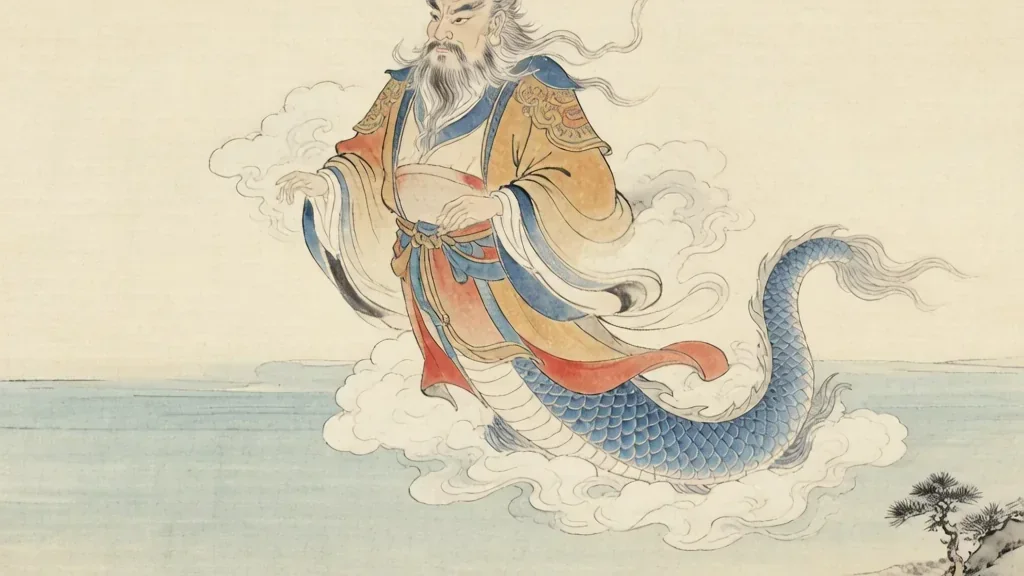
In the Chinese imagination, every body of water — from the vast Eastern Sea to the smallest village well — has a ruler. He is the Longwang (龙王, lóng wáng), the Dragon King, a fearsome and beneficent deity who commands rain, controls floods, and dwells in a crystal palace at the bottom of his watery domain. Unlike the abstract celestial gods of the high tradition, Longwang is a vividly imagined figure who has appeared in folk tales, classical novels, and temple art for over two thousand years. He is both a weather god and a king, a dragon and a bureaucrat, a figure of immense power who can be petitioned by a simple farmer with a sincere heart and a stick of incense.
Origins: From Rain Spirit to Water King
The Dragon King's roots lie in the ancient Chinese cult of the dragon as a rain spirit. The dragon (龙, lóng) was associated with water and clouds from the earliest records: the I Ching speaks of "the dragon seen in the field," and the Classic of Mountains and Seas (山海经, shān hǎi jīng) describes rain-bringing dragon spirits living in rivers and lakes. As early as the Han dynasty, local officials performed rain dances with dragon puppets and offered sacrifices to dragon spirits during droughts. But these were vague, impersonal forces — not yet gods with palaces, families, and courtly titles.
The transformation from spirit to king was driven by two forces: the spread of Buddhism from India and the systematizing impulse of Chinese folk religion. Indian Buddhism brought the nāga — a serpent-like water deity that guarded treasures and controlled rainfall — and Chinese translators rendered nāga as long (龙). The Buddhist nāga-king traditions merged with native dragon beliefs, and by the Tang dynasty the Dragon King had become a distinct figure: a divine ruler of a specific body of water, often depicted in human form wearing a dragon-head crown and robes embroidered with wave patterns.
The Ming dynasty novels Journey to the West (西游记, xī yóu jì) and Investiture of the Gods (封神演义, fēng shén yǎn yì) cemented the Dragon King in the popular imagination. In Journey to the West, the Dragon Kings of the Four Seas are vassals of the Jade Emperor, living in crystal palaces staffed by crab generals and shrimp soldiers. Sun Wukong's famous visit to the East Sea Dragon King to demand a weapon — emerging with the magical Golden-Banded Staff — is one of the most beloved episodes in all of Chinese literature, and it fixed the Dragon King's image as a slightly comical but genuinely powerful figure presiding over undersea splendor.
The Four Dragon Kings and Their Realms
Chinese cosmology traditionally recognized four seas — east, south, west, and north — each ruled by a Dragon King with a personal name. The most famous is Ao Guang (敖广, áo guǎng) of the East Sea, who appears in Journey to the West as the first dragon Sun Wukong harasses. His brothers are Ao Qin of the South Sea, Ao Shun of the West Sea, and Ao Run of the North Sea. Together they report to the Ministry of Thunder in Heaven and are responsible for the global distribution of rainfall.
Below these four great kings stretches a vast hierarchy. Every major river — the Yangtze, the Yellow River, the Pearl River — has its own Dragon King, as does every large lake — Dongting, Poyang, Taihu. Even a deep well or a major spring might have its own local Dragon King, a small spirit king ruling his few cubic meters of water with the same dignity as Ao Guang rules the entire Eastern Sea. This hierarchy mirrored the imperial administration: the Dragon King of the Yangtze was a "governor," while the Dragon King of a village well was a "county magistrate" of water.
In traditional art, the Dragon Kings are distinguished by the color of their robes — green for the east, red for the south, white for the west, and black for the north — and by the direction they face in temple statues. Temples dedicated to the Dragon King are often built near water — on riverbanks, lake shores, or coastal cliffs — and are designed so that the god's gaze sweeps protectively across his domain.
Festival Role: Praying for Rain and Averting Flood
The Dragon King's most important practical function was controlling the weather. In an agrarian society where a drought meant famine and a flood meant ruin, the Longwang temple was the focus of desperate, annual supplication. When spring planting came without rain, villagers would process to the Dragon King temple, beating drums and gongs to wake the god from his winter sleep, then offer a feast of pork, wine, and rice. If rain still did not come, the ritual could escalate to "sun-beating the Dragon King" — pulling his statue from the temple and leaving it in the burning sun to teach the god what thirst felt like.
Conversely, during flood season, communities offered prayers asking the Dragon King to restrain the waters. The Festival of the Dragon King, celebrated on the thirteenth day of the sixth lunar month in many regions, involved dragon boat races, paper offerings in the shape of boats filled with mock treasure, and communal feasts along the riverbank. The dragon boat itself was understood as a representation of the Dragon King's power — racing it was a way of channeling the water deity's energy toward productive ends rather than destructive floods.
Cultural Meaning: Water, Power, and the Cosmic Bureaucracy
The Dragon King embodies a distinctively Chinese way of understanding nature: the natural world is not wild and lawless but ruled by a bureaucracy as orderly as the imperial court. A drought is not mere bad luck but the result of a breakdown in the celestial waterworks — perhaps the local Dragon King was neglected, or a higher official overruled him. The solution is never to fight nature but to petition the right official, to restore the proper ritual relationship between the human community and the spirit who governs its water.
This bureaucratization of nature had a profound consequence: it made the environment morally legible. If water was a king, then floods were a king's wrath, and rain was a king's favor. A village that suffered a flood could ask itself what it had done to offend its Dragon King. A village blessed with ample rain could thank its dragon and praise his benevolence. The natural world was folded into the same moral framework that governed human society — neither random nor indifferent but responsive to virtue, ritual, and respect.
Today, in an age of reservoirs and weather forecasts, the Dragon King's direct power has receded. But he survives as a cultural icon: in the dragon boat races of the Duanwu Festival, in the dragon dances of Chinese New Year, and in the phrase "the Dragon King's son" (龙王之子, lóng wáng zhī zǐ) used to describe a prodigiously talented young person. His face — stern, crowned, surrounded by waves and clouds — still gazes from the walls of temples near every river and lake in the Chinese world, reminding passersby that water, the most ordinary and essential of elements, has always had a king.