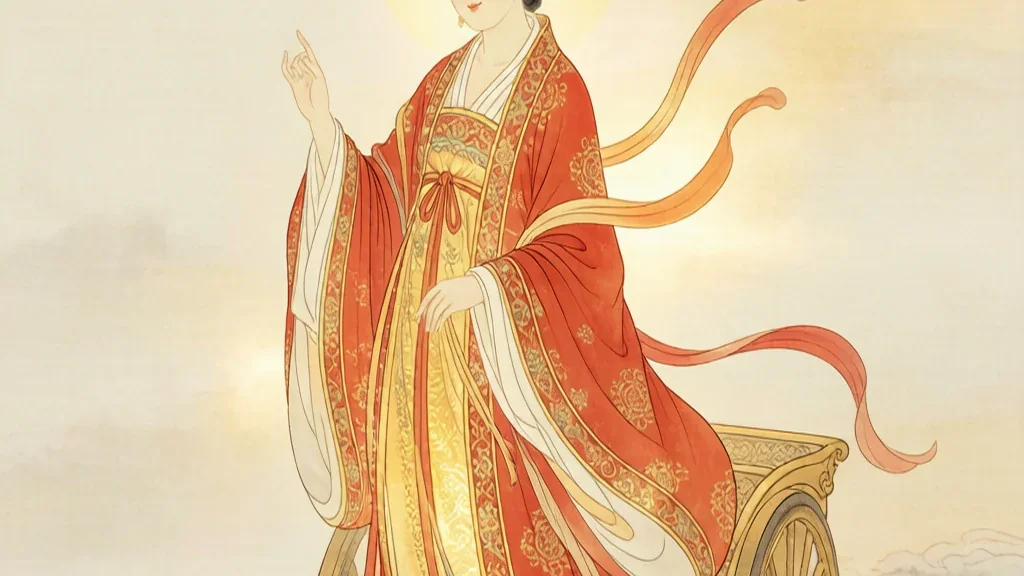
Xihe (羲和), the mother of the suns, is a luminous figure in the most ancient stratum of Chinese mythology. Recorded in the Shanhaijing (Classic of Mountains and Seas), she is the wife of the supreme god Di Jun and the bearer of ten suns, which in mythic time once all rose together and scorched the earth until the archer Hou Yi shot down nine of them. Xihe's role as the one who bathes, tends, and sends forth the suns makes her the gentle custodian of the day's light, a necessary counterweight to the drama of solar excess.
Sources in the Classic of Mountains and Seas
Xihe appears in the Shanhaijing, the archaic compendium of mythic geography compiled across the Warring States and Han periods. There she is named as the consort of Di Jun and the mother who gave birth to the ten suns that dwell in a cosmic tree.
Her appearances are brief, yet they place her at the very genesis of the daily solar cycle, which the text describes in concrete, almost industrial terms: the suns bathe, then one mounts the sky each day in orderly succession.
Because the Shanhaijing preserves older, shamanic cosmologies, Xihe belongs to a world where celestial bodies are living children of divine couples rather than the products of an abstract heaven.
Mother of the Ten Suns
In the earliest version, ten suns are born to Xihe and live in a mulberry tree called Fusang at the edge of the eastern sea. Each day one sun circles the sky while the others rest, and Xihe is the one who prepares and releases them.
The number ten corresponds to the ancient decimal cycle used in counting days, so the ten suns neatly map the ten-day "week" of the traditional calendar. Their mother thus governs the basic unit of timekeeping.
This orderly system, however, breaks down in the famous catastrophe when the suns disobey and rise all at once, turning the world to cinder—a mythic explanation for drought, heat, and the need for heroic correction.
Bathing and Sending Forth the Suns
The Shanhaijing says Xihe bathes the suns in a certain valley, an image of maternal care that frames sunrise as a daily renewal. Washing the suns also suggests purification before they take their place in the sky.
After bathing, she is said to drive them forth, sometimes in a chariot, ensuring that only one appears at a time. Her steady hand keeps the cosmos on schedule and prevents the chaos of simultaneous suns.
This domestic, nurturing portrayal makes Xihe the quiet operator of the heavens—the one whose routine labor makes life possible without fanfare.
The Catastrophe of Ten Suns
The best-known episode linked to Xihe's children is the tale of the ten suns who, neglecting their turn, all climbed into the sky together and baked the earth, drying rivers and withering crops. The people suffered terribly.
In response, the divine archer Hou Yi was summoned and shot down nine of the suns, leaving one to continue the proper daily cycle. The single remaining sun is Xihe's sole surviving child in the popular telling.
This story explains both the origin of a single sun and the perennial danger of excess: even the life-giving sun becomes a destroyer when it abandons measure, a theme echoed throughout Chinese thought.
Xihe and Di Jun
Di Jun, Xihe's consort, is an archaic supreme deity associated with the eastern sky and with agriculture. With two wives—Xihe for the suns and Changxi for the moons—he fathers the two great luminaries that order time.
The pairing divides cosmic responsibility cleanly: Xihe's solar line is active, hot, and prone to excess; Changxi's lunar line is calm and recurrent. Together they embody the rhythmic balance of heaven.
Though Di Jun later faded before the Jade Emperor, in the Shanhaijing layer he and Xihe remain the generative parents of the visible sky.
Xihe as a Solar Charioteer
Later elaborations picture Xihe driving the sun across the sky in a carriage drawn by dragons or six dragons, a motif that parallels solar chariots in other ancient mythologies. In this role she is both mother and chauffeur of the day.
This image elevates her from passive bather to active cosmic driver, responsible for the sun's journey from east to west. Her route defines the measurable day and the horizons of the world.
The chariot motif also connects her to the wider Eurasian pattern of sun-deities who traverse the heavens, showing a shared poetic logic in how peoples imagine the day's light.
Later Literary and Cultural Echoes
Xihe's name became a literary epithet for the sun itself in classical poetry, where "Xihe" can stand for sunrise, daytime, or the passage of time. Poets invoked her to lament the brevity of life or the flight of youth.
In modern retellings and fantasy inspired by the Shanhaijing, she is often reimagined as a dignified solar goddess, sometimes sympathetic to her children even as they are punished, adding maternal pathos to the old myth.
Though less prominent in popular religion than lunar goddesses like Chang'e, Xihe endures in scholarship and literature as the original mother of light.
The Ten-Day Cycle and the Calendar
The ten suns map neatly onto the ancient decimal count of days, a ten-day unit (the "xun") that structured the traditional week long before the seven-day cycle became common. Each sun's turn corresponded to one day in this revolving schedule, making Xihe the keeper of the basic rhythm of time in early Chinese life.
This system later combined with the twelve earthly branches to form the sexagenary cycle still used for years and dates in Chinese culture. Xihe's children thus stand at the root of one of the world's longest unbroken calendrical traditions, linking a sun goddess to the very way days and years are reckoned.
The myth quietly teaches that time itself is a heavenly ordinance: the suns do not rise by chance but by a maternal order that, when obeyed, keeps the world in measure—and when broken, as in the ten-suns catastrophe, brings ruin. Orderly succession, the tale implies, is the foundation of civilization.
❓ Frequently Asked Questions
Who is Xihe?
Xihe is the goddess in the Shanhaijing who is the wife of Di Jun and the mother of the ten suns, responsible for bathing and sending them across the sky.
What happened to the ten suns?
They once all rose at once and devastated the land; the archer Hou Yi shot down nine, leaving one sun to mark the day as it does now.
Where do the suns live?
In the myth they rest in a cosmic mulberry tree called Fusang at the eastern edge of the sea, from which they emerge one by one.
How is Xihe different from Changxi?
Xihe mothers the suns (day) while Changxi mothers the moons (night); the two are complementary consorts of Di Jun governing the luminaries.
Why does Xihe bathe the suns?
Bathing is a mythic image of renewal and purification, preparing each sun to shine and symbolizing the daily rebirth of daylight.
Is Xihe still worshiped?
She is not a major popular deity today, but her name survives in poetry and scholarship as a personification of the sun and ancient cosmogony.