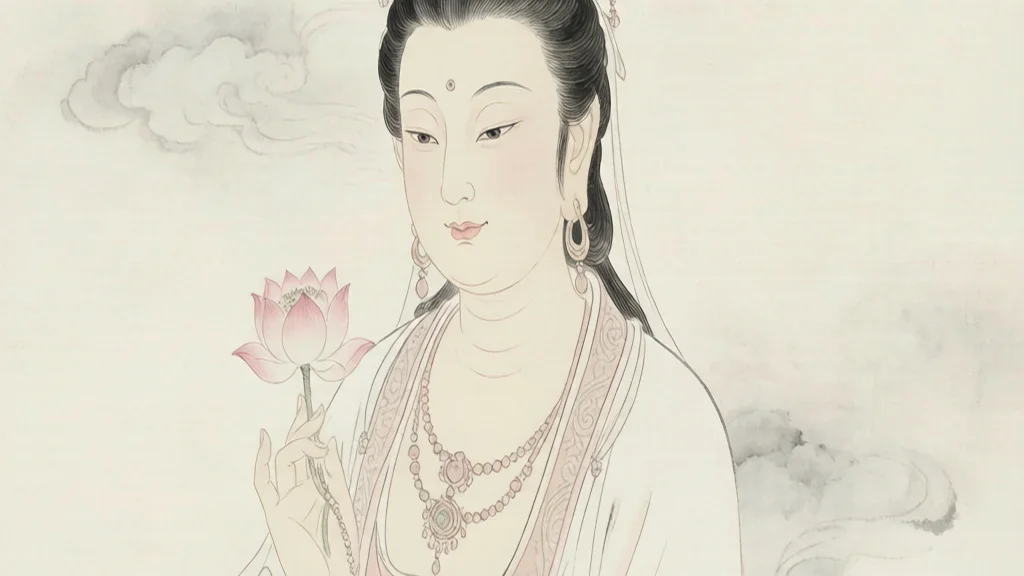
Guanyin, full name Guanshiyin ("The One Who Perceives the Sounds of the World"), is the Bodhisattva of Great Compassion and arguably the most beloved deity in Chinese religious life. Venerated across Chinese Buddhism, Taoism, and popular folk religion, Guanyin is invoked for protection from danger, relief from suffering, and the gift of children. Originally a male bodhisattva in Indian Buddhism, the figure gradually took on a serene feminine form in China, becoming a universal mother-like savior embraced by people of every social class. Her image — calm, merciful, and ever-ready to answer a cry for help — sits in household shrines, temple halls, and roadside niches throughout the Chinese cultural world.
Origins in Indian Buddhism
The Chinese Guanyin descends from Avalokiteshvara, the bodhisattva of compassion in Indian Mahayana Buddhism. The Sanskrit name means "the lord who looks down," suggesting a figure who gazes upon the world's suffering with boundless empathy. Early Buddhist scriptures promised that anyone who called upon Avalokiteshvara in moments of peril — from shipwreck to attack by beasts — would be delivered.
When Buddhist teachings traveled along the Silk Roads into China during the early centuries of the common era, this compassionate savior entered the Chinese imagination alongside the sutras and the monasteries. The Lotus Sutra's "Universal Gate" chapter, which praises Avalokiteshvara's power to rescue beings from fear, became one of the most recited texts in Chinese Buddhism and shaped the devotional identity of the deity for over a thousand years.
The Transformation into a Chinese Figure
In India, Avalokiteshvara was usually depicted as a handsome princely youth, sometimes bearded. In China, the figure underwent a remarkable change of gender, becoming increasingly androgynous and then clearly feminine from roughly the late Tang and Song dynasties onward. Several reasons are proposed for this shift: the Chinese ideal of mercy was closely tied to maternal care, and a female form made the bodhisattva more approachable to laywomen and to those praying for children.
By the Ming dynasty, Guanyin was almost universally portrayed as a graceful woman in flowing white robes, often barefoot and crowned. This Chinese Guanyin absorbed local sensibilities of gentleness, self-sacrifice, and maternal devotion, becoming something distinct from her Indian ancestor while remaining rooted in the same Buddhist vow to relieve suffering.
Titles, Forms, and Manifestations
Guanyin is known by many names and forms. As Guanshiyin she "hears the cries of the world"; as Songzi Guanyin she bestows sons upon childless couples; as Qianshou Qianyan Guanyin she appears with a thousand arms and a thousand eyes, each hand holding a different instrument of salvation. These multiple forms reflect the belief that the bodhisattva assumes whatever shape is needed to help a particular being.
The "thirty-three manifestations" tradition describes Guanyin appearing as a monk, a layman, a dragon, a boy, or a goddess, depending on what the moment requires. This doctrine of skillful means allowed Guanyin to be all things to all devotees — a protector of sailors, a patron of mothers, a guide of the dead, and a companion of the lonely.
Role as Savior and Protector
At the heart of Guanyin devotion lies the promise of rescue. The Lotus Sutra lists dangers from which she saves believers: fire, flooding, storms at sea, robbers, and binding chains. For a population that traveled by river and ocean and lived close to natural catastrophe, this protective function was deeply meaningful.
Fishermen and merchants along the southeast coast especially revered Guanyin as a sea-protectress long before the rise of the separate goddess Mazu. Sailors would chant her name during tempests, and coastal temples raised her image facing the water. Even today, many believers turn to Guanyin first in times of fear or grief, trusting her vow never to abandon a sincere caller.
Guanyin and Motherhood
One of Guanyin's most cherished Chinese roles is as giver of children. The form Songzi Guanyin ("Child-Sending Guanyin") shows her holding or accompanied by a healthy infant, and women who wished to conceive would pray to her, make offerings, and sometimes eat symbolic foods. This association grew as the bodhisattva's feminine identity solidified.
After birth, families might dedicate a child to Guanyin, dressing the boy or girl in miniature monastic robes for a period as a gesture of gratitude and protection. In this way Guanyin bridged the Buddhist world of renunciation and the very worldly Chinese concern with family continuity and the well-being of children.
The Sacred Mountain of Putuo
Putuo Shan, an island off the coast of Zhejiang, is the foremost sacred site of Guanyin in China and is counted among the Four Sacred Mountains of Chinese Buddhism. Tradition holds that Guanyin manifested there, and the island became a great pilgrimage center where monks, nuns, and laypeople gathered to worship the "Southern Sea Guanyin."
Across the centuries, emperors patronized Putuo Shan and communities of devotees maintained its temples. Even when official Buddhism declined, the island remained a living center of Guanyin faith. Pilgrims still climb its hills, circumambulate its caves, and face the sea in the belief that the bodhisattva's compassion radiates from that shore to the whole world.
Iconography and Symbolism
Guanyin is most often shown seated or standing on a lotus, wearing a diadem that may bear a small image of Amitabha Buddha, her spiritual teacher. She frequently holds a willow branch and a vase of sweet dew, with which she sprinkles healing upon the suffering. The willow, flexible yet resilient, and the pure water together signal life-giving mercy.
In the thousand-armed form, the many hands arranged in a great disc behind her body each carry an eye or a tool, visualizing the infinite reach of compassion. White, the color of her usual robe, signifies the purity that suffering cannot stain. Artisans across regions developed distinct local styles, yet all sought to convey serenity and attentive kindness.
Guanyin in Folk Religion and Taoism
Beyond the Buddhist monastery, Guanyin entered the broad stream of Chinese folk religion, where she is often treated less as a doctrinal figure and more as a kindly grandmother-deity who answers prayers. Taoist temples sometimes include her among their pantheon, and village shrines may host her alongside local gods.
This porous boundary between Buddhism and folk practice is typical of Chinese religion, where ordinary households blend elements freely. A family might burn incense to Guanyin for safety, consult a Buddhist nun about a vow, and still observe Taoist rites — all without feeling contradiction, because Guanyin's compassion is understood to transcend any single institution.
Festivals and Popular Worship
Devotees mark Guanyin's birthday, enlightenment day, and the day of her renunciation, celebrated on the nineteenth day of the second, sixth, and ninth lunar months respectively. On these occasions, temples hold special services, vegetarian feasts are offered, and pilgrims flock to sacred sites. Many believers adopt a vegetarian diet on these days as an act of reverence.
Daily household worship is simpler: lighting a stick of incense before a small image, reciting the name "Namo Guanshiyin Pusa," or chanting the Heart Sutra. The repetition of her name is itself a meditation on mercy, and among laypeople the short phrase "Guanyin save us" remains a spontaneous cry in moments of trouble.
Guanyin in Art and Literature
Guanyin has inspired some of the most beautiful religious art in East Asia — sculptures in wood, bronze, and jade; paintings on silk; and, in later centuries, the delicate white porcelain figures for which Dehua kilns became famous. Each medium sought the quiet grace that defines her presence.
In literature and drama, Guanyin frequently appears as a deus ex machina who rescues the virtuous and reforms the wicked, most famously in the novel "Journey to the West," where she guides the pilgrim monk Xuanzang and his companions. Through such stories she entered the common moral imagination as the patient, forgiving power that never gives up on a struggling soul.
Modern Devotion
Today Guanyin remains a living presence for millions. In Chinese communities worldwide, her altars stand in homes, restaurants, and shops, and her image travels with migrants who carry their faith abroad. Modern devotees may pray for health, harmony, business success, or simply peace of mind, continuing a practice centuries old.
Her message of compassionate action has also been taken up in humanitarian and environmental contexts, where "Guanyin's mercy" is invoked to encourage care for the vulnerable and for nature. Whatever the setting, the core remains the same: a willingness to hear the world's pain and answer it with an open heart.
❓ Frequently Asked Questions
Is Guanyin male or female?
In India she was a male bodhisattva, Avalokiteshvara, but in China she gradually became a gentle female figure, especially from the Song dynasty onward.
What does Guanyin do for believers?
She is believed to hear cries of suffering and rescue people from danger, illness, and fear, and to grant children to those who pray.
Where is Guanyin mainly worshipped?
Her premier pilgrimage site is Putuo Shan in Zhejiang, but shrines to her exist in homes and temples across the Chinese world.
How is Guanyin different from the Buddha?
She is a bodhisattva — one who delays full buddhahood to help others — not a supreme creator god, and she appears in many flexible forms.
Why is she linked to the sea?
Coastal people honored her as a protectress of sailors and travelers, and her mythical abode is the Southern Sea.
Can non-Buddhists venerate Guanyin?
Yes; in Chinese folk practice many who are not formally Buddhist still pray to her for mercy and protection.