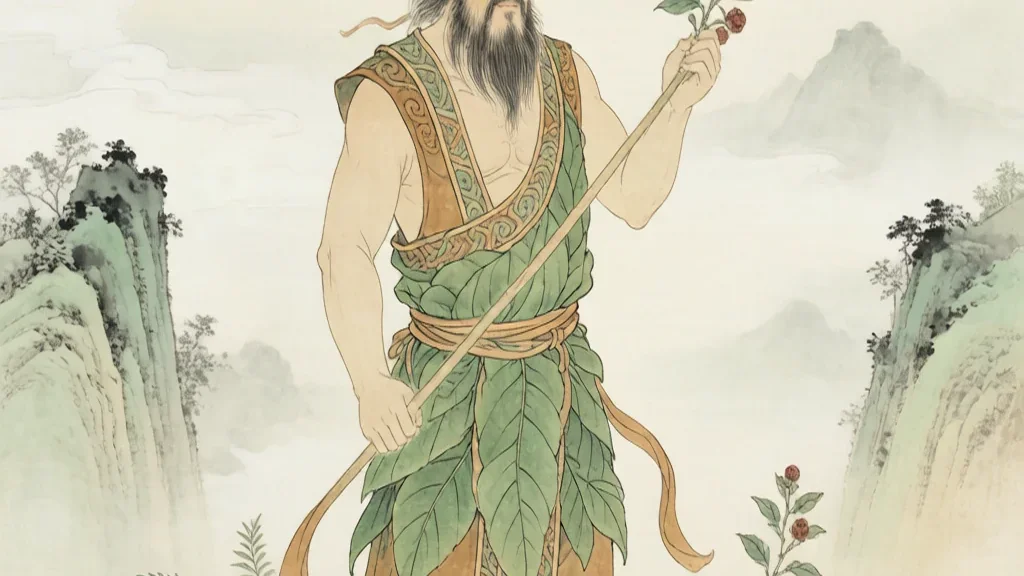
Shennong (神农), the "Divine Farmer," is one of the great culture heroes of Chinese mythology and a central figure among the Three Sovereigns. Credited with teaching humanity agriculture, the use of fire in clearing land, the tasting of hundreds of plants to discover medicines, and the establishment of markets, he embodies the transition from foraging to farming that made Chinese civilization possible. Often shown with the body of a man and the head of an ox, Shennong bridges the animal and human worlds and stands as the patron of farmers, herbalists, and the rural calendar.
Identity and the Ox-Headed Form
Shennong is typically depicted with a human body and the head of an ox or buffalo, a form that signals his deep connection to plowing, draft animals, and the soil. The ox was the chief beast of Chinese agriculture, so its head on a divine farmer is fitting.
He is also counted as the second of the Three Sovereigns in many versions, following Fuxi and preceding the Yellow Emperor, each sovereign contributing a distinct gift: Fuxi gave order, Shennong gave sustenance, and the Yellow Emperor gave governance and craft.
His title "Divine Farmer" (Shennong) became so identified with agriculture that it was later used as a dynastic or honorific name, and emperors regularly offered him sacrificial rites as the spirit of farming.
The Gift of Agriculture
The core of Shennong's legend is his teaching of cultivation. He is said to have shown people how to clear fields with fire, break the soil, sow grain, and reap harvests, replacing a life of uncertain gathering with the steady productivity of farmed land.
He is particularly associated with the five grains—rice, millet, wheat, barley, and soybeans in various listings—which became the staple foundation of the Chinese diet. By naming and promoting these crops he is credited with ending famine and stabilizing settlement.
Tools such as the plow and the hoe are attributed to his instruction, and the very practice of observing seasons and soils to decide what to plant is folded into his legacy as the first scientific farmer.
Tasting the Hundred Herbs
Shennong's most famous act of benevolence is the tasting of plants to find which were edible, which were medicinal, and which were poisonous. Legend says he tasted hundreds of herbs daily, and on one celebrated day encountered seventy poisons, surviving through his divine constitution and the aid of tea.
This myth makes him the founder of Chinese herbal medicine. The classic Shennong Bencao Jing (Divine Farmer's Materia Medica) is attributed to him in tradition, even though it was actually compiled centuries later, organizing hundreds of substances by their properties.
The story also explains why medicine requires trial and self-sacrifice: the healer must risk his own body to learn what will cure others, a value deeply respected in Chinese medical ethics.
The Discovery of Tea
A beloved episode holds that when Shennong was poisoned, a few leaves drifted into his boiling water and cured him; these were the first tea leaves. This tale makes him the mythic discoverer of tea, which became one of China's great gifts to the world.
Whether or not the story is taken literally, it binds the origins of tea to the same figure who safeguarded health through herbs, reinforcing tea's long-standing role as both beverage and mild medicine in Chinese culture.
The image of Shennong with a transparent or glowing abdomen—said to let him see how plants affected his organs—further illustrates the observational ideal behind Chinese pharmacology.
Markets and Trade
Beyond farming and healing, Shennong is credited with instituting regular markets where people could exchange goods by midday and disperse by sunset. This innovation turned surplus grain into a medium of exchange and founded the rhythm of periodic fairs.
By organizing trade he completed the economic base of early civilization: production (farming), health (medicine), and distribution (markets) all flow from his teachings. In mythic economy, he is the architect of prosperity.
Some accounts also credit him with teaching the proper use of fire for cooking and for clearing forests, linking him to the broader mastery of natural elements that defines civilization.
Shennong and the Fire Emperor
Shennong is frequently identified with or closely linked to Yandi, the Flame Emperor, and the two are sometimes treated as a single deity. Yandi represents the fire and southern, agricultural aspect of sovereignty, complementing the Yellow Emperor's metal and central authority.
The famous conflict between Yandi's line and the Yellow Emperor, and their later alliance, became a founding narrative of the Chinese people, who often call themselves "descendants of Yandi and Huangdi." Shennong's identity is thus woven into ethnic self-understanding.
This merging shows how agricultural and fiery symbolism were joined: fire clears the field and cooks the crop, just as Shennong's knowledge transforms wilderness into civilization.
Cult and Modern Festivals
Across China, especially in Hunan, Hubei, and Shaanxi, temples and festivals honor Shennong, and the city of Yichang area hosts rites at the Shennongjia ("Shennong's Ladder") mountains, a region rich in medicinal plants that bear his name.
Imperial rites treated him as the spirit of agriculture, and the "Praying for Grain" ceremonies invoked him each planting season. Farmers' altars sometimes kept a small image of the ox-headed sage.
Today he appears in agricultural expos, herbal-medicine promotions, and cultural festivals as a symbol of China's long farming heritage and respect for the land.
Legacy in Medicine and Agriculture
Shennong's influence survives most concretely in Chinese medicine, where the Materia Medica attributed to him remains a foundational reference and where the ideal of direct empirical testing of remedies echoes his myth.
In agriculture he lives on as the patron of the rural year, honored at harvest and invoked in prayers for rain and good crops. His ox-head image decorates farm tools and New Year prints in farming regions.
Though historical fact and myth are inseparable in his story, Shennong endures as the humane inventor who traded his own safety for the nourishment and healing of all people.
❓ Frequently Asked Questions
What is Shennong known for?
Shennong is known as the Divine Farmer who taught agriculture, discovered medicinal herbs by tasting plants, and established markets, forming the economic and healing base of Chinese civilization.
How is Shennong linked to tea?
A legend says that leaves falling into his boiling water cured him of poison, making him the mythic discoverer of tea as both a beverage and a remedy.
Is Shennong the same as Yandi?
He is frequently identified with or merged with Yandi, the Flame Emperor, and together they represent the agricultural, fiery pole of ancient sovereignty.
Why does he have an ox head?
The ox was the chief draft animal of Chinese farming, so giving the farmer-god an ox head symbolizes his mastery over plowing and the soil.
What is the Shennong Bencao Jing?
It is the foundational Chinese materia medica attributed traditionally to Shennong, listing hundreds of substances by their healing properties, though actually compiled later.
How is Shennong honored today?
He is honored at temples and festivals, especially in farming regions and at Shennongjia, and remains the patron spirit of agriculture and herbal medicine.