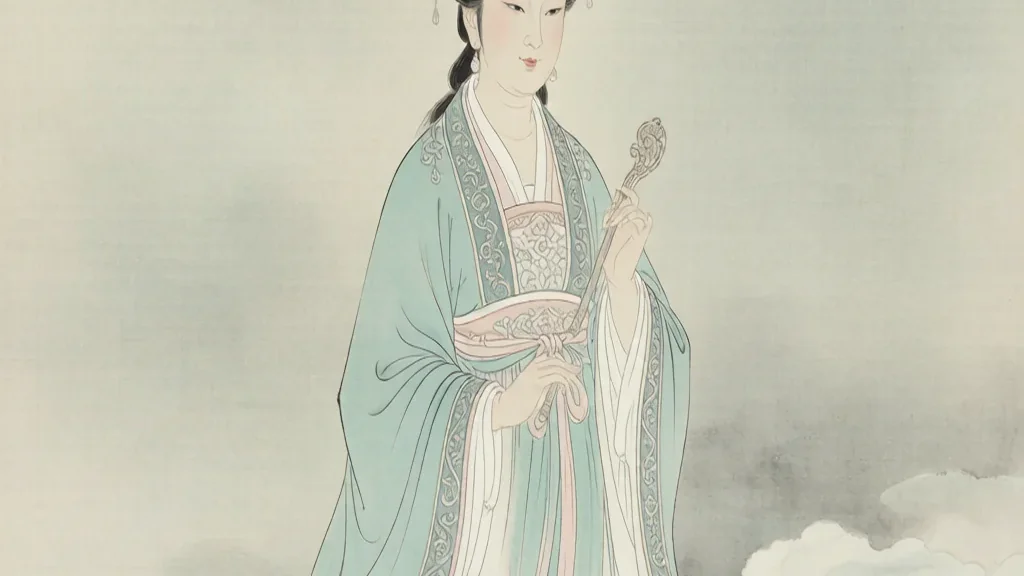
Mazu (妈祖), also known as Tianhou (Empress of Heaven) or the "Ancestral Mother," is the beloved Chinese goddess of the sea, sailors, and fishermen. Rising from a historical woman named Lin Mo, who lived on Meizhou Island in Fujian, she became over the centuries one of the most widely worshiped deities in coastal China and across the Chinese diaspora. Her cult spread with merchant junks and migrant communities to Taiwan, Southeast Asia, and beyond, where she is still prayed to for safe passage, calm waters, and protection from storms.
Historical Roots: Lin Mo of Meizhou
Mazu began as a real or semi-legendary woman surnamed Lin, often called Lin Mo or Lin Moniang, born on Meizhou Island off the Fujian coast. Local tradition places her in the later imperial period, and says she showed unusual spiritual gifts from childhood, including the ability to foresee storms.
Stories tell that she could enter trances in which her spirit traveled to aid family members caught in shipwrecks, and that once, while seemingly asleep, she saved her father and brother from drowning by psychically guiding them to safety. Such tales mark her as a shamanic mediator between the human and spirit worlds.
After her early death—often said to have occurred in her late teens or twenties—neighbors began to report appearances of her in white robes walking on waves, and they built a small shrine that grew into the great Mazu cult.
From Woman to Goddess
Mazu's elevation followed a familiar pattern in Chinese religion: a locally venerated worthy is gradually recognized by the state through bestowal of titles. Over successive dynasties, emperors granted her ever-grander honorifics, from "Lady" to "Queen" to "Empress of Heaven."
This imperial patronage transformed a regional sea-spirit into a nationally sanctioned goddess, embedding her in the official ritual system while keeping her popular, grassroots devotion intact. The titles also reflected the growing importance of maritime trade to the state.
By the late imperial era Mazu was one of the very few female deities to receive the supreme title Tianhou, "Empress of Heaven," placing her among the highest ranks of the pantheon.
Patron of Sailors and the Sea
Mazu's chief role is protector of those who go to sea. Fishermen, merchants, and naval crews pray to her before voyages and thank her after safe return, and many boats carry a small image or altar of the goddess at the stern.
Devotees tell of her lantern guiding lost ships, her calm voice stilling the wind, and her white figure standing atop waves to ward off disaster. These miracles form the living core of her worship and are recounted at every major temple.
Because China's coast is long and storm-prone, the practical need for a dependable sea-goddess ensured her enduring popularity among communities whose livelihood depended on the water.
Temples and the Meizhou Pilgrimage
The spiritual center of Mazu worship is Meizhou Island, home to the ancestral Mazu Temple, which pilgrims regard as the source of all other Mazu shrines. Major festivals there draw worshippers from across the strait and overseas.
Taiwan alone has hundreds of Mazu temples, the most famous being the Chaotian Temple in Beigang, a major site of annual pilgrimage. The goddess is a powerful bond across the Taiwan Strait, shared by communities on both sides.
Overseas, Mazu temples in Singapore, Malaysia, the Philippines, and elsewhere served as anchors of immigrant identity, combining religious solace with community gathering and mutual aid.
Festivals and Rituals
Mazu's birthday, observed on the twenty-third day of the third lunar month, is the high point of the ritual year, marked by processions, opera performances, and the carrying of her sedan chair through streets. The incense and music create a festive, communal atmosphere.
Some traditions also commemorate her "ascension" day, when she is said to have risen to heaven. On both occasions devotees offer food, burn spirit money, and seek her blessings for the coming season.
Pilgrimage processions, in which her image is borne from one temple to another, physically enact the goddess's movement across the land and renew ties between villages and the sea.
Mazu in the Chinese Diaspora
As Fujianese and other coastal Chinese migrated for trade and labor, they carried Mazu with them, founding temples that doubled as clan and merchant halls. In port cities her shrine was often the first building raised.
Her cult thus became a carrier of Chinese maritime culture, linking disparate communities through a shared protectress and providing continuity of identity far from home. She remains a symbol of overseas Chinese heritage.
In many places Mazu worship has been recognized as intangible cultural heritage, affirming its value not only as religion but as a living social tradition.
Symbolism and Modern Meaning
Mazu embodies compassion, vigilance, and the protective feminine principle. Her white robe and calm demeanor contrast with the violent sea she tames, making her a figure of reassurance in moments of danger.
Today she is also embraced as a symbol of cross-strait and regional connection, with joint pilgrimages and cultural exchanges built around her cult. Her image appears on stamps, in museums, and in public art.
Though rooted in ancient maritime anxiety, Mazu's meaning has expanded to represent safety, family reunion, and the enduring bond between people and the ocean that sustains them.
Mazu Among the Sea Deities
Mazu sits within a broader family of Chinese water gods, most notably the Dragon King (Long Wang), who rules the oceans and rainfall, and the river god Hebo. Where the Dragon King embodies the vast, impersonal power of the sea, Mazu is the intimate, compassionate protector appealed to by individual sailors, merchants, and the families who wait for them on shore.
She is sometimes honored as "Tianfei," the Heavenly Consort, a title that places her in the celestial hierarchy below the Jade Emperor yet above many local spirits. This ranking let state ritual integrate her popular cult without displacing the older deities, smoothing her path from village shrine to imperial patronage.
In practice, coastal worshippers rarely saw a conflict: they might pray to the Dragon King for rain and to Mazu for a safe voyage, drawing on different gods for different needs, with Mazu as the closest and most responsive of the sea's powers. Her approachability is precisely what made her the favorite of those whose lives literally rode on the waves.
❓ Frequently Asked Questions
Who was Mazu before she became a goddess?
She is based on Lin Mo (Lin Moniang), a young woman from Meizhou Island in Fujian said to have had spiritual powers to foresee and calm storms and to aid shipwrecked kin.
What does Mazu protect against?
She is the patron of sailors, fishermen, and travelers by sea, invoked for safe passage, calm weather, and rescue from storms and shipwreck.
Where is the main Mazu temple?
The ancestral temple is on Meizhou Island in Fujian; major daughter temples include the Chaotian Temple in Beigang, Taiwan, and many across the Chinese diaspora.
Why is she called Tianhou?
Tianhou, "Empress of Heaven," is the highest title granted by imperial decree, reflecting the state's recognition of her as a major protective deity.
How is Mazu worship observed?
Devotees hold processions, burn incense, perform opera, and make pilgrimages, especially on her lunar birthday and ascension day.
Is Mazu worship found outside China?
Yes; Mazu temples are widespread in Taiwan, Southeast Asia, and overseas Chinese communities, where they also serve as cultural and mutual-aid centers.