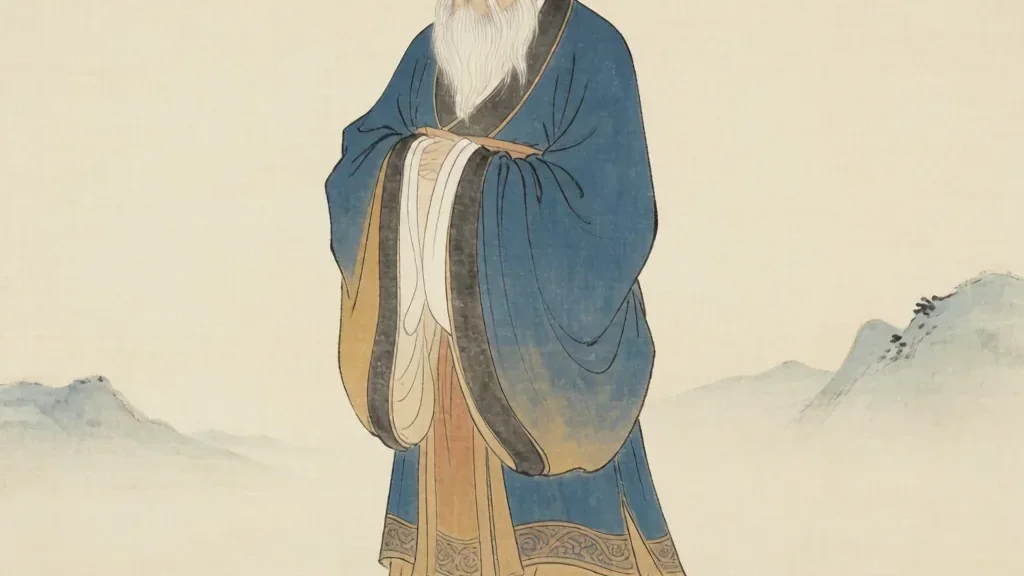
If there is a single human figure whom Chinese tradition calls the father of the nation, it is Huang Di (黄帝 — ), the Yellow Emperor. More than a mythic king, he is the ancestor from whom the Chinese people trace their line, the sovereign who defeated the Flame Emperor, tamed a monstrous rival at Zhuolu, and presided over the invention of countless arts of civilization. His yellow color links him to the earth and the center, the stable ground beneath all things. To know the Yellow Emperor is to know the founding story of a people who see themselves as his children, heirs to a golden age of order, craft, and unity.
The Yellow Emperor and the Center of the World
In the Chinese mapping of the cosmos, the color yellow and the element earth belong to the center, the still point around which the four directions turn. Huang Di is the Central August One, the emperor who holds the middle and keeps the world balanced. Where Yan Di's fire leaps and spreads, the Yellow Emperor's earth receives and orders. This placement is why he, more than any other early ruler, came to stand for unified sovereignty — the calm center that gathers the scattered parts into one realm.
Legends say he was born of a thunderous omen and chose the color yellow for his banners and robes. He is often shown as a wise, almost royal figure rather than a wild giant, the kind of leader who governs through capable ministers and useful inventions. His court becomes a mythic model of good government: a ruler who delegates, who listens, and who turns the wisdom of many helpers into the wealth of a people.
The Battle of Zhuolu and the Defeat of Chaos
The Yellow Emperor's claim to the world was not won without a fight. First he contended with Yan Di, the Flame Emperor, and prevailed, joining the lines of fire and earth. Then came the greater threat: Chi You, a bronzed, beast-like warlord of the Miao or Nine Li tribes, who commanded fog, storm, and a host of monstrous allies. At the plain of Zhuolu the two armies clashed, and for a time Chi You's magic of mist left Huang Di's troops lost and blind.
The emperor's answer was invention. With the help of the goddess and the wind-bag of a clever minister, he built a compass chariot that always pointed south, guiding his army out of the fog. He called down the drought maiden to scatter the rain, and with these tools he broke Chi You's power and restored order. The battle is remembered not merely as a victory but as the moment civilization turned back the forces of chaos, securing the world for human rule. Chi You, strangely, is also honored in some regions as a strong ancestral spirit, showing how myth can hold both sides of a great war.
The Many Inventions of His Court
What sets the Yellow Emperor apart is the sheer number of civilizing gifts attributed to his reign. His wife, Leizu, is credited with discovering silk, teaching women to raise silkworms and weave the precious thread that would dress emperors and travel the Silk Road. His minister Cangjie is said to have invented writing by studying the tracks of birds and beasts. Others in his court gave the people the calendar, the chariot, the boat, the bow and arrow, pottery, and the first codes of medicine.
The Huangdi Neijing, or Yellow Emperor's Inner Canon, is the foundational text of traditional Chinese medicine, cast as a dialogue between the emperor and his physician on the workings of the body, breath, and the seasons. Whether or not he spoke those words, the book bears his name because he stands for the moment knowledge was gathered and systematized. Under Huang Di, myth says, a scattered humanity learned to count, to write, to heal, and to make.
Ascent to Heaven and the Search for Immortality
The end of the Yellow Emperor's earthly life is told as a departure rather than a death. In later Daoist legend, having ruled long and well, he ascended to heaven on a dragon, leaving his mortals behind but sending word of the arts that preserve life. This gentle exit turns him into a bridge between the human and the immortal, a king who became a celestial lord. It is a fitting close for a figure who gave so much and then rose, rather than faded.
His quest for longevity also made him a patron of the alchemists and the early Daoist seekers. Tales of his journeys to find the mushrooms or elixirs of immortality fed a long Chinese fascination with extending life. Though the historical emperor is surely a mythic composite, the figure of Huang Di became a banner under which later seekers pursued health, harmony, and the secret of not dying — a very Chinese kind of hope.
The Yellow Emperor as National Ancestor
Over the centuries Huang Di was adopted as the shared ancestor of the Han Chinese and, by extension, of the Chinese people as a whole. The phrase "descendants of Yan and Yellow" pairs him with the Flame Emperor, but it is Huang Di who gives the lineage its central, unifying name. Modern reformers in the early twentieth century invoked the Yellow Emperor as a symbol of a united nation, and his tomb at Qiaoshan in Shaanxi remains a site of official and popular reverence.
Each spring, ceremonies are held at his mausoleum to honor the founder and to reaffirm cultural continuity. For overseas Chinese, too, the Yellow Emperor is a touchstone of identity, a figure who reaches across oceans and centuries to say: wherever you are, you come from this. In that role he is less a god of thunder than a founding father, the human face of a civilization's long memory.
Why the Yellow Emperor Endures
The Yellow Emperor endures because he answers a deep need: the need for a beginning that is also a standard. He is the ancestor who did not merely conquer but cultivated — who surrounded himself with inventors, who married silk to the world, who asked how the body works and how the year turns. His greatness is collective, the greatness of a people learning to live together with skill and order.
In a culture that prizes harmony, craft, and continuity, Huang Di is the perfect first hero. He is the center that holds, the yellow earth beneath the four directions, the father whose gifts — writing, medicine, silk, the calendar — are still with us. To remember the Yellow Emperor is to remember that civilization itself was the first and greatest invention.
The Union of Flame and Yellow
Although the two began as rivals, the Yellow Emperor and the Flame Emperor Yan Di came to represent a united ancestral line. After Huang Di defeated Yan Di, their peoples merged, and the phrase descendants of Yan and Yellow became an enduring way to name the Chinese people as a whole. This pairing matters because it frames China's origin not as a single conquest but as a joining of fire and earth, energy and order. Folk temples sometimes enshrine both emperors side by side, and seasonal rites honored them as joint founders. The alliance also let later storytellers present diversity within unity, a theme that resonated with successive dynasties seeking to govern many regions and peoples under one rule. Even today the phrase appears in speeches and textbooks as a gentle reminder of shared roots that cross modern regional and political boundaries.
The Yellow Emperor and Daoism
Centuries after his mythic reign, Daoist schools adopted the Yellow Emperor as a patriarch of their arts. He became associated with meditation, breathing exercises, and the search for long life, and was credited as a speaker in early alchemical and medical dialogues. The Yellow Emperor's Inner Canon secured his place as patron of medicine, while later Daoist hagiographies described him meeting immortals and ascending on a dragon. This religious afterlife transformed a culture hero into a sage of inner cultivation, a figure seekers could imitate through discipline rather than only admire through story. His example thus bridged the public world of government and the private world of spiritual practice, making him relevant to both emperors and hermits. Taoist monasteries still recite texts attributed to him, and wellness traditions from qigong to dietary lore often invoke his authority, keeping the ancient king present in daily practice.
❓ Frequently Asked Questions
📝 Chinese Vocabulary
黄帝 — : the Yellow Emperor, central sovereign and ancestor.
蚩尤 — : Chi You, the warlord defeated at Zhuolu.
嫘祖 — : Leizu, the Yellow Emperor's wife who discovered silk.
仓颉 — : Cangjie, the minister credited with inventing writing.
黄帝内经 — : the Yellow Emperor's Inner Canon, a foundation of Chinese medicine.
炎帝 — : Yan Di, the Flame Emperor, the rival whom the Yellow Emperor defeated and later joined with to form the ancestral line of the Chinese people.
指南车 — : The south-pointing chariot, the compass-like cart built to guide the emperor's army out of Chi You's fog at the battle of Zhuolu.
轩辕 — : Xuanyuan, an alternative name for the Yellow Emperor, still used in poetry as a dignified way to refer to China itself.
🎉 Fun Facts
- The Yellow Emperor's wife Leizu is honored as the discoverer of silk, after a silkworm cocoon supposedly dropped into her tea.
- His minister Cangjie is said to have wept or caused ghosts to wail when he invented writing, so powerful was the new art.
- A "south-pointing chariot" built to defeat Chi You's fog is considered an ancient ancestor of the compass.
- The Yellow Emperor's mausoleum at Qiaoshan still hosts official ceremonies each spring honoring the national ancestor.
- According to legend, the Yellow Emperor cast nine bronze ding cauldrons whose possession later came to signal the right to rule all of China.
- The Yellow Emperor's name Xuanyuan is still used today as a literary and poetic name for China in some formal or classical contexts.