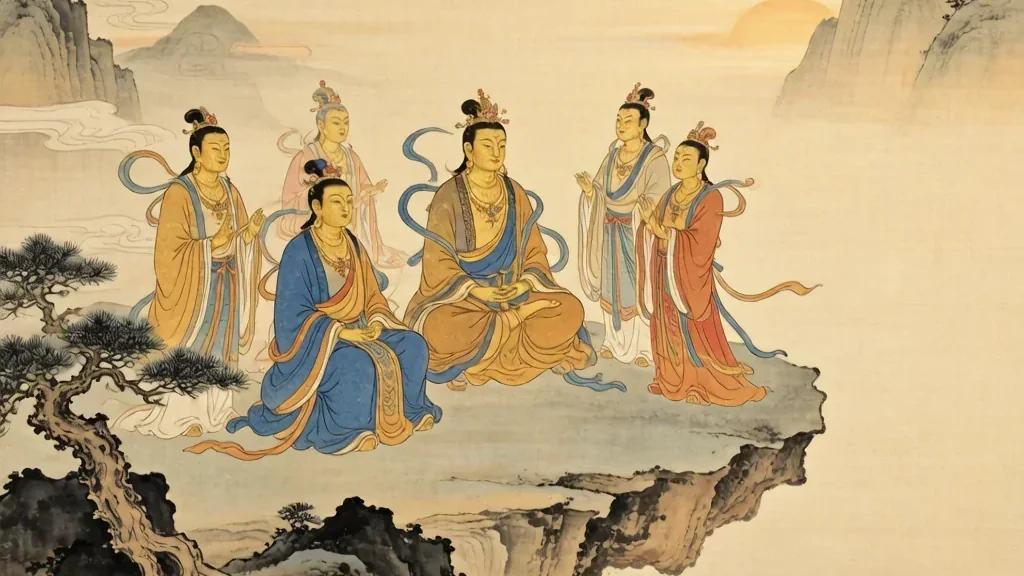
Before dynasties, before emperors, Chinese myth places a golden age of godlike rulers who gave humanity its first tools and laws. These are the Three Sovereigns (三皇 — ), the demigods of the dawn who taught people to survive, to count, to heal, and to live in order. The exact names vary across texts — some lists name Fu Xi, Shennong, and Nüwa; others name Fu Xi, Shennong, and the Yellow Emperor; still others add Suiren, the fire-maker, or Youchao, the builder of shelters. What stays constant is the idea: a small band of culture heroes at the world's beginning, each granting one essential gift, together lifting humankind out of the animal dark.
What "The Three Sovereigns" Means
The phrase Sanhuang pairs with the later Wu Di, the Five Emperors, to form the standard opening of Chinese mythic history: "the Three Sovereigns and the Five Emperors." The Sovereigns belong to the deepest past, a time when rulers were more than human and less than ordinary kings — they were embodiments of the forces that made civilization possible. To call them "sovereigns" rather than "emperors" marks their strangeness: they reigned, but they reigned as living principles.
Because the lists differ, the Three Sovereigns function less as fixed persons than as a template: three founding gifts. One gives order and signs, one gives food and medicine, one gives the spark of fire or the making of humans. The number three itself resonates with the Chinese love of triads — heaven, earth, and humanity; past, present, and future — so the Sovereigns feel less like a committee than like the three legs of a stool on which early society rests.
Fu Xi: The Giver of Order
In nearly every list, Fu Xi (伏羲) leads the Sovereigns. He is the one who separated chaos from pattern, who invented the fishing net, who taught the use of fire for cooking, and who devised the eight trigrams that became the root of Chinese writing and divination. His gift is structure: the insight that the world's confusion can be sorted into signs. Where there was only experience, Fu Xi brought record; where there was only luck, he brought method.
His place at the head of the Sovereigns tells us what Chinese culture values first. Before food or fire, there must be a way to make sense of things. Fu Xi is the founding mind, the one who turned bare existence into a world that could be known and taught. That is why, even when later lists swap the third name, Fu Xi almost never moves.
Shennong: The Giver of Sustenance
The second Sovereign is almost always Shennong, the Divine Farmer (神农). He taught people to grow the five grains, to use the plow, and to tell healing herbs from poison by tasting them himself. His gift is life's material base: without cultivated food and without medicine, no society can last. Shennong is the body to Fu Xi's mind, the one who fills the stomach and mends the wound.
Together the first two Sovereigns cover the two needs no civilization escapes — meaning and nourishment. Fu Xi gives the form; Shennong gives the substance. Their pairing is the mythic version of the Chinese saying that a people need both wen, the cultured arts, and zhi, the means of livelihood. Between them they account for almost everything a village requires to begin.
Nüwa, the Yellow Emperor, or the Fire-Maker
The third Sovereign is where the lists diverge, and each choice adds a different emphasis. Some traditions name Nüwa, the goddess who molded the first humans from yellow clay and repaired the broken sky with melted stones — making her the giver of people themselves. Others name the Yellow Emperor, Huang Di, the ancestor-king of inventions, who extends the Sovereigns into the age of empire. Still others name Suiren, who drilled wood to make fire, or Youchao, who taught people to build nests and houses against beasts and weather.
These variants are not contradictions but complements. Nüwa emphasizes origins — who we are; the Yellow Emperor emphasizes institution — how we are ruled; Suiren and Youchao emphasize the bare means of survival — warmth and shelter. The flexible third seat lets the Three Sovereigns speak to whatever a teller most wants to honor, while keeping the sacred number three intact.
The Sovereigns and the Five Emperors
The Three Sovereigns hand the world to the Five Emperors, among whom the Yellow Emperor usually stands first. The Sovereigns are the inventors; the Emperors are the organizers. Where the Sovereigns give single, world-changing gifts, the Emperors establish lineages, battles, and the first sketches of government. The two groups together form a smooth mythic ramp from the animal past to the historical kingdom.
This sequencing is itself a philosophy of progress. First come the gifts that make survival possible (fire, food, order), then come the rulers who make society possible (law, war, succession). The Chinese imagination thus tells the story of humanity as a stair built by teachers, each step resting on the one below. The Sovereigns are the foundation stones, and the whole later edifice of dynasty is said to rise from their work.
Why the Three Sovereigns Matter
The Three Sovereigns matter because they are the mythic charter of Chinese civilization's self-image. They say that to be human is to invent — to make a net, to plant a seed, to strike a spark, to draw a sign. They locate greatness not in conquest but in the first useful act, the small discovery that lets a thousand others follow. In honoring them, China honors its own genius for patient, practical creativity.
They also matter because they are shared. Unlike a single national founder, the Sovereigns are a council, a reminder that civilization is teamwork across generations. Fu Xi, Shennong, and their shifting third companion are less three kings than three hands, each holding up a different corner of the human world. To remember the Three Sovereigns is to remember that everything we have was first someone's gift.
Suiren and the Gift of Fire
In lists that name Suiren as the third Sovereign, his gift is fire, the spark that changed everything. Legend says he discovered how to make flame by drilling wood, ending the age when people ate raw food and feared the dark and the cold. Fire meant cooked meals, warmer homes, and protection from beasts, so Suiren's single invention underpins nearly every later comfort. As a Sovereign he stands for the most basic of human leaps: turning a natural force into a tool. His place in the trio beside Fu Xi's order and Shennong's food shows that Chinese myth traces civilization to a few founding arts. Whether or not the story is literal, it marks fire as the first technology and Suiren as its mythic teacher.
Youchao and the First Shelters
Another candidate for the third Sovereign is Youchao, remembered as the one who taught people to build nests and raised houses against wind, rain, and wild animals. Before his gift, the story goes, humans slept in the open or in trees, vulnerable to the weather and to beasts. By showing them how to construct shelter, Youchao began the long move from a wandering life to settled villages. His name, meaning nest builder, captures a simple but world-changing idea: that humans can remake their environment rather than merely endure it. Placing him among the Sovereigns honors the craft of building as a founding art of civilization, equal in mythic weight to writing and farming. His humble invention is the seed of every wall, roof, and city that followed.
❓ Frequently Asked Questions
📝 Chinese Vocabulary
三皇 — : the Three Sovereigns, founders of civilization.
五帝 — : the Five Emperors who follow the Sovereigns.
伏羲 — : Fu Xi, the Sovereign who gave order and signs.
神农 — : Shennong, the Sovereign who gave food and medicine.
燧人 — : Suiren, the Sovereign credited with making fire.
有巢 — : Youchao, a candidate third Sovereign credited with teaching people to build shelters.
女娲 — : Nüwa, a candidate third Sovereign who molded the first humans from clay and mended the sky.
黄帝 — : The Yellow Emperor, a candidate third Sovereign who extends the Sovereigns into the age of empire.
🎉 Fun Facts
- Fu Xi appears in nearly every list of the Three Sovereigns, but the third name changes between Nüwa, the Yellow Emperor, Suiren, and Youchao.
- The phrase "Three Sovereigns and Five Emperors" is the standard opening of traditional Chinese historical memory.
- Suiren, a possible third Sovereign, is said to have discovered fire by drilling wood, changing human diet forever.
- Nüwa, another candidate, is the goddess who molded the first humans from yellow clay and mended the fallen sky.
- Youchao, a candidate third Sovereign, is credited with teaching people to build nests and houses for shelter from beasts and weather.
- The Yellow Emperor, another candidate, is said to have invented many things including the compass and early forms of writing.