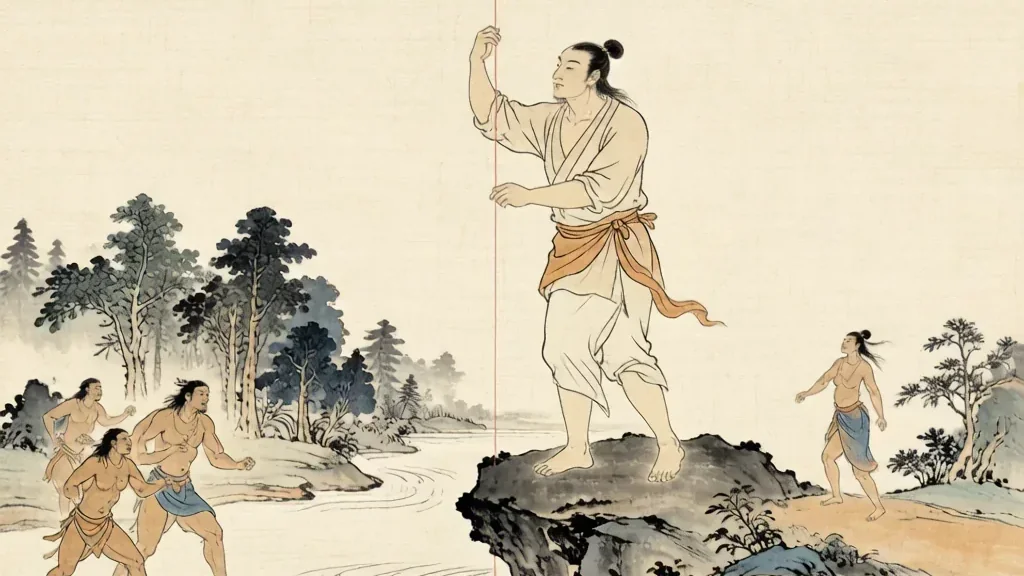
After the world was separated and the first humans wandered without order, Chinese myth tells of a hero who gave them the tools of civilization. His name is Fu Xi (伏羲 — ), often called the first of the culture heroes, the one who taught people to fish with nets, to cook with fire, to keep records with written signs, and to understand the changing world through the eight trigrams. Half human and half something more, born of a miraculous mother, Fu Xi stands at the threshold between the animal past and the human present. His story is less about cosmic power and more about a gift that still shapes daily life: the gift of order, method, and meaning.
The Birth of a Culture Hero
The legends of Fu Xi's birth are themselves wonderful. One popular account says his mother, Huaxu, stepped into a giant footprint left by a supernatural being and, in time, gave birth to Fu Xi after a pregnancy of twelve years. He is often described with a human head and the body of a serpent or dragon, a form he shares with his sister and later consort Nuwa. This blended shape signals that he belongs to both the wild world of beasts and the thinking world of people, a bridge between nature and culture.
Fu Xi is usually placed at the very beginning of recorded mythic history, among the earliest sovereigns who ruled before dynasties. In some tellings he is the brother of Nuwa, and together they survive a great flood that destroys the earlier world and then marry to restart the human race. The theme of a brother-sister pair renewing humanity after catastrophe appears across many Asian flood myths, and Fu Xi's version is among the most enduring in Chinese memory.
Gifts That Built Daily Life
Fu Xi's greatness lies in practical invention. Before him, people are said to have gathered what grew wild and eaten it raw. Fu Xi taught them to twist plant fibers and sinew into nets for catching fish and snaring birds, so they could feed themselves reliably. He is also credited with showing people how to domesticate animals and with the use of fire for cooking, lifting humans above the raw diet of the beasts. Each of these gifts answers a basic need, and together they mark the move from foraging to a settled, skilled way of life.
Beyond food, Fu Xi is honored for taming the chaos of experience into manageable signs. He is said to have looked at the patterns of the heavens, the markings on a dragon-horse that rose from the river, and the lines on a tortoise shell, and from them devised the eight trigrams — sets of broken and unbroken lines that became the foundation of the Book of Changes. With these trigrams people could keep records before writing fully developed, and could reflect on the cycles of nature, fortune, and fate.
The Eight Trigrams and the Search for Pattern
The eight trigrams, or bagua, are the heart of Fu Xi's intellectual legacy. Each trigram is made of three lines, either solid or broken, and each stands for a force or thing in the world: heaven, earth, thunder, wind, water, fire, mountain, and lake. By combining them in pairs, sixty-four hexagrams are formed, a system later used for divination, medicine, and philosophy. Fu Xi is remembered as the one who first saw that the world's endless variety could be sorted into a small set of repeating patterns.
This is why Fu Xi is a culture hero rather than a warrior king. His conquest is of confusion itself. To name the patterns of nature — to say that water behaves so, that fire behaves thus — is to give people a handle on reality. The trigrams became a kind of alphabet of the cosmos, and their influence runs straight into later Chinese thought, from the Book of Changes to the practice of medicine and the art of arranging space in harmony.
Fu Xi and Nuwa: Partners in Survival
No account of Fu Xi is complete without Nuwa. In the flood version of the myth, the two are the only survivors, and to repopulate the earth they marry, becoming the parents of humankind. Nuwa is famous for molding the first people from yellow clay, while Fu Xi provides the structures of society. Their union is often shown in ancient art as two intertwined serpent-tailed figures, each holding the tools of civilization — Fu Xi with a ruler and a square, Nuwa with a compass and a circle, symbols of measure and order.
Together they represent the paired principles that make a world livable: creation and structure, earth and heaven, the making of life and the making of law. The image of the two serpent-tailed deities circling each other appears on Han dynasty tomb tiles, where they guard the gates between the living and the dead, reminding the departed that order and continuity were gifts won long ago.
How Fu Xi Is Worshipped Today
Fu Xi is venerated not as a distant god but as a human ancestor and benefactor. In Gansu province, at the foot of Mount Taihao, stands a large temple complex dedicated to him, where annual festivals draw crowds who burn incense and reenact his marriage to Nuwa. These rites are less about fear than about gratitude: people thank the hero who taught their forebears to eat cooked food and to read the signs of the world.
In modern Chinese culture Fu Xi appears in textbooks as a symbol of human ingenuity. The message carried by his story is that progress comes not from magic alone but from observation and patient invention — watching the river, studying the tortoise shell, and turning what you see into a tool others can use. That is a quietly revolutionary idea, and it is the reason his name still heads the list of culture heroes.
Why Fu Xi Belongs at the Start of the Story
If Pangu gave the world its body, Fu Xi gave it its mind. He is the figure who turns bare survival into culture: nets instead of luck, signs instead of silence, partnership instead of isolation. His myths insist that being human is not only a matter of being born but of learning to order the world around us, to see pattern in chaos and to share that pattern with others.
In a civilization that would come to prize education, ritual, and harmony above brute force, Fu Xi is the fitting first teacher. He shows that the highest heroism can be the quiet act of invention — the moment someone first thought to make a net, to draw a line, to write a sign — and thereby lifted everyone who came after.
Fu Xi and the Invention of Music
Besides nets and trigrams, Fu Xi is honored as a maker of music. Legend credits him with fashioning a long zither from gourds, silk, and wood, and with tuning the strings to match the tones of nature so that sound itself became orderly. Music in early China was never mere entertainment; it was a tool of harmony that attuned human feeling to the order of the cosmos, much as the trigrams attuned thought. By giving people instruments and scales, Fu Xi extended his project of civilization from the body to the ear, teaching that a settled life needs rhythm and beauty as well as food and shelter. The claim also links him to later ritual music performed at courts and temples, so that the first culture hero is remembered not only as a provider but as the one who first made the world sing in measure.
Fu Xi Among the Three Sovereigns
Fu Xi heads the list of the Three Sovereigns, the first mythic rulers who precede the legendary emperors and dynasties. With Nuwa and Shennong, he forms a triad of culture heroes who between them give humanity its basic arts: Fu Xi the order and signs, Nuwa the people themselves, and Shennong the crops and medicine. To place him among the Sovereigns is to say that civilization began with teaching, not with conquest, and that the highest ancient authority was the one who invented what others could use. Later histories opened their accounts with the Three Sovereigns precisely because they represent a golden dawn of invention and care. Fu Xi's place at the front of that line makes him, in effect, the first teacher of China, the figure who turned a frightened, scattered humanity into a people with nets, signs, and a sense of pattern.
❓ Frequently Asked Questions
📝 Chinese Vocabulary
伏羲 — : Fu Xi, the first culture hero and inventor of order.
八卦 — : the eight trigrams devised by Fu Xi.
女娲 — : Nuwa, the goddess who made humans and Fu Xi's consort.
网 — : a net, the fishing tool Fu Xi is said to have invented.
文化英雄 — : "culture hero," a being who gives civilization its tools.
三皇 — : The Three Sovereigns, the earliest mythic rulers of China, among whom Fu Xi is numbered.
河图 — : The River Chart, the pattern shown by a dragon-horse from the Yellow River that inspired Fu Xi's trigrams.
熟食 — : Cooked food, which Fu Xi taught people to prepare by using fire.
🎉 Fun Facts
- Fu Xi is often shown holding a ruler and a square, while Nuwa holds a compass and a circle — together symbols of measuring and ordering the world.
- The eight trigrams Fu Xi devised are the foundation of the ancient Book of Changes, still studied as philosophy and divination today.
- One legend says Fu Xi's mother became pregnant for twelve years after stepping into a supernatural footprint.
- Fu Xi is numbered among the Three Sovereigns, the earliest mythic rulers who precede the legendary emperors of China.
- Fu Xi is credited with inventing a long zither from gourds or tubes, giving people their first music.
- He is said to have established the first marriage rites, replacing casual pairing with formal unions and clear kinship.