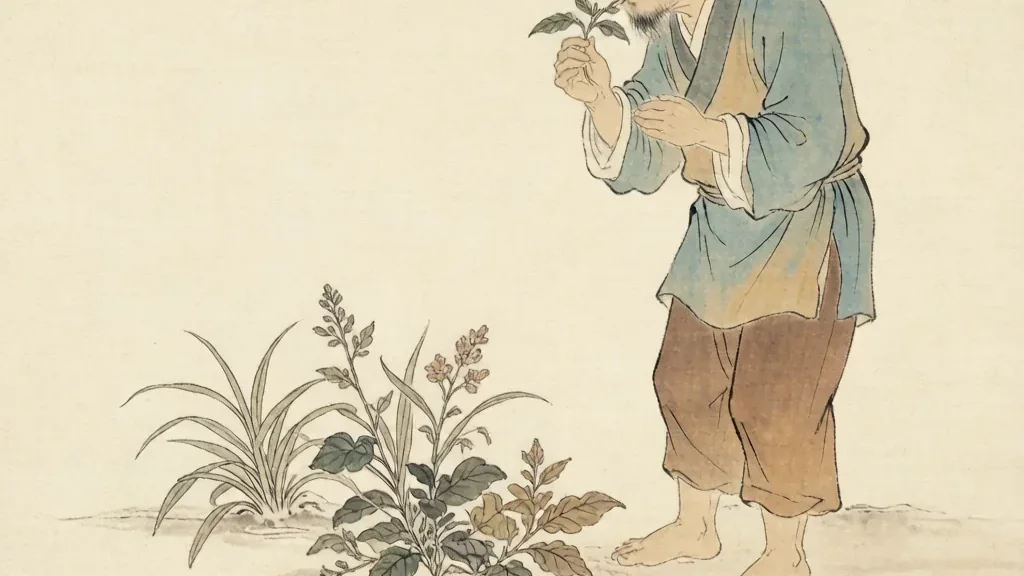
Long before pharmacies and laboratories, Chinese myth tells of a ruler who learned the healing power of plants the hardest possible way: by tasting them himself. His name is Shennong (神农 — ), the Divine Farmer, the culture hero who taught people to grow grain, to trade at markets, and to tell food from poison. He is said to have tasted hundreds of herbs, recording which cured illness and which brought death, and in doing so he founded the Chinese art of medicine and agriculture alike. The story of Shennong is the story of curiosity joined to courage — a god who risked his own body so that ordinary people might live longer and eat more surely.
A Ruler With a Transparent Belly
One of the most charming details in the Shennong legend is his body. He is often described as having a transparent or glowing belly, so that when he swallowed a plant he could watch it travel through him and see how it acted on his organs. This wonderful image is the myth's way of saying that he observed cause and effect directly, with his own eyes, rather than guessing. It also suggests innocence and openness: a body through which the truth of nature could be seen plainly.
Shennong is counted among the earliest sovereigns, usually placed after Fu Xi in the mythic sequence of culture heroes. Where Fu Xi gave people nets and signs, Shennong gave them the staple of settled life — cultivated food. He is the one who looked at wild grasses and saw not just fodder but the possibility of fields, and who taught people to plant rather than merely gather. In a land defined by rice and millet, that gift is hard to overstate.
Tasting a Hundred Herbs
The central act of the Shennong story is the great tasting. According to tradition, he tested seventy-two thousand (or in some versions hundreds of) plants to learn their natures. Each day he encountered many that were poisonous, and he is said to have been poisoned seventy times in a single day, yet his body was strong enough to recover, and his transparent belly let him note exactly where each toxin struck. From this endless experiment he separated the nourishing from the harmful and the healing from the deadly.
Out of this work came the first herbal knowledge. Shennong is honored as the author of the foundational text on materia medica, the Shennong Bencao Jing, or Divine Farmer's Classic of Materia Medica. Whether or not he truly wrote it, the book bears his name because it gathers the kind of practical plant wisdom his legend represents: careful observation, honest record, and a willingness to suffer for the sake of knowledge. It remains a cornerstone of traditional Chinese medicine.
The Gift of Agriculture
Shennong's name means "Divine Farmer," and farming is as central to him as healing. He is credited with teaching people to clear the land, to sow the five grains, and to use the plow drawn by oxen. Before his time, the story goes, people ate whatever the seasons offered and often went hungry; after him they could store surplus grain and build stable villages. The leap from gathering to cultivation is the leap from a wandering life to a civil one, and Shennong is its patron.
He is also linked to the invention of the wooden plow and the improvement of tools for tillage. In some accounts he discovered tea when leaves from a wild tree blew into his boiling water and refreshed him after a day of tasting bitter herbs. That gentle origin story ties the national drink to the farmer-god's endless labor, a small reward for a life spent testing poisons on behalf of others.
Markets, Trade, and the Order of Daily Life
Beyond the field and the herb patch, Shennong is remembered as a bringer of commerce. He is said to have established the first markets, where people could bring what they grew or made and exchange it by barter at midday. This gift may seem modest next to tasting poisons, but it matters: a market is where strangers meet as equals, where surplus becomes shared wealth, and where the peace of a settled society is practiced daily.
Together, his inventions — grain, herbs, the plow, the market — describe the full fabric of an agrarian civilization. Food, health, and exchange: these are the three things a village cannot do without, and Shennong is the mythic founder of all three. Small wonder that farmers through the centuries have burned incense to him at spring planting, asking for rain and a good crop in the name of the first farmer.
Shennong's Death and His Lasting Legacy
The legends do not let Shennong die peacefully. In the most famous version, he was finally killed by a plant so toxic that even his mighty body could not survive it — sometimes named as a "heart-breaking" herb that unraveled him from within. He died, in other words, doing exactly what he had always done: testing the limit of the world's danger so that others would not have to. His death is the final gift, a warning encoded in the body of the teacher.
Today Shennong lives on in many forms. The city of Yichang in Hubei and the surrounding Shennongjia mountains are named for him, and a large memorial temple stands where people honor the Divine Farmer each spring. In traditional medicine his spirit presides over the herbalist's craft, and schoolchildren still learn that the first pharmacopoeia was written by a god who was willing to be poisoned for their sake. His transparent belly has become, in the end, a symbol of science itself: seeing clearly what nature does.
Why Shennong Matters to Chinese Culture
Shennong matters because he models a particular kind of greatness — not the crushing power of a storm god, but the patient, embodied search for useful truth. He is the patron of the practical sciences: agriculture and medicine, the two arts on which Chinese civilization most depended. To call someone a "Shennong" is to call them a tireless healer and teacher.
In a broader sense, his story insists that knowledge is earned through the body. He did not receive a tablet of rules from heaven; he tasted, suffered, recorded, and shared. That empirical, humble, and brave approach to the world is a value Chinese culture has treasured for millennia, and it is woven into the very origins of its medicine and its farming alike.
Shennong and the Origins of Tea
One of the most charming stories about Shennong explains the discovery of tea. While tasting bitter herbs to test their effects, he would boil drinking water to refresh himself. According to the tale, leaves from a wild tea tree blew into his pot, and the resulting brew cleared his mind and soothed the fatigue of a long day of tasting poisons. Whether or not the story is historical, it ties China's national drink to the farmer-god's endless, selfless labor. Tea thus becomes a small reward for a life spent testing danger on behalf of others. The legend also gives tea a medicinal origin, matching Shennong's role as the founder of herbal knowledge and the first to sort the healing from the harmful.
Shennong's Place Among the Three Sovereigns
Shennong is almost always counted as the second of the Three Sovereigns, the mythic founders of Chinese civilization, sitting between Fu Xi, who gave order and signs, and a shifting third figure such as Nüwa or the Yellow Emperor. His place honors the belief that no society can begin without food and medicine, the two gifts he alone provides. As the Divine Farmer he represents the body to Fu Xi's mind: the plow and the herb patch beneath the written word and the trigram. Together the Sovereigns form a picture of civilization built by teachers rather than conquerors. By ranking Shennong among them, the tradition declares that farming and healing are not humble chores but founding arts, as essential to being human as language or law.
❓ Frequently Asked Questions
📝 Chinese Vocabulary
神农 — : the Divine Farmer, patron of agriculture and medicine.
本草 — : "root and herb," the traditional term for materia medica.
五谷 — : the five grains that Shennong taught people to cultivate.
药 — : medicine, remedy, the knowledge Shennong gathered.
茶 — : tea, sometimes said to have been discovered by Shennong.
耕 — : To plow or till, the farm work Shennong taught people to master.
尝百草 — : To taste a hundred herbs, the phrase for Shennong's great search for medicine.
集市 — : Market or fair, the institution of exchange Shennong is said to have founded.
🎉 Fun Facts
- Shennong is said to have been poisoned dozens of times in a single day yet recovered each time thanks to his extraordinary constitution.
- The Shennongjia forest region in Hubei is named after him and is still rich in the medicinal plants his legend celebrates.
- He is credited with founding the first markets, where goods were exchanged at midday by barter.
- Shennong is one of the Three Sovereigns, ranked among the earliest mythic rulers of China alongside Fu Xi and the Yellow Emperor.
- The Shennong Bencao Jing lists hundreds of substances and became the foundation of traditional Chinese herbal medicine for two thousand years.
- Farmers in parts of China still burn incense to Shennong at planting time, asking for rain and a good harvest.