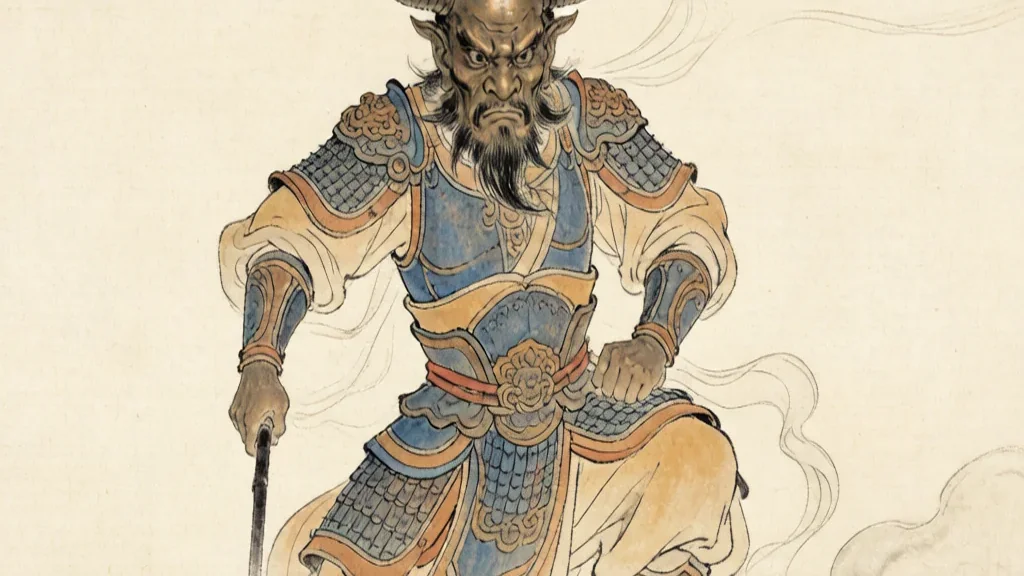
Chi You, written in Chinese as 蚩尤 (chī yóu), is one of the most complex figures in Chinese myth, remembered both as the fearsome god of war who battled the Yellow Emperor for supremacy over the early world and as a culture hero who taught humanity the craft of metal weapons. He leads the Nine Li tribes in the foundational conflict that precedes the unification of China under the Yellow Emperor, and although he loses, his stature only grows after death, when rival rulers enshrine him as a patron of warfare and martial skill. The story of Chi You sits at the border between history and mythology, drawing on ancient memories of clashes among peoples of the north China plain and transforming them into a cosmic struggle whose outcome explains the order of Chinese civilization.
Who Was Chi You
In the surviving traditions Chi You is described as the leader of the Nine Li, a confederation of southern or eastern tribes whose customs and loyalties set them apart from the followers of the Yellow Emperor and the Flame Emperor. He is cast as a formidable warrior king whose authority rests on both military prowess and mastery of metal, and he is often counted among the culture heroes who advanced early technology.
Although he is the losing side of the great primeval war, Chi You is not painted as merely evil. Later rulers and generals honored him precisely because he represented the virtue of martial courage, and his image was carried into battle as a talisman. This dual status, villain in the founding myth yet hero in the cult of war, makes him one of the most nuanced characters in the Chinese pantheon of antiquity.
The Nine Li and Metalworking
Chi You's people, the Nine Li, are credited in several sources with skill in working bronze and iron, and Chi You himself is sometimes called the inventor or patron of metal weapons and armor. In a world where stone and wood had long been the materials of tools and arms, the mastery of metal would have been a decisive advantage and a mark of technological leadership.
This association explains why later smiths and soldiers worshipped Chi You as a professional deity. The forge and the battlefield were linked in his person, so that the god who could supply sharp blades was naturally the god who commanded respect in war. His reputation as a master of arms thus outlived his defeat and became the basis of an enduring cult.
Appearance in the Classic of Mountains and Seas
The Classic of Mountains and Seas gives Chi You a striking monstrous form suited to a primordial war leader. He is said to have a human torso with the head of a beast, skin of bronze, and an iron brow, and he is accompanied by eighty-one brothers who share his bestial and thunderous nature. This imagery marks him as belonging to the older, wilder order of beings that the civilized empires of the Yellow Emperor would supplant.
Such descriptions should be read as mythological rather than literal, a way of signaling that Chi You belongs to a different and more violent register of existence than human rulers. The bronze and iron body also echoes his identity as a master of metal, turning his very flesh into a symbol of the weapons he forged, so that the warrior and his arms are fused into a single terrifying image.
The Battle of Zhuolu
The central event of the Chi You legend is the Battle of Zhuolu, the great confrontation between his Nine Li and the allied forces of the Yellow Emperor, who is sometimes joined by the Flame Emperor in the accounts. Zhuolu is remembered as the decisive clash that determined who would rule the world of mortals and which people would carry forward the line of civilization.
The battle is depicted as more than a normal war, since both sides command supernatural powers, weather, and creatures drawn from the spirit world. The scale of the conflict and the cosmic stakes attached to it elevate Zhuolu above a mere tribal fight and turn it into a founding moment, the violent birth of a unified realm out of competing primal powers.
The Fog and the South-Pointing Chariot
One of the most famous episodes of the war tells how Chi You summoned a dense, disorienting fog that blanketed the battlefield and caused the Yellow Emperor's army to lose its way. The fog represents both a literal tactical weapon and a symbolic confusion, the old order clouding the path of the new.
To counter this, the Yellow Emperor is said to have devised the south-pointing chariot, a mechanical carriage with a fixed pointing figure that always indicated the south regardless of the surrounding murk. With this invention his troops could march in formation through the haze and locate the enemy. The story celebrates ingenuity and ordered knowledge as the means by which civilization overcomes the chaos Chi You embodies.
Defeat by the Yellow Emperor
Even with his metal arms and monstrous brothers, Chi You was ultimately worn down by the combined stratagems of the Yellow Emperor. The south-pointing chariot broke the fog, and other marvels turned the tide against the Nine Li. The defeat is presented as the necessary victory of order, centrality, and legitimate rule over a rebellious and uncanny rival.
The routed army of Chi You scatters, and his own capture or death becomes the closing act of the war. Yet the manner of his fall is told with a strange respect, as though the defeated king earned admiration through the very ferocity that made him dangerous. This respect is what allows his worship to continue even under the dynasty founded by his conqueror.
Death and the Drought Demon
Some accounts bring the drought demon, Nüba, into the struggle, for Chi You is said to have called up wind and rain through allies such as the storm god, and only the arid power of Nüba could dry the fields and let the Yellow Emperor prevail. The contest of weather between the two sides frames the battle as a clash of natural forces as much as of armies.
After his death, legend holds that Chi You's blood or body produced omens, and that his likeness was preserved by the victors so that they could harness his martial spirit. The image of the dead warrior bound yet still feared became a potent emblem, capturing the idea that even a conquered enemy can be useful if his strength is properly mastered and directed.
Worship as God of War
What makes Chi You unusual is that the victorious Yellow Emperor and his successors did not erase him but enshrined him as a god of war. Generals would pray to Chi You before campaigns, and his statue or banner might lead an army, on the theory that the greatest warrior of the age made the best patron for soldiers.
This official cult shows a pragmatic attitude toward power, treating martial excellence as worthy of reverence no matter which side displayed it. Chi You thus became a shared symbol across the rival traditions of the early realm, a point of unity in the very figure who had once threatened to divide the world, and his worship persisted in various forms for centuries.
Chi You and the Miao People
Among several southern peoples, especially groups identified with the Miao, Chi You is honored not as a defeated rebel but as an ancestral founder and culture hero. In these traditions he is remembered as a wise leader who gave his people agriculture, law, and metalcraft, and his defeat is framed as an injustice rather than a judgment.
This alternative memory preserves a perspective outside the Yellow Emperor's official history and shows how the same myth can encode both the center's story of unification and the periphery's story of loss and resistance. The coexistence of the two views makes Chi You a rare figure claimed by both the imperial cult of war and the ancestral pride of minority peoples.
Legacy in Culture
The figure of Chi You has endured in Chinese literature, opera, folk religion, and modern media as the archetype of the indomitable warrior who loses the war but wins lasting renown. He appears in historical novels that retell the age of the Yellow Emperor, in temple worship dedicated to the god of war alongside other martial deities, and in contemporary games and films that enjoy the spectacle of the primeval conflict.
His story also serves as a reminder that Chinese civilization understood its own origins as the product of struggle rather than peaceful inevitability, a forging of order through contest. By keeping the defeated god within the pantheon, the tradition acknowledged that strength, craft, and defiance deserve respect even when they stand on the losing side of history.
❓ Frequently Asked Questions
Who was Chi You?
Chi You was the leader of the Nine Li tribes and a master of metal weapons who fought the Yellow Emperor for control of the early world, becoming the patron god of war after his defeat.
What was the Battle of Zhuolu?
It was the decisive battle between Chi You's Nine Li and the army of the Yellow Emperor, a cosmic struggle whose outcome established the order of early Chinese civilization.
How did the Yellow Emperor win?
The Yellow Emperor used the south-pointing chariot to navigate the fog Chi You summoned and called on the drought demon Nüba to end the storms, turning the battle in his favor.
Why was Chi You worshipped after losing?
Later rulers and soldiers honored his martial excellence, enshrining him as a god of war whose spirit could aid armies in battle.
How is Chi You viewed by the Miao?
Among some Miao traditions he is honored as an ancestral founder and culture hero who gave his people agriculture, law, and metalcraft.
What did Chi You look like?
The Classic of Mountains and Seas describes him with a beast head, bronze skin, and an iron brow, leading eighty-one similarly monstrous brothers.