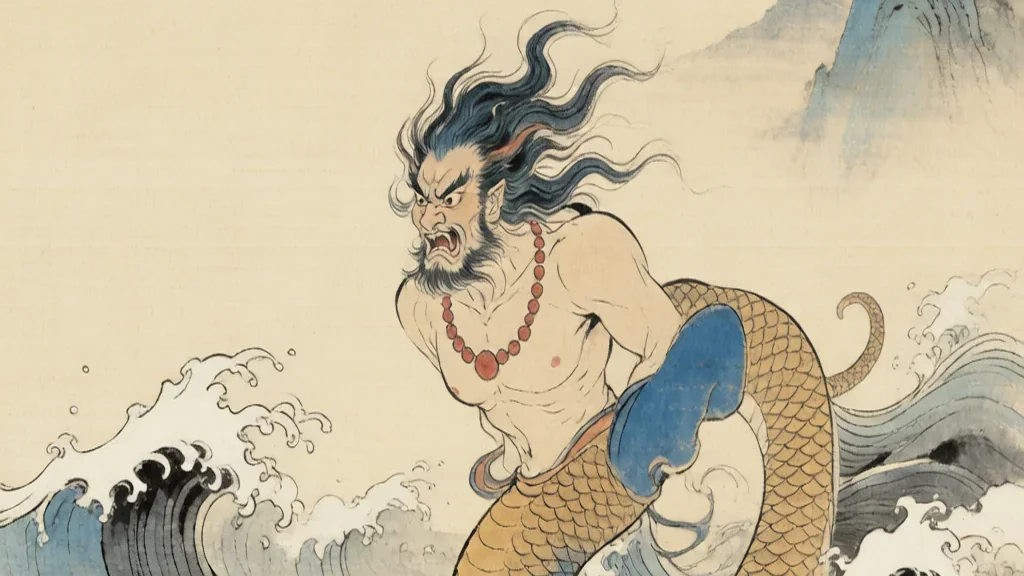
Gonggong is one of the most dramatic and destructive figures in Chinese mythology, a water deity whose fury is said to have physically reshaped the geometry of heaven and earth. According to classical accounts preserved in texts such as the Huainanzi and the commentaries on the ancient classics, Gonggong in a moment of rage butted his head against Mount Buzhou, one of the great pillars that held up the sky, and the violent collision caused the heavens to tilt toward the northwest while the earth sloped downward toward the southeast. This single act of mythical vandalism is traditionally used to explain why the great rivers of China flow eastward to the sea and why the celestial bodies appear to wheel toward the northwest. More than a simple storm god, Gonggong embodies the untamable energy of floodwater and the primordial chaos that stands in opposition to the ordered cosmos fashioned by the creator deities.
Origins and Identity of the Water God
Gonggong is most commonly described in the early sources as a water deity associated with the floods, the rivers, and the destructive power of standing or rushing water. In the received mythological tradition he is frequently said to be a descendant or kinsman of the Yan Emperor, the flame sovereign who stands as a counterweight to the Yellow Emperor in the foundational legends of Chinese antiquity. This lineage is significant because it places Gonggong among the defeated or marginal lineages of the early mythical age, the peoples and powers who lost the great contests for cosmic supremacy and who thereafter became associated with disorder rather than order.
His name, written with characters meaning something close to collective or shared work, is less important than the consistent role he plays across texts: he is the spirit of water let loose, the personification of the deluge that the culture heroes must labour to control. Unlike the benevolent river lords who later preside over local waterways, Gonggong is almost never a domesticated or auspicious figure. He is the flood itself, angry and sovereign, refusing to be channelled.
In visual and literary tradition he is sometimes imagined with a human face above a serpentine or monstrous body, a form that connects him to the many dragon and water serpent beings who populate the Chinese mythological imagination. This hybrid shape signals his liminal status, neither fully human nor fully beast, a creature of the boundary where the known world gives way to the chaos of the deep.
Gonggong and the Battle for Heaven
The central conflict in the Gonggong legends is a contest, usually with the supreme ruler Zhuanxu, for control of the cosmos or the right to rule over heaven and earth. In this version of the story, Gonggong raises a rebellion against the established order, gathering the waters and the forces of the flood to challenge the legitimate sovereign. The battle is cosmic in scale, involving not merely armies but the elemental powers of water against the settled structure of the world.
The defeat of Gonggong in this struggle is what precipitates his famous act of vengeance. Rather than accept his loss, he turns his rage against the architecture of the universe itself, an act of spite that distinguishes him from the more noble defeated culture heroes who simply perish or withdraw. His refusal to accept defeat marks him as a figure of pure rebellion, the divine analogue of the flood that will not be contained.
Some variants of the tradition muddy the identity of his opponent, at times naming the fire god Zhurong as the one who clashes with the water deity. In these accounts the opposition is elemental, water against fire, and the victory of one over the other determines the temperament of the age. Whichever rival is named, the structure of the myth remains the same: a titanic struggle at the dawn of time whose consequence is written into the shape of the world.
The Smashing of Mount Buzhou
Mount Buzhou, whose name suggests a mountain that is incomplete or unrounded, was understood in early cosmology as one of the pillars that supported the dome of the sky and kept it separated from the flat earth below. When the defeated Gonggong hurled himself against this pillar in frustration, he broke it, and the consequence was catastrophic. The northwestern corner of the sky collapsed inward, while the southeastern portion of the earth sank and spread.
The image of a god using his own body as a battering ram against the framework of heaven is one of the most vivid scenes in all of Chinese myth. It expresses a deep cultural intuition that the ordered world is fragile, that it rests on supports which, though ancient and mighty, can be shattered by a single act of will. The broken pillar is not repaired in the same place; instead the cosmos simply settles into its new, tilted configuration.
This event is the hinge upon which the rest of the cosmological explanation turns. Because the sky no longer sits level above the earth, everything that moves across the heavens and everything that flows across the land acquires a direction. The broken mountain is the origin of orientation itself, the moment when up and down, north and south, became fixed in the Chinese imagination.
How the World Was Reshaped
After the pillar fell, the mythological tradition explains, the sky tilted toward the northwest and the earth sloped toward the southeast. As a result the waters of the flood, which Gonggong had loosed, ran down the incline toward the eastern lowlands and eventually found their way to the ocean. This is the traditional explanation for the eastward flow of the Yellow River, the Yangzi, and the other great waterways of the Chinese heartland.
The tilt of the heavens likewise accounted for the observed motion of the stars. Ancient astronomers noted that the celestial sphere appears to rotate around a pole that lies in the north, and the myth supplied a cause: the northwestern collapse of the sky drew the stars in that direction, so that the whole vault of heaven seems to wheel slowly toward the northwest as the nights pass.
In this elegant piece of mythical physics, a single act of divine violence produces both the drainage of the flood and the regularity of the heavens. The disorder that Gonggong caused is thereby transformed, through the logic of the story, into the very order that later sages would observe and record. Chaos becomes cosmos not by being undone but by being given a direction.
Gonggong in the Classic Texts
The Gonggong narrative appears across a remarkable range of early Chinese literature, which is one reason it remained so durable in the tradition. The Huainanzi, compiled in the second century before the common era, contains a famous account of the broken pillar and the tilted sky, and it is this version that later writers most often echoed. The commentary tradition on the classics, including the glosses on the Shanhaijing, also preserves fragments of the story.
Different texts disagree about the precise identity of Gonggong's foe and about the details of his punishment, but they agree on the essential outline: a water power rebelled, was defeated, and in his fury damaged the supporting structure of the world. This consistency across centuries of separate compilation suggests that the core legend was already ancient and well fixed before the surviving texts were written down.
The Shanhaijing, the classic catalogue of mountains and strange creatures, lists Gonggong among the offspring of earlier divine generations and places his descendants in specific mythic geographies. These genealogies matter because they situate him within a total map of the cosmos, a genealogy of powers that explains why certain regions are watery, certain mountains are broken, and certain peoples trace their line to the defeated gods.
The Minister Xiang Yao and the Monstrous Flood
Several versions of the myth supply Gonggong with a minister or lieutenant named Xiang Yao, a nine headed serpentine monster who continued the work of devastation even after his master was defeated. Xiang Yao is said to have poisoned the land with his passage, turning fertile fields into marshes and making the earth undrinkable wherever he travelled. His presence extends the logic of the flood beyond a single moment of rage into a lingering condition of the world.
The struggle against Xiang Yao is then handed to the great culture heroes, notably Yu the Great, who must dredge and channel the waters that Gonggong and his minister loosed upon the earth. In this way the Gonggong legend feeds directly into the great flood narrative, the story of how human civilization was won through the patient engineering of rivers rather than through the mere command of heaven.
Read together, the figures of Gonggong and Xiang Yao represent two faces of the same catastrophe: the sudden violent break and the slow persistent corruption that follows it. The myth insists that the flood was not a single event but a condition, a wound in the world that required generations to heal.
Gonggong and the Flood Narratives
The Chinese flood tradition is unusually rich, and Gonggong occupies an important place within it as the ultimate source of the waters that the heroes must master. Where the biblical flood is sent as a judgment and then withdrawn, the Chinese flood in the Gonggong cycle is a structural injury to the world, a tilt that must be lived with and managed rather than simply ended.
This framing had profound consequences for how later Chinese thought understood the relationship between humanity and nature. Because the disorder of water was built into the tilted earth, the task of the sage was not to pray the flood away but to labour upon the land, to dig channels, to build dikes, and to accommodate the inevitable flow toward the southeast. Gonggong thus stands at the origin of a profoundly engineering minded relationship to the environment.
Local flood cults and the worship of river gods in later centuries can be read as a continuing negotiation with the power that Gonggong represents. To appease the waters was to acknowledge that the order of the world was always provisional, always threatened by the memory of the broken pillar.
Nuwa and the Repair of the Sky
In the most celebrated aftermath of the Gonggong catastrophe, the goddess Nuwa undertakes the repair of the broken sky. According to the Huainanzi, after the pillar collapsed and the heavens were torn, Nuwa melted five coloured stones to patch the vault, severed the legs of a giant turtle to replace the broken supports, and calmed the floods with the ash of reed ashes. Her labour is the direct response to Gonggong's destruction.
The pairing of Gonggong and Nuwa is one of the great complementary contrasts in Chinese myth: the male water power who breaks, and the goddess who mends; the rage that undoes the cosmos, and the craft that restores it. Where Gonggong acts in a single spasm of violence, Nuwa works patiently with materials, colour, and fire, reweaving the fractured dome thread by thread.
It is worth noting that Nuwa's repair does not undo the tilt. The sky remains inclined toward the northwest, and the rivers still run east. What she restores is not the original symmetry but the habitability of the world. The myth thereby teaches a kind of realism: some damage cannot be reversed, but it can be made livable through skilled and compassionate work.
Gonggong in Later Folklore and Local Worship
Although Gonggong is chiefly a figure of high myth, echoes of his cult appear in local traditions that personify rivers and floods as punishable or negotiable powers. In some regional accounts he is remembered not only as a villain but as a fallen hero, a mighty being whose defeat was also a kind of martyrdom for the watery principle against the dry order of the empire.
Occasionally he is conflated with other water lords and dragon kings of local religion, so that the ancient cosmic rebel survives in fragmentary form as a neighbourhood deity of a particular stream or lake. Such syncretism is typical of Chinese popular religion, which tends to absorb ancient mythic figures into the dense bureaucracy of local spirits.
Scholars of myth have also read Gonggong as a memory of real catastrophic floods in the deep past, perhaps the breaching of natural river dams or the shifting of the Yellow River course, events so overwhelming that they were preserved as the act of an angry god. Whether or not this is literally true, the persistence of the figure shows how powerfully the experience of flood shaped the cultural memory.
Symbolism of Water and Chaos
At the deepest level, Gonggong functions as a symbol for the principle of chaos that underlies and threatens all order. In the Chinese cosmological imagination, the world is maintained by a balance of forces, and water, especially floodwater, is the force most liable to dissolve boundaries, to erase the distinctions between field and river, between cultivated and wild, between life and drowning.
The broken pillar is therefore a permanent reminder that order is won, not given; that the tilt of the sky and the flow of the rivers are the scar of an ancient violence that was only partially healed. To tell the story of Gonggong is to tell the story of why the world is as it is, and why human effort must forever stand guard against the return of the waters.
In this sense Gonggong is less a villain to be condemned than a necessity to be understood. Without the flood there is no engineering, without the broken pillar no orientation, without the chaos no cosmos. He is the shadow against which every later achievement of order defines itself, and for that reason he remains one of the most essential figures in the whole of Chinese mythology.
❓ Frequently Asked Questions
Who was Gonggong in Chinese mythology?
Gonggong was a water deity, often described as a descendant of the Yan Emperor, who rebelled against the cosmic ruler and in his fury smashed one of the pillars supporting the sky, reshaping the world.
What happened when Gonggong broke Mount Buzhou?
The collapse of the pillar caused the sky to tilt northwest and the earth to slope southeast, which the tradition cites as the reason rivers flow east and the stars wheel toward the northwest.
Who did Gonggong fight?
Most accounts name the ruler Zhuanxu as his opponent, while some variants describe an elemental struggle against the fire god Zhurong instead of a political rebellion.
How was the damage to the sky repaired?
The goddess Nuwa melted five coloured stones to patch the sky, used a giant turtle's legs as new supports, and calmed the flood with reed ash, though the tilt remained.
What is the meaning of the Gonggong myth?
The story explains the geography and astronomy of the world while symbolising the eternal tension between chaos and order that human effort must continually manage.
Is Gonggong considered good or evil?
He is primarily a destructive chaotic power, yet later folklore sometimes treats him as a fallen hero of the watery principle, and his cult fragments survive in local river worship.