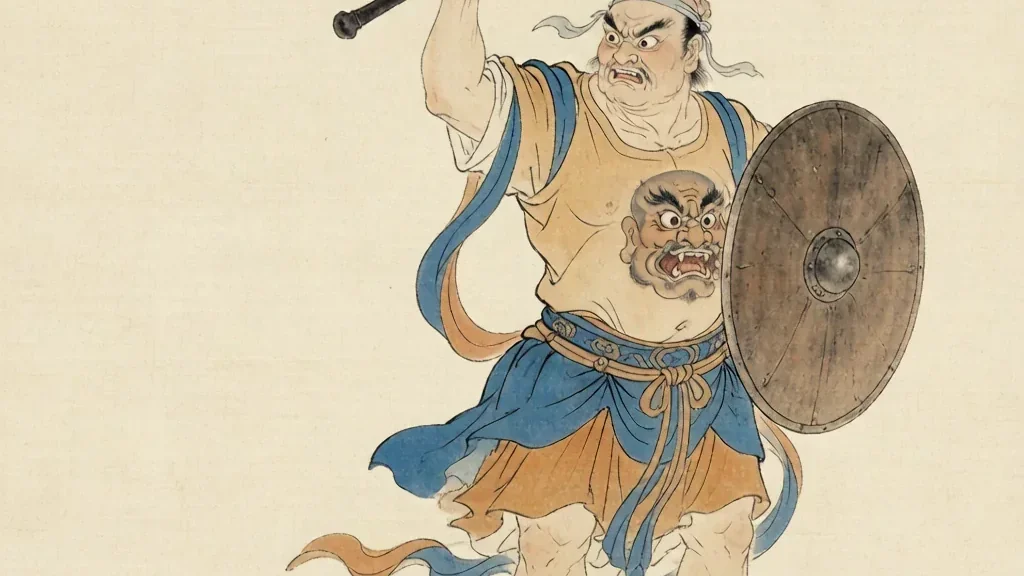
Of all the figures in Chinese mythology, none is as strange, as frightening, or as inspiring as Xing Tian. He is a warrior without a head. His eyes are in his chest. His mouth is in his belly. He carries an axe and a shield, and he dances — eternally, furiously, defiantly — against an enemy he can never defeat. He is the embodiment of the spirit that refuses to surrender, the will that cannot be broken, the courage that outlasts the body itself. His story is one of the oldest in Chinese mythology, and it remains one of the most powerful.
The tale of Xing Tian (刑天) is recorded in the "Classic of Mountains and Seas" (山海经), that ancient compendium of myth and geography compiled over two thousand years ago. In just a few sparse lines, the text describes a figure so vivid, so startling, that he has captured the imagination of every generation since. He is not a hero in the conventional sense. He is something more — a symbol of resistance itself, of the human capacity to keep fighting even when all hope is lost.
The War of the Gods
To understand Xing Tian, we must first understand the world he lived in. In the mythology of ancient China, the cosmos was not a peaceful place. It was a battlefield, where gods and giants, heroes and monsters, struggled for supremacy. At the center of this cosmic drama was the Yellow Emperor, Huangdi, the divine ruler who would become the mythical ancestor of the Chinese people. He was the embodiment of order, civilization, and heavenly authority.
But the Yellow Emperor had rivals. Chief among them was Chiyou, the god of war, a terrifying figure with a bronze head and iron forehead, four eyes and six arms, who devoured metals and stones for sustenance. Chiyou led a rebellion against the Yellow Emperor, gathering to his banner all those who chafed under heavenly rule — giants, demons, rogue gods, and spirits of all kinds. The war that followed was one of the most terrible in mythological history, a conflict so vast that it reshaped the very landscape of China.
Xing Tian was one of Chiyou's generals. Some accounts say he was a giant; others describe him as a minor deity or a powerful spirit. What all accounts agree on is that he was a warrior of unmatched ferocity and loyalty, devoted to Chiyou's cause and willing to fight to the very end. When Chiyou fell in battle against the Yellow Emperor — slain, according to most versions, by the emperor's divine might — Xing Tian did not surrender. He did not flee. He did not mourn. He picked up his weapons and continued the fight alone.
The Decapitation
What followed was a duel of cosmic proportions. Xing Tian, armed with his giant axe and his bronze shield, confronted the Yellow Emperor himself. The two fought on the slopes of Mount Changyang, and the battle raged for days. The earth shook. The sky darkened. Rivers reversed their courses. Xing Tian, despite his courage and skill, was ultimately no match for the Yellow Emperor, who wielded the power of heaven itself. With a single mighty blow, the emperor struck off Xing Tian's head.
The head rolled down the mountainside and came to rest at the foot of a great tree. The Yellow Emperor, believing the battle won, turned to leave. But Xing Tian did not fall. His body, headless and bleeding, stood firm. And then, with a movement that would define his legend forever, he reached down to the earth, seized his severed head, and carried it — not to his neck, where it might be reattached, but to the entrance of a cave, where he buried it.
Why did he bury his own head? The myths offer no explicit answer, but the implication is clear: Xing Tian did not want to be made whole again on his enemy's terms. He did not want to be restored to a form that the Yellow Emperor could recognize and subjugate. He chose, instead, to remain broken — to become something new, something the world had never seen. He would not surrender, and he would not be healed. He would simply continue.
The Warrior Reborn
And continue he did. From the stumps of his severed neck, two new features emerged. His nipples became eyes — fierce, unblinking, glaring out from his chest with the same fury that had driven him in life. His navel became a mouth, open in a perpetual battle cry, a soundless scream of defiance that echoed across the mountains. His torso had become his face. His body had become his head. He was a monster, perhaps, but a monster of his own making — a creature that had remade itself rather than accept defeat.
And then, with his axe in one hand and his shield in the other, Xing Tian began to dance.
The "Classic of Mountains and Seas" describes this scene in just six Chinese characters that have become among the most famous in all of Chinese literature: 刑天舞干戚 — "Xing Tian dances with axe and shield." The simplicity of the description is its power. There is no explanation, no commentary, no moral. There is only the image: a headless warrior, his eyes in his chest, his mouth in his belly, dancing with his weapons, forever, against an enemy he cannot defeat, in a battle that will never end.
What the Dance Means
The image of Xing Tian dancing has resonated through Chinese culture for over two millennia, and its meaning has been interpreted in many ways. At its most basic level, it is a symbol of indomitable spirit — the refusal to surrender, even in the face of certain defeat. Xing Tian has lost his head, the most fundamental part of his body, and yet he fights on. He has been mutilated, transformed into something monstrous, and yet he does not despair. He dances. He wields his weapons. He continues.
The great Jin dynasty poet Tao Yuanming (365–427 CE) immortalized this interpretation in one of the most famous poems in Chinese literature: "刑天舞干戚,猛志固常在" — "Xing Tian dances with axe and shield; his fierce resolve endures forever." For Tao Yuanming, writing in a time of political chaos and personal disappointment, Xing Tian was a model of integrity, a figure who embodied the spirit of resistance against an unjust world. The poem has been memorized by Chinese schoolchildren for centuries, and the phrase "猛志固常在" has become a proverb, a declaration that true courage does not fade.
But there are other interpretations as well. Some scholars see in Xing Tian a critique of authority itself. He is, after all, fighting the Yellow Emperor — the mythical ancestor of the Chinese state, the symbol of legitimate rule. By continuing to resist even after the emperor has won, Xing Tian represents the irrepressible spirit of dissent, the voice that refuses to be silenced even when the head has been cut off. In a culture that has often valued obedience to authority, Xing Tian stands as a reminder that there are things worth fighting for even when the fight seems hopeless.
Others see in Xing Tian a symbol of the body itself — the flesh that persists after the mind (the head) has been destroyed, the raw vital energy that animates us even when reason and consciousness have been stripped away. In this reading, Xing Tian is not a hero or a rebel but a force of nature, the irreducible essence of life that cannot be killed because it has no center to kill.
Xing Tian in Modern Culture
Xing Tian's image has proven remarkably adaptable, appearing in every medium Chinese culture has produced. In classical opera, he is often depicted as a fearsome warrior with a mask covering his chest, his head hidden beneath a flowing mane. In painting, he is shown in mid-dance, axe raised, shield forward, a figure of terrible beauty. In modern video games, comics, and anime, he has been reimagined countless times, his headless form lending itself to striking visual design.
The character has also found new life in literature. Lu Xun, the great 20th-century writer, invoked Xing Tian in his essays as a symbol of the unyielding spirit of the Chinese people in the face of foreign imperialism and domestic oppression. In recent years, he has appeared in fantasy novels and films as both a hero and a monster, a complex figure whose meaning shifts depending on who tells his story.
What remains constant, through all these retellings, is the power of that image: the headless warrior, dancing. It is an image of horror, yes, but also of awe. It says something about the human condition that few other myths capture so concisely — that we are more than our minds, more than our reason, more than the parts of ourselves that can be taken away. There is something in us, Xing Tian tells us, that cannot be defeated. Something that, even when everything else has been stripped away, will pick up its weapons and dance.
The Eternal Battle
And so, according to the myth, Xing Tian dances still. On the slopes of Mount Changyang, in the realm where myth and geography blur, a headless warrior swings his axe and raises his shield, his chest-eyes glaring, his belly-mouth roaring. He fights an enemy he cannot defeat, in a battle that will never end, with a courage that will never fade. He is the patron of all who refuse to give up, the symbol of all who fight on when hope is gone, the proof that the spirit can outlast the body, and that the will can outlast the world.
When you face a challenge that seems impossible, when the odds are stacked against you and defeat seems certain, remember Xing Tian. Remember the headless warrior, dancing. And know that as long as you have the will to fight, the battle is never truly over.
Xing Tian and Chiyou's Revolt
Xing Tian did not fight alone, and understanding his rebellion means understanding the larger war of the ancient gods. He served as a general under Chiyou, the fearsome god of war who rose against the Yellow Emperor's growing authority. When Chiyou was slain, Xing Tian took up the cause himself, confronting the emperor on Mount Changyang with his great axe and bronze shield. This context matters because it turns Xing Tian from a random monster into a loyal follower who would not abandon a lost cause. The myth preserves the memory of a cosmic conflict between rival powers, where the defeated side was not erased but remembered through its most stubborn fighter. Later Chinese writers read this episode as a meditation on loyalty and resistance, using Xing Tian to ask whether obedience to the victor is always the right course.
The Body Without a Head
The most striking image in Xing Tian's story is his remade body, with eyes in the chest and a voice in the belly. This transformation has invited centuries of interpretation. On one level it shows the persistence of life and will after the loss of the head, the seat of reason and identity. On another it suggests a critique of authority, since Xing Tian keeps fighting the very ruler who defined what a proper human form should be. The poet Tao Yuanming praised exactly this defiance, and modern readers have seen in the headless dancer a symbol of the irreducible human spirit that cannot be killed because it has no single vulnerable center. The strange anatomy thus carries a philosophical weight far beyond its monstrous appearance, making Xing Tian a figure of profound meaning.
❓ Frequently Asked Questions
📝 Chinese Vocabulary
刑天 — : The headless warrior of Chinese mythology; his name means "Punished Heaven" or "Severed Heaven."
干戚 — : "Shield and axe" — the weapons Xing Tian wields; 干 (gān) is a shield, 戚 (qī) is a battle axe.
刑天舞干戚 — : "Xing Tian dances with axe and shield" — the famous phrase from the Classic of Mountains and Seas; a symbol of indomitable spirit.
猛志固常在 — : "His fierce resolve endures forever" — the famous line from Tao Yuanming's poem about Xing Tian.
黄帝 — : The Yellow Emperor, the mythic ruler who defeated Xing Tian and became a forefather of the Chinese people.
蚩尤 — : Chiyou, the god of war and leader of the revolt to which Xing Tian belonged.
常羊山 — : Mount Changyang, the site of Xing Tian's duel with the Yellow Emperor and his burial place.
山海经 — : The Classic of Mountains and Seas, the ancient text that first records the tale of Xing Tian.
🎉 Fun Facts
- Xing Tian appears in the popular video game "Smite" as a playable character, and in numerous Chinese-inspired video games and anime as both a boss and a hero.
- The phrase "刑天舞干戚,猛志固常在" is one of the most quoted lines in classical Chinese poetry and is memorized by Chinese schoolchildren nationwide.
- Some scholars believe Xing Tian's story may have originated as a myth explaining a prehistoric rock formation or a type of ancient war dance performed with shields and axes.
- Unlike most figures in Chinese mythology, Xing Tian is never depicted in temples or worshipped as a deity — he is purely a literary and symbolic figure, a symbol rather than a god.
- The phrase Xing Tian dances with axe and shield is still used in modern Chinese to describe someone who refuses to give up after defeat, making an ancient myth part of everyday speech.
- Some scholars think the headless warrior may preserve the memory of prehistoric decapitation rituals or of a war dance performed with a shield and axe, later carried into myth.
☯️ Discover Your Inner Element
Xing Tian's unbreakable spirit reflects the power of the Five Elements. Discover which element — Wood, Fire, Earth, Metal, or Water — shapes your character.
Find My Element →