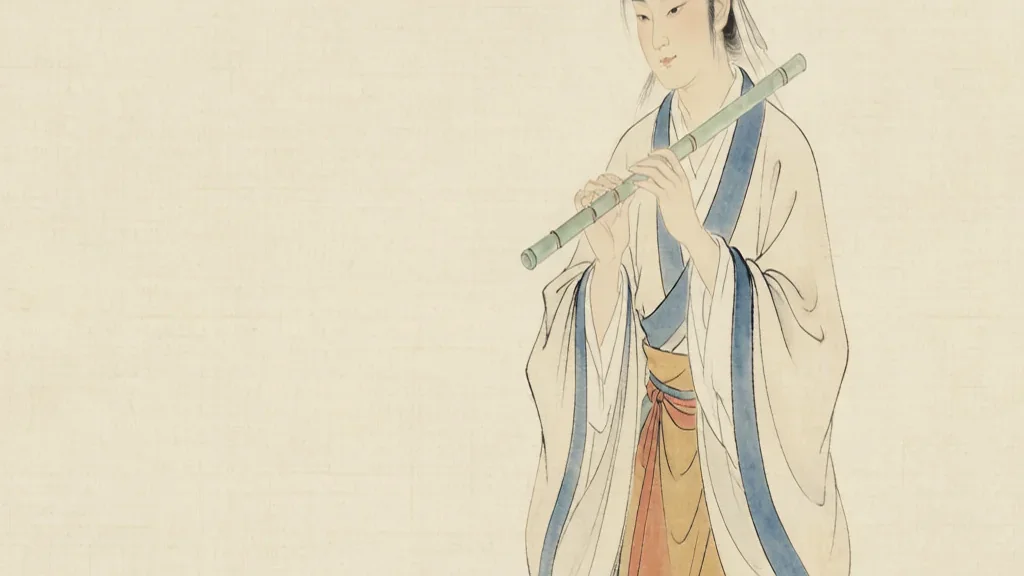
Han Xiangzi is the Eight Immortal of music and the flute, a youth associated in legend with the great Tang statesman and literary master Han Yu, whose nephew or descendant he is said to be. While Han Yu stood for orthodox Confucian seriousness and the suppression of heterodox cults, his immortal kinsman embodied the Daoist love of freedom, wine, and song, and the two became the subject of a famous legend in which the flute playing nephew demonstrates supernatural powers to the stern uncle and gently mocks the futility of worldly ambition. As patron of musicians, Han Xiangzi represents the triumph of art and spontaneity over rigid respectability, the note of melody in a world of rules. In the company of the Eight he is the eternal young artist, proof that the highest wisdom may arrive not in a treatise but in a tune.
Kinsman of the Great Han Yu
The most distinctive feature of Han Xiangzi's legend is his connection to Han Yu, the formidable Tang official, essayist, and champion of Confucian orthodoxy who argued against the spread of Buddhism and demanded strict moral order. To make the immortal the kinsman of such a figure is a deliberate irony, setting the free spirit against the stern censor within a single family.
Different traditions name Han Xiangzi as Han Yu's nephew, grandnephew, or distant descendant, but the relation is always close enough to make the contrast pointed. The uncle represents the letter of the law and the weight of office; the nephew represents the spirit that slips between the letters and refuses the weight.
This family framing gave the legend a literary prestige, for Han Yu was one of the most revered prose masters in the Chinese canon. To attach an immortal to his household was to stage a debate between Confucianism and Daoism using the most respected names on both sides, a debate the people clearly enjoyed resolving in favour of the flute.
The Flute and Its Magic
Han Xiangzi's signature instrument is the transverse flute, the dizi, and his music is said to carry supernatural power, able to summon cranes, calm storms, and lift the hearer into a trance of forgetting. The flute is not merely an attribute but the very instrument of his immortality, the thing by which he crosses from the ordinary world into the realm of the immortals.
In legend the sound of his playing draws the attention of the other immortals and marks him as one of their number even before his formal admission. Music is presented as a faster road to liberation than study or office, a direct path that bypasses the slow disciplines of the academy and the court.
The choice of the flute, a breath instrument, also carries a gentle physiology: to play is to learn control of the breath, the very substance of life in Daoist theory. Han Xiangzi's art is thus at once entertainment, magic, and a covert lesson in the nourishing of vital energy.
The Snow Bloom Miracle
The central wonder of the Han Xiangzi legend is the blossoming of flowers in the snow. Invited by his disbelieving uncle to prove his Daoist claims, the youth causes a winter branch to burst into full bloom before the amazed onlookers, sometimes inscribing a prophetic poem within the petals. The miracle is a public humiliation of scepticism by beauty.
The snow bloom is richly symbolic. Flowers in winter are impossible by nature's rule, and their appearance argues that the immortal operates beyond the ordinary laws that bind the magistrate's world. The cold of the season mirrors the coldness of the uncle's heart, warmed at last by the sudden colour.
In some versions the blooming branch is a blue lotus, the flower most associated with Han Xiangzi, and its unexpected opening in frost became one of the most painted scenes in the whole repertoire of Eight Immortals art. The image fixed the youth as the immortal of impossible and timely beauty.
The Poem to the Stern Uncle
Alongside the flowering branch, Han Xiangzi is said to have left his uncle a poem that prophesied the official's future troubles and gently advised him to abandon his anxious career for the free life of the Dao. The poem works as both warning and invitation, the artwork that carries the lesson the uncle will not accept in conversation.
The encounter captures the whole dynamic of the legend: the younger man does not argue but demonstrates, and having demonstrated, withdraws with a smile. The uncle, bound by duty, suffers the fate the poem foretold, and only late in life comes to regret his refusal of the flute's wisdom.
This narrative made Han Xiangzi the gentle victor in a family quarrel that stood for a civilisational one. The people who heard it could enjoy the spectacle of the stuffy Confucian, however great, being outmatched by a boy with a reed and a song.
Han Xiangzi and Confucian Orthodoxy
The tension between Han Xiangzi and Han Yu is really a tension between two ideals of life that Chinese culture never fully resolved. Confucianism prized service, order, and the cultivation of the person through ritual and study; Daoism prized spontaneity, withdrawal, and the cultivation of the person through harmony with nature. The kinsmen personify the split.
What is remarkable is that the tradition refuses to condemn either. Han Yu remains a paragon of letters, and Han Xiangzi a paragon of liberation, so that the legend reads as a dialogue rather than a verdict. The ideal person, the culture implied, might somehow hold both, the dutiful official and the free flute player, in a single soul.
In this balanced treatment the Eight Immortals as a whole participate. They are not anti Confucian so much as extra Confucian, a supplementary mythology that lets the earnest citizen dream of release without renouncing the duties of the day. Han Xiangzi is the dream's musician.
The Flower of the Blue Lotus
The blue lotus, or simply the lotus in his case, is Han Xiangzi's floral emblem, connecting him to the purity that rises unstained from the mud, a favourite Buddhist and Daoist image of the enlightened mind. The flower ties his otherwise playful legend to a sober symbolism of spiritual cleanliness.
In art he is frequently shown holding the flute in one hand and a spray of lotus in the other, the two objects together stating his doctrine: the sound that lifts, and the flower that purifies. The lotus also links him visually to He Xiangu, the only female immortal, with whom he shares the floral motif.
The blue lotus blooming in snow is the perfect compression of his message, that purity and joy can appear where reason says they cannot, and that the immortal's task is to make the impossible blossom for those still caught in the frost of routine.
Han Xiangzi Among the Eight
Within the fellowship of the Eight Immortals, Han Xiangzi is the artist and the youngster, the one whose gift is beauty rather than strength or office. His flute provides the music for the group's raucous immortality, and his youth keeps the company from growing solemn with age.
In the crossing the sea tableau he is often shown floating on a flower or borne along by the sound of his own playing, the least martial of the eight yet essential to their character. A band of immortals without a musician would be only a committee; Han Xiangzi makes them a choir.
His presence also broadens the social range of the group to include the aesthetic temper, the person whose vocation is song. The Eight thus embrace not only the useful and the holy but the beautiful, and Han Xiangzi is its appointed representative before the heavens.
Patron of Musicians
Because of his flute, Han Xiangzi became the patron of musicians, especially those who play wind instruments, and of the musical professions generally. Troupes and teachers of music invoked him for inspiration and skill, and his image adorned the walls of rehearsal halls as a blessing on the art.
The patronage extended to the pleasure of music in daily life, for the immortal sanctioned delight as a path, not a distraction. To play or listen with a free heart was, in his spirit, a small practice of the Dao, a momentary escape from the prison of calculation.
In a culture that sometimes suspected pleasure as frivolous, Han Xiangzi offered a corrective, insisting that melody is a serious matter because it alone can do what argument cannot: open the heart without asking permission. The flute, in his hand, is a key to the heavens.
Symbolism of Spontaneous Art
The deepest meaning of Han Xiangzi lies in spontaneity. His miracles are not laboured; they flower at a breath, like the notes of his flute, appearing without strain. He embodies the Daoist ideal of wuwei, action without forcing, in which the greatest effects follow the least visible effort.
This symbolism spoke to everyone who had felt the deadening weight of routine and rule, and who suspected that the best things arrive when one stops trying so hard. The snow bloom is the image of grace, the beauty that cannot be commanded but only allowed, the tune that cannot be forced but only breathed.
In the end Han Xiangzi remains the Eight Immortals' apostle of art, the youth who answered the stern uncle not with a treatise but with a flower and a song. His flute still sounds across the legends, inviting each hearer to lay down the heavy brief and listen for the melody that was always there.
❓ Frequently Asked Questions
Who is Han Xiangzi?
Han Xiangzi is one of the Eight Immortals, the youthful patron of music who plays the flute and is said to be a kinsman of the Tang statesman Han Yu.
What is his famous miracle?
He caused a branch to bloom with flowers in the winter snow before his disbelieving uncle, sometimes inscribing a prophetic poem within the petals.
How is he connected to Han Yu?
Tradition names him as Han Yu's nephew or descendant, using the relation to stage a gentle contrast between Daoist freedom and Confucian duty.
What does his flute represent?
The flute is the instrument of his immortality and a lesson in breath control, able in legend to summon cranes, calm storms, and lift the hearer into forgetting.
Who worships Han Xiangzi?
Musicians, especially wind players, and music teachers honour him as patron, and his image blesses rehearsal halls and performances.
What does he symbolise?
He symbolises spontaneous art and wuwei, the effortless grace by which the greatest beauty appears without strain, answering duty with a song.