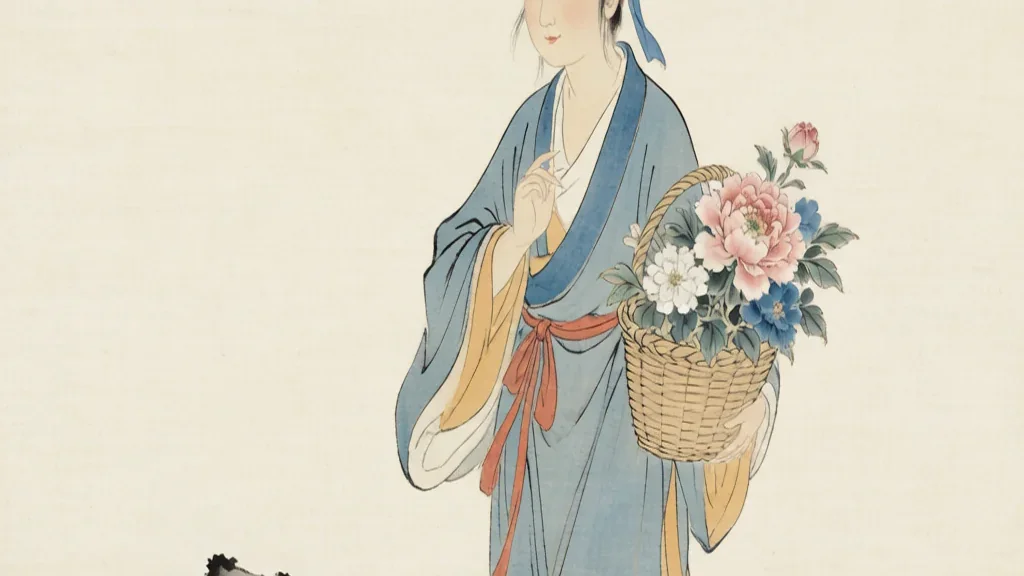
Lan Caihe is the most androgynous and free spirited of the Eight Immortals of Daoist legend, a wandering beggar singer who drifted through the marketplaces of Tang dynasty China clad in rags, wearing only one shoe, and carrying a flower basket. Unlike the other immortals, whose gender is fixed in the standard portraits, Lan Caihe is deliberately ambiguous, described in different tales as a young man, a woman, or something in between, a fluidity that made the figure a beloved patron of flower sellers, musicians, and all who lived outside the rigid boundaries of respectability. The story of Lan Caihe is less a tale of conquest or high office than a hymn to carefree transcendence, the kind of immortality won not by power but by laughing at the world's seriousness while singing Daoist songs in the dust of the street. In a pantheon otherwise dominated by statesmen, generals, and healers, Lan Caihe is the immortal of those who refuse to be respectable.
The Androgynous Immortal
What most distinguishes Lan Caihe from the other Seven is the deliberate uncertainty about sex and gender that surrounds the figure. Classical descriptions waver: one passage calls the immortal a young man in women's clothes, another presents a barefoot girl with a roguish air, and still others simply avoid the question altogether. This refusal to settle the matter is not a gap in the tradition but its point, an insistence that the perfected person stands beyond the categories that govern ordinary social life.
The ambiguity also connects Lan Caihe to the Daoist ideal of naturalness, the conviction that the artificial distinctions of society obscure the underlying unity of things. By refusing the fixed costume of either man or woman, the immortal enacts the teaching that the liberated spirit is not confined by the roles assigned at birth. The ragged dress and single shoe complete the picture of someone indifferent to appearance.
In art Lan Caihe is usually shown as a slender youth or young woman in loose garments, holding the flower basket aloft, with a face of serene unconcern. The androgyny is preserved even in visual form, so that viewers across the centuries have disagreed about the figure's sex, exactly as the legends intend.
A Wandering Singer in the Market
The core biography of Lan Caihe, such as it is, places the immortal in the public squares and markets of the cities, singing for coins and giving away whatever was received. The songs were not entertainments in the ordinary sense but Daoist teachings set to simple tunes, verses that mocked the pursuit of wealth and urged listeners to wake from the dream of worldly ambition before death arrived.
Witnesses in the tales describe a person who seemed never to age, who appeared in the same marketplace decade after decade with the same ragged look, singing the same strange songs. The immortality of Lan Caihe is thus not announced by a dramatic ascent but betrayed by this uncanny permanence, the beggar who is always there and never older.
The market setting is itself meaningful. Daoist transcendence is not confined to monasteries or mountain retreats; it can appear in the most ordinary and vulgar places, among merchants and beggars alike. Lan Caihe's chosen stage is the crowd, where the lesson of detachment is most needed and least expected.
The Flower Basket
The single most recognizable attribute of Lan Caihe is the basket of flowers, usually carried in one hand and offered or displayed as the immortal wanders. The basket is more than a prop; it is a symbol of the fleeting beauty of the world, the blossoms that are lovely precisely because they will soon fade, and of the immortal's carefree gathering of life's pleasures without clinging to them.
In some versions of the legend the flowers in the basket possess a magical property, blooming out of season or never wilting, a small miracle that marks the bearer as no ordinary peddler. The basket thus bridges the ordinary and the supernatural, a humble working object charged with immortal power.
The flower basket also ties Lan Caihe to the trades of floristry and gardening, and to this day the figure is invoked by those who sell flowers or work with plants. The immortality won by the beggar singer is thereby extended, in popular devotion, to everyone who handles the fragile beauty of growing things.
Songs of Detachment
The songs attributed to Lan Caihe form the emotional centre of the legend. They are short, sardonic, and pointed, warning that the officials in their silks and the merchants with their gold are all rushing toward the same grave, while only the person who sings in the dust is truly free. The verses circulate independently in some collections as examples of Daoist street poetry.
One recurring motif is the contrast between the long sleep of death and the brief waking of life, a theme that runs through much Daoist reflection on mortality. Lan Caihe's songs press this contrast on the heedless crowd, using humour rather than sermon to make the point land. The laughter is the teaching.
Because the songs are said to have been sung rather than written, they occupy a borderline between scripture and folklore, between the authorized texts of the temple and the improvised wisdom of the street. Lan Caihe is the immortal of the oral and the anonymous, the doctrine that travels by voice alone.
The Drunken Immortal
Like several of the Eight Immortals, Lan Caihe is frequently depicted as drunk, staggering through the market with a wine jar and a laugh. Drunkenness here is not vice but a badge of liberation, the state in which social inhibitions fall away and the spirit speaks without calculation. The wine loosens the tongue for the truth the sober will not hear.
The tales tell of the immortal drinking the money given by onlookers and then scattering the remainder into the air or to the poor, keeping nothing. This extravagant disregard for accumulation is the practical demonstration of the songs' message: to hold nothing is to be mastered by nothing. The wine and the flowers together paint a portrait of holy indifference.
In the company of the other immortals, the drunken Lan Caihe provides the comic and licentious note, the reminder that enlightenment need not be solemn. The Eight as a group balance gravity and levity, and Lan Caihe supplies most of the latter, the laughing counterpart to the stern magistrate or the brooding sage.
Accounts in the Early Sources
The earliest substantial notice of Lan Caihe appears in the writings of the Tang period, where the figure is already presented as an immortal beggar singer of uncertain sex. Later Daoist hagiographies, especially the compilations that fixed the standard list of Eight Immortals, absorbed this wandering figure into the canonical group and supplied the connecting narratives that link the eight lives.
Because Lan Caihe's legend is thinner than those of the statesman immortals, later storytellers filled the gap with vignettes rather than a full biography: a scene in the market, a song overheard, a sudden disappearance on a cloud. The figure's appeal lay precisely in this elusiveness, the sense of a presence half seen and never captured.
The persistence of the character across a millennium of retelling, from Tang anecdote to Yuan drama to the printed story collections of the late imperial age, shows how sturdy the image of the androgynous singing beggar proved to be. Each era refashioned the songs to its own taste while keeping the ragged immortal at the centre.
Lan Caihe and the Eight Immortals
The Eight Immortals are a closely bound group in Daoist folklore, usually pictured together crossing the sea on their respective powers, and Lan Caihe is the most unconventional member of the crew. Where Lü Dongbin is the scholar swordsman and Cao Guojiu the courtier, Lan Caihe is the one with no status at all, the member who unsettles the respectability of the rest.
In the famous episode of the Eight crossing the sea, each immortal places a personal object on the water as a raft, and Lan Caihe's flower basket floats as his vessel. The scene encapsulates the group's lesson that liberation is available to every type of person, from emperor's brother to market beggar, each by means of his or her own nature.
The grouping also softens the solitude of the figure. Although Lan Caihe sings alone in the marketplace, the later tradition nests that loneliness inside a fellowship of immortals, suggesting that the free spirit is not isolated but belongs to a hidden community of the liberated that walks among ordinary people unseen.
Patron of Outsiders
Because of the androgyny, the poverty, and the refusal of respectability, Lan Caihe became a patron of those who stood at the margins of conventional society: singers, flower sellers, the poor, and in modern times interpreters have extended the figure's shelter to those whose gender or identity set them apart. The immortal is the saint of the unrespectable.
This patronage is not merely sentimental. It expresses a Daoist conviction that holiness is not the property of the powerful and that the person the world discards may be the one who is truly free. To pray to Lan Caihe is to claim dignity for a life lived outside the approved lines.
Festivals and operas that feature the Eight Immortals regularly give Lan Caihe a special cheer, the crowd recognising in the ragged singer a mirror of their own wish to escape the grind of obligation. The immortal's marginality is exactly the source of his appeal, the freedom everyone desires and few dare to live.
Symbolism of Freedom
At bottom Lan Caihe stands for freedom, the liberty that comes not from rank or wealth but from detachment, the trained ability to hold the world lightly. The flower basket, the single shoe, the song, and the wine are all signs of a person who is present in the market yet not captured by it, who touches life without grasping it.
The androgyny extends this freedom to identity itself, suggesting that the perfected person is not fixed even by the deepest social categories. To be like Lan Caihe is to be, in the richest sense, nobody in particular, and therefore free to be everyone. The rags are a robe of liberty.
In a culture that prized family duty, official career, and sober demeanour, the figure of the laughing beggar immortal is a necessary pressure valve, a sanctioned way of imagining escape. Lan Caihe keeps alive the possibility that the highest attainment might look, from the outside, exactly like a carefree fool singing in the dust.
❓ Frequently Asked Questions
Who is Lan Caihe?
Lan Caihe is one of the Eight Immortals, a wandering beggar singer of uncertain sex who drifted through Tang marketplaces singing Daoist songs and carrying a flower basket.
Why is Lan Caihe's gender unclear?
The tradition deliberately leaves the sex ambiguous to symbolise the liberated spirit's freedom from social categories, depicting the figure at times as a youth, a girl, or between the two.
What is Lan Caihe's symbol?
The flower basket is the principal emblem, representing the fleeting beauty of the world and the immortal's carefree gathering of life without clinging to it.
How did Lan Caihe become immortal?
Rather than through office or combat, the figure attained transcendence by a life of detachment, singing, drinking, and giving away all possessions, then ascending on a cloud.
Who worships Lan Caihe?
The figure is a patron of flower sellers, musicians, the poor, and outsiders, and is honoured as a symbol of freedom from social convention.
What role does Lan Caihe play among the Eight?
Lan Caihe is the unconventional, comic member who supplies levity and proves that liberation is open to the lowliest person, not only to scholars and officials.